Review
. 2020 Sep;52(9):1475-1485.
doi: 10.1038/s12276-020-00500-y. Epub 2020 Sep 11.

Combination of anti-angiogenic therapy and immune checkpoint blockade normalizes vascular-immune crosstalk to potentiate cancer immunity

Affiliations
Review

Combination of anti-angiogenic therapy and immune checkpoint blockade normalizes vascular-immune crosstalk to potentiate cancer immunity

Won Suk Lee et al. Exp Mol Med. 2020 Sep.

Abstract

Cancer immunotherapy with immune checkpoint inhibitors (ICIs) has revolutionized the treatment of advanced cancers. However, the tumor microenvironment (TME) functions as a formidable barrier that severely impairs the efficacy of ICIs. While the crosstalk between tumor vessels and immune cells determines the nature of anti-tumor immunity, it is skewed toward a destructive cycle in growing tumors. First, the disorganized tumor vessels hinder CD8+ T cell trafficking into the TME, disable effector functions, and even kill T cells. Moreover, VEGF, the key driver of angiogenesis, interferes with the maturation of dendritic cells, thereby suppressing T cell priming, and VEGF also induces TOX-mediated exhaustion of CD8+ T cells. Meanwhile, a variety of innate and adaptive immune cells contribute to the malformation of tumor vessels. Protumoral M2-like macrophages as well as TH2 and Treg cells secrete pro-angiogenic factors that accelerate uncontrolled angiogenesis and promote vascular immaturity. While CD8+ T and CD4+ TH1 cells suppress angiogenesis and induce vascular maturation by secreting IFN-γ, they are unable to infiltrate the TME due to malformed tumor vessels. These findings led to preclinical studies that demonstrated that simultaneous targeting of tumor vessels and immunity is a viable strategy to normalize aberrant vascular-immune crosstalk and potentiate cancer immunotherapy. Furthermore, this combination strategy has been evidently demonstrated through recent pivotal clinical trials, granted approval from FDA, and is now being used in patients with kidney, liver, lung, or uterine cancer. Overall, combining anti-angiogenic therapy and ICI is a valid therapeutic strategy that can enhance cancer immunity and will further expand the landscape of cancer treatment.


Conflict of interest statement

The authors declare that they have no conflict of interest.

Figures
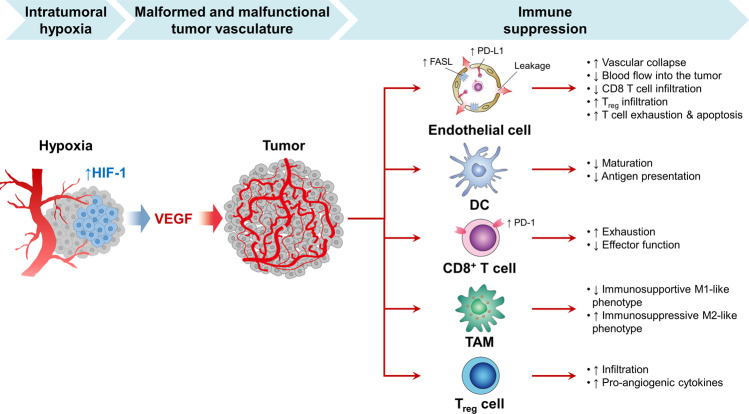
Fig. 1
Fig. 1. The abnormal tumor vasculature elicits immune suppression in the tumor microenvironment.
Tumor cells rapidly outgrow their blood supply, leading to hypoxia and acidosis in the tumor microenvironment (TME), which in turn promotes immunosuppressive mechanisms. Hypoxia stimulates HIF-1 and thereby upregulates VEGF. VEGF induces tumor angiogenesis, resulting in the malformed and malfunctional vasculature. Tumor endothelial cells exhibit immunosuppressive characteristics, such as PD-L1 expression, which enhance the exhaustion and apoptosis of T cells. Dendritic cell (DC) maturation is suppressed, resulting in interruption of T cell priming by impaired antigen presentation. In addition, TOX-mediated transcriptional reprogramming severely exhausts CD8+ T cells. Furthermore, tumor-associated macrophages (TAMs) polarize from an immunosupportive M1-like phenotype to an immunosuppressive M2-like phenotype. Regulatory T (Treg) cells also accumulate within the TME to promote tumor angiogenesis.
Fig. 2
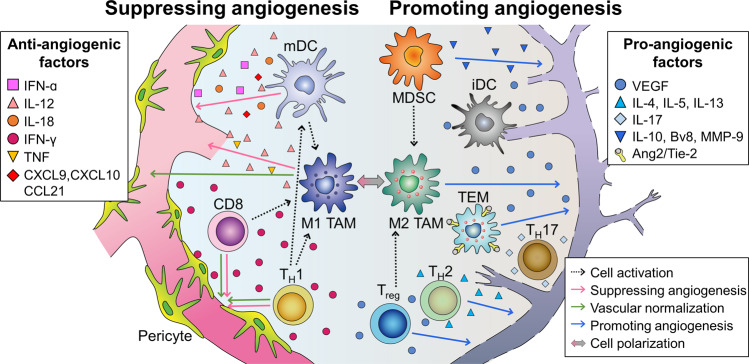
Fig. 2. A variety of immune cells orchestrate tumor angiogenesis.
Immune cells directly influence the phenotypes and functions of tumor vessels through various cytokines. Innate immune cells, such as mature dendritic cells (mDCs) and M1-like TAMs, produce cytokines (IFN-α, IL-12, IL-18, or TNF) and chemokines (CXCL9, CXCL10, or CCL21) that suppress tumor angiogenesis. Meanwhile, adaptive immune cells, such as CD8+ T cells and T helper 1 (TH1) cells, secrete IFN-γ, a potent cytokine that inhibits angiogenesis and induces vascular normalization in the TME. However, immature DCs (iDCs), myeloid-derived suppressor cells (MDSCs), M2 TAMs and Tie2-expressing macrophages (TEM) significantly promote tumor angiogenesis by secreting VEGF, IL-10, Bv8, and MMP-9. Moreover, Treg, TH2, and TH17 cells can also release pro-angiogenic factors such as VEGF, IL-4, IL-5, IL-13, and IL-17. In addition to direct effects on tumor vasculature, immune cells regulate tumor vasculature indirectly by communicating and polarizing with each other. mDC, CD8, and TH1 cells can skew macrophage polarization away from the M2 to the M1 phenotype. However, MDSCs and Treg cells can reprogram TAMs from M1 to M2.

References

    1. Ribas A, Wolchok JD. Cancer immunotherapy using checkpoint blockade. Science. 2018;359:1350–1355. - PMC - PubMed
    1. Fukumura D, Kloepper J, Amoozgar Z, Duda DG, Jain RK. Enhancing cancer immunotherapy using antiangiogenics: opportunities and challenges. Nat. Rev. Clin. Oncol. 2018;15:325–340. - PMC - PubMed
    1. Khan KA, Kerbel RS. Improving immunotherapy outcomes with anti-angiogenic treatments and vice versa. Nat. Rev. Clin. Oncol. 2018;15:310–324. - PubMed
    1. Yi M, et al. Synergistic effect of immune checkpoint blockade and anti-angiogenesis in cancer treatment. Mol. Cancer. 2019;18:60. - PMC - PubMed
    1. Huang Y, et al. Improving immune-vascular crosstalk for cancer immunotherapy. Nat. Rev. Immunol. 2018;18:195–203. - PMC - PubMed

Publication types

MeSH terms

Substances