Review
. 2020 Dec;18(12):690-704.
doi: 10.1038/s41579-020-00441-3. Epub 2020 Sep 10.

Prospects for SARS-CoV-2 diagnostics, therapeutics and vaccines in Africa

Affiliations
Review

Prospects for SARS-CoV-2 diagnostics, therapeutics and vaccines in Africa

Emmanuel Margolin et al. Nat Rev Microbiol. 2020 Dec.

Abstract

The emergence of severe acute respiratory syndrome coronavirus 2 (SARS-CoV-2) has resulted in a global pandemic, prompting unprecedented efforts to contain the virus. Many developed countries have implemented widespread testing and have rapidly mobilized research programmes to develop vaccines and therapeutics. However, these approaches may be impractical in Africa, where the infrastructure for testing is poorly developed and owing to the limited manufacturing capacity to produce pharmaceuticals. Furthermore, a large burden of HIV-1 and tuberculosis in Africa could exacerbate the severity of infection and may affect vaccine immunogenicity. This Review discusses global efforts to develop diagnostics, therapeutics and vaccines, with these considerations in mind. We also highlight vaccine and diagnostic production platforms that are being developed in Africa and that could be translated into clinical development through appropriate partnerships for manufacture.


Conflict of interest statement

The authors declare no competing interests.

Figures
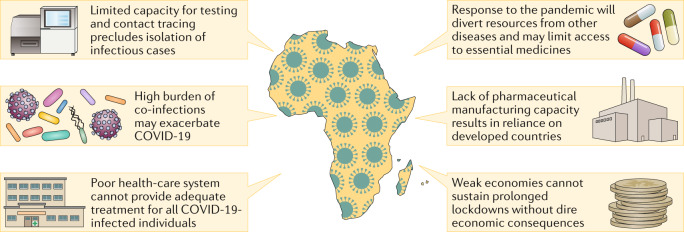
Fig. 1
Fig. 1. Challenges for African countries in their response to the COVID-19 pandemic.
The limited capacity for testing and contact tracing, poor health-care systems, lack of pharmaceutical manufacturing capacity and underdeveloped infrastructure in Africa pose several challenges that constrain the response of the region to the coronavirus disease-2019 (COVID-19) pandemic. This is worsened by the high burden of infectious diseases, which may worsen disease outcome and compete for the available resources. A further challenge is the dire economic consequences of prolonged lockdowns in countries with weak economies.
Fig. 2
Fig. 2. Global population demographics and health-care status underscore important risk factors for severe COVID-19 disease.
Population demographics and prevalence of known co-morbidities for each of the six World Health Organization regions. Although Africa reports a lower average age compared with other regions, the burden of infectious disease is disproportionately high. Both HIV and tuberculosis are associated with an increase in coronavirus disease-2019 (COVID-19) disease severity, and their prevalence in Africa will increase the risk of fatal infection for a large number of people. There is also a large proportion of individuals in Africa with raised blood pressure, which is a known risk factor for severe disease. Other known co-morbidities, including raised cholesterol, raised glucose and obesity, are less prevalent in Africa compared with the other reported regions. Raised blood pressure (systolic blood pressure ≥140 mm/Hg or diastolic blood pressure ≥90 mmHg), raised fasting blood glucose levels (≥7 mmol/l or taking medication), raised total cholesterol levels (≥5 mmol/l) and body mass index (BMI) >25 are reflected as age-standardized estimates. All data shown reflect the latest available data from the World Health Data Platform (Global Health Observatory). The number of people living with HIV-1/AIDS (in millions) reflects the population of individuals who were infected in 2018, tuberculosis cases shown reflect the number of incident cases in 2018 and malaria cases reflect the estimated number of cases in 2017.

References

    1. Su S, et al. Epidemiology, genetic recombination, and pathogenesis of coronaviruses. Trends Microbiol. 2016;24:490–502. - PMC - PubMed
    1. Drosten C, et al. Identification of a novel coronavirus in patients with severe acute respiratory syndrome. N. Engl. J. Med. 2003;348:1967–1976. - PubMed
    1. Zaki AM, van Boheemen S, Bestebroer TM, Osterhaus AD, Fouchier RA. Isolation of a novel coronavirus from a man with pneumonia in Saudi Arabia. N. Engl. J. Med. 2012;367:1814–1820. - PubMed
    1. Zhu N, et al. A novel coronavirus from patients with pneumonia in China, 2019. N. Engl. J. Med. 2020;382:727–733. - PMC - PubMed
    1. Chen N, et al. Epidemiological and clinical characteristics of 99 cases of 2019 novel coronavirus pneumonia in Wuhan, China: a descriptive study. Lancet. 2020;395:507–513. - PMC - PubMed

Publication types
