Review
. 2020 Aug 15;12(8):4795-4806.
eCollection 2020.

Efficacy and safety of intravenous thrombolysis for acute ischemic stroke in cancer patients: a systemic review and meta-analysis

Affiliations
Review

Efficacy and safety of intravenous thrombolysis for acute ischemic stroke in cancer patients: a systemic review and meta-analysis

Sui Huang et al. Am J Transl Res. .

Abstract

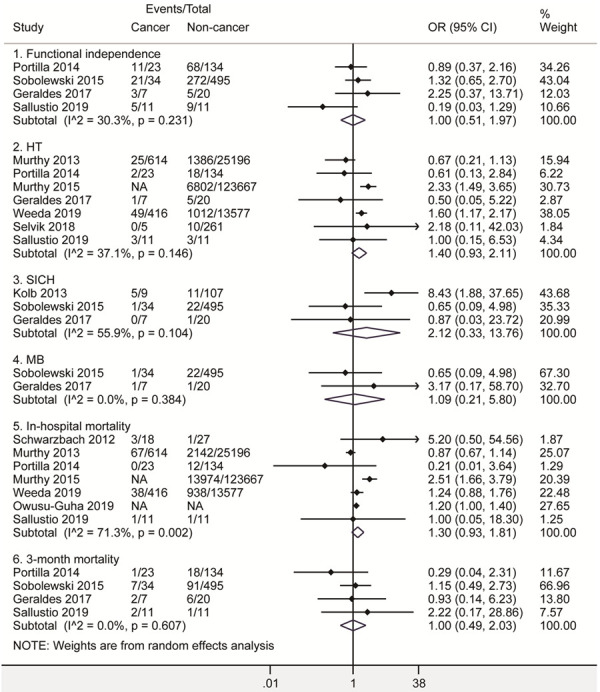
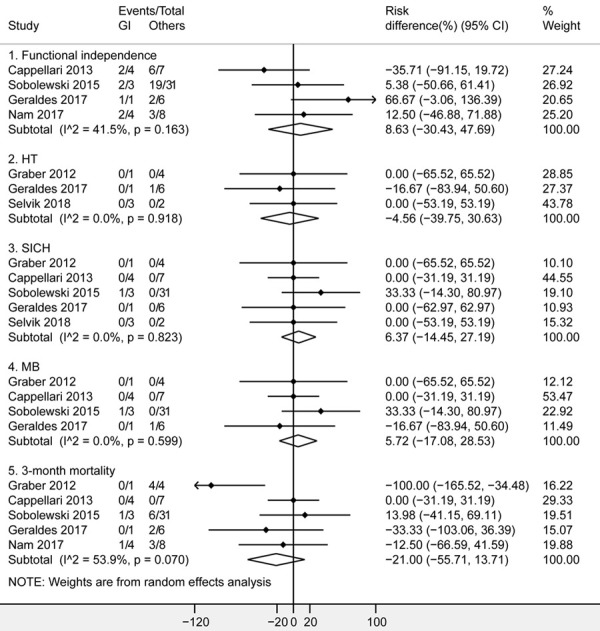
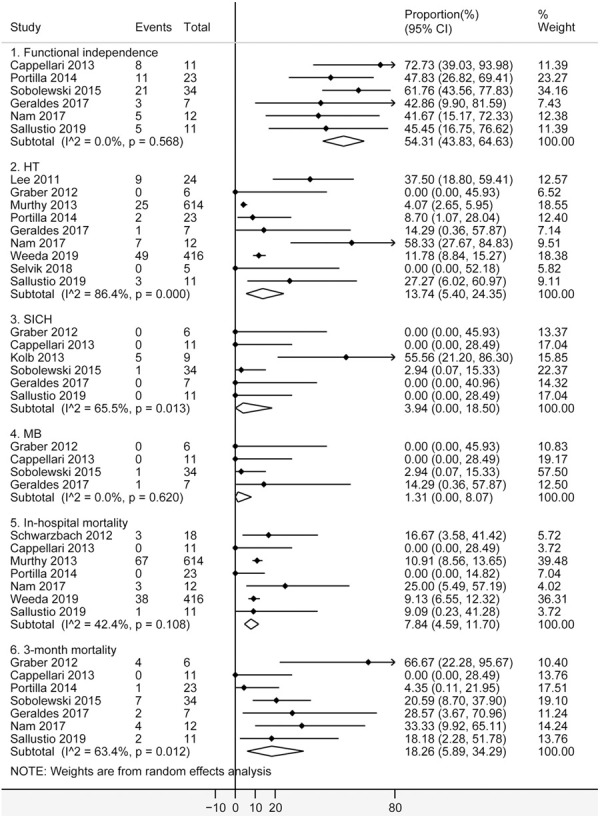
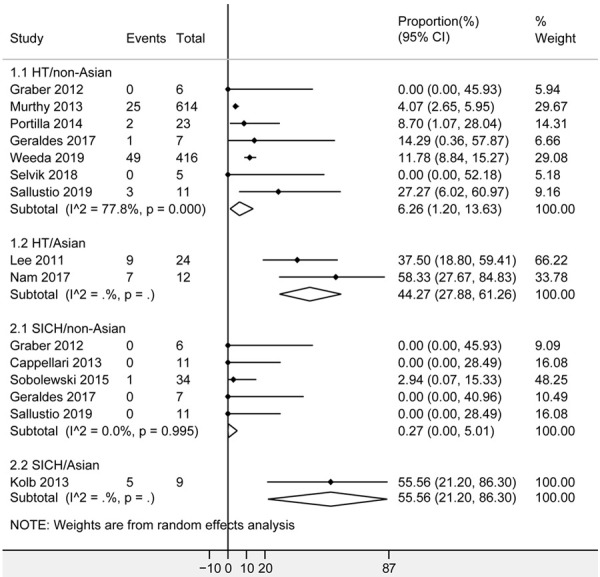
The efficacy and safety of intravenous thrombolysis (IVT) for acute ischemic stroke (AIS) in cancer patients remained uncertain due to low level evidence in the latest guideline for AIS. The aim of this study was to assess the efficacy and safety of IVT in cancer patients with stronger evidence. We searched Medline, Embase, CENTRAL and ClinicalTrials.gov until April 2020 for studies reporting outcomes of functional independence, hemorrhagic transformation (HT), symptomatic intracranial hemorrhage (SICH), major bleeding (MB), in-hospital mortality or 3-month mortality after IVT for AIS in cancer patients. For each outcome, the odds ratio between cancer and non-cancer patients, the risk difference between gastrointestinal and other malignancy, and the proportion in cancer patients were calculated. The meta-analysis showed no significant difference between cancer and non-cancer patients in favorable outcome, HT, SICH, MB, in-hospital mortality and 3-month mortality. Furthermore, there's no significant difference between patients with gastrointestinal and other malignancy in favorable outcome, HT, SICH, MB and 3-month mortality. In race-based subgroup analysis, Asians implied greater likelihood of HT and SICH than non-Asians. Therefore, the study confirmed and strengthened the validity of the guideline with stronger evidence that cancer shouldn't be an exclusion criterion of IVT. Inconsistent with the guideline, gastrointestinal malignancy may not remain an absolute contraindication of IVT while Asians implied increased HT and SICH, which needed further exploration.

Keywords: Acute ischemic stroke; cancer; gastrointestinal malignancy; intravenous thrombolysis; meta-analysis; systemic review.


Conflict of interest statement

None.

Figures
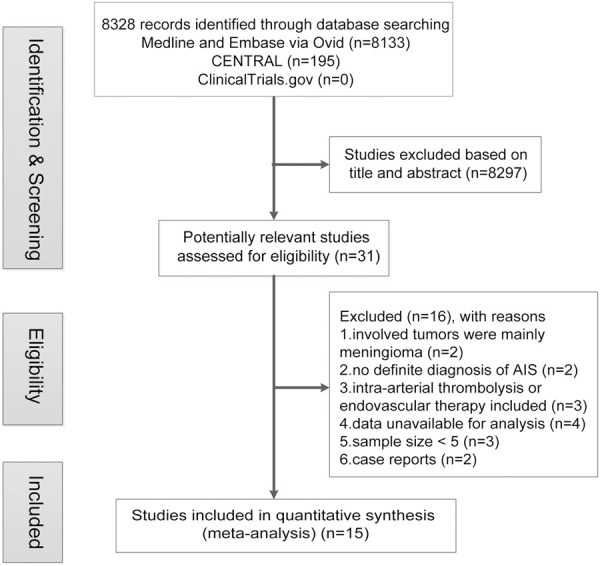
Figure 1
Figure 1
Flow chart of publication search and selection. Abbreviations: AIS, acute ischemic stroke.
Figure 2
Figure 2
Forest plots of functional independence, HT, SICH, MB, in-hospital mortality and 3-month mortality after intravenous thrombolysis for acute ischemic stroke in cancer and non-cancer patients. The diamond indicated the estimated odds ratio (95% confidence interval) of cancer to non-cancer patients. The I2 statistic and p value showed on each figure was for heterogeneity test. Abbreviations: OR, odds ratio; HT, hemorrhagic transformation; SICH, symptomatic intracranial hemorrhage; MB, Major bleeding.
Figure 3
Figure 3
Forest plots of functional independence, HT, SICH, MB and 3-month mortality after intravenous thrombolysis for acute ischemic stroke in patients with GI and other malignancy. The diamond indicated the estimated risk difference (95% confidence interval) between GI and other malignancy. The I2 statistic and p value showed on each figure was for heterogeneity test. Abbreviations: GI, gastrointestinal; HT, hemorrhagic transformation; SICH, symptomatic intracranial hemorrhage; MB, Major bleeding.
Figure 4
Figure 4
Forest plots of functional independence, HT, SICH, MB, in-hospital mortality and 3-month mortality after intravenous thrombolysis for acute ischemic stroke in cancer patients. The diamond indicated the estimated proportion (95% confidence interval) in cancer patients. The I2 statistic and p value showed on each figure was for heterogeneity test. Abbreviations: HT, hemorrhagic transformation; SICH, symptomatic intracranial hemorrhage; MB, Major bleeding.
Figure 5
Figure 5
Forest plots of HT and SICH after intravenous thrombolysis for acute ischemic stroke in non-Asian and Asian patients with cancer. The diamond indicated the estimated proportion (95% confidence interval) in Asian or non-Asian cancer patients. The I2 statistic and p value showed on each figure was for heterogeneity test. Abbreviations: HT, hemorrhagic transformation; SICH, symptomatic intracranial hemorrhage.

References

    1. Bray F, Ferlay J, Soerjomataram I, Siegel RL, Torre LA, Jemal A. Global cancer statistics 2018: GLOBOCAN estimates of incidence and mortality worldwide for 36 cancers in 185 countries. CA Cancer J Clin. 2018;68:394–424. - PubMed
    1. Navi BB, Reiner AS, Kamel H, Iadecola C, Okin PM, Elkind MSV, Panageas KS, DeAngelis LM. Risk of arterial thromboembolism in patients with cancer. J Am Coll Cardiol. 2017;70:926–938. - PMC - PubMed
    1. Navi BB, Reiner AS, Kamel H, Iadecola C, Elkind MS, Panageas KS, DeAngelis LM. Association between incident cancer and subsequent stroke. Ann Neurol. 2015;77:291–300. - PMC - PubMed
    1. Zaorsky NG, Zhang Y, Tchelebi LT, Mackley HB, Chinchilli VM, Zacharia BE. Stroke among cancer patients. Nat Commun. 2019;10:5172. - PMC - PubMed
    1. Wilbers J, Sondag L, Mulder S, Siegerink B, van Dijk EJ. Cancer prevalence higher in stroke patients than in the general population: the Dutch String-of-Pearls institute (PSI) stroke study. Eur J Neurol. 2020;27:85–91. - PMC - PubMed

LinkOut - more resources