. 2020 Dec;35(12):2301-2313.
doi: 10.1002/mds.28263. Epub 2020 Sep 11.

Clinical Conditions "Suggestive of Progressive Supranuclear Palsy"-Diagnostic Performance

Affiliations

Clinical Conditions "Suggestive of Progressive Supranuclear Palsy"-Diagnostic Performance

Max-Joseph Grimm et al. Mov Disord. 2020 Dec.

Abstract

Background: The Movement Disorder Society diagnostic criteria for progressive supranuclear palsy introduced the diagnostic certainty level "suggestive of progressive supranuclear palsy" for clinical conditions with subtle signs, suggestive of the disease. This category aims at the early identification of patients, in whom the diagnosis may be confirmed as the disease evolves.

Objective: To assess the diagnostic performance of the defined clinical conditions suggestive of progressive supranuclear palsy in an autopsy-confirmed cohort.

Methods: Diagnostic performance of the criteria was analyzed based on retrospective clinical data of 204 autopsy-confirmed patients with progressive supranuclear palsy and 216 patients with other neurological diseases.

Results: The conditions suggestive of progressive supranuclear palsy strongly increased the sensitivity compared to the National Institute of Neurological Disorders and Stroke and Society for Progressive Supranuclear Palsy criteria. Within the first year after symptom onset, 40% of patients with definite progressive supranuclear palsy fulfilled criteria for suggestive of progressive supranuclear palsy. Two-thirds of patients suggestive of progressive supranuclear palsy evolved into probable progressive supranuclear palsy after an average of 3.6 years. Application of the criteria for suggestive of progressive supranuclear palsy reduced the average time to diagnosis from 3.8 to 2.2 years.

Conclusions: Clinical conditions suggestive of progressive supranuclear palsy allow earlier identification of patients likely to evolve into clinically possible or probable progressive supranuclear and to have underlying progressive supranuclear palsy pathology. Further work needs to establish the specificity and positive predictive value of this category in real-life clinical settings, and to develop specific biomarkers that enhance their diagnostic accuracy in early disease stages. © 2020 The Authors. Movement Disorders published by Wiley Periodicals LLC on behalf of International Parkinson and Movement Disorder Society.

Keywords: autopsy; clinical diagnostic criteria; early diagnosis; neuropathology; progressive supranuclear palsy; suggestive.


Conflict of interest statement

Relevant conflicts of interest/financial disclosures: Nothing to report.

Figures

FIG. 1.
FIG. 1.
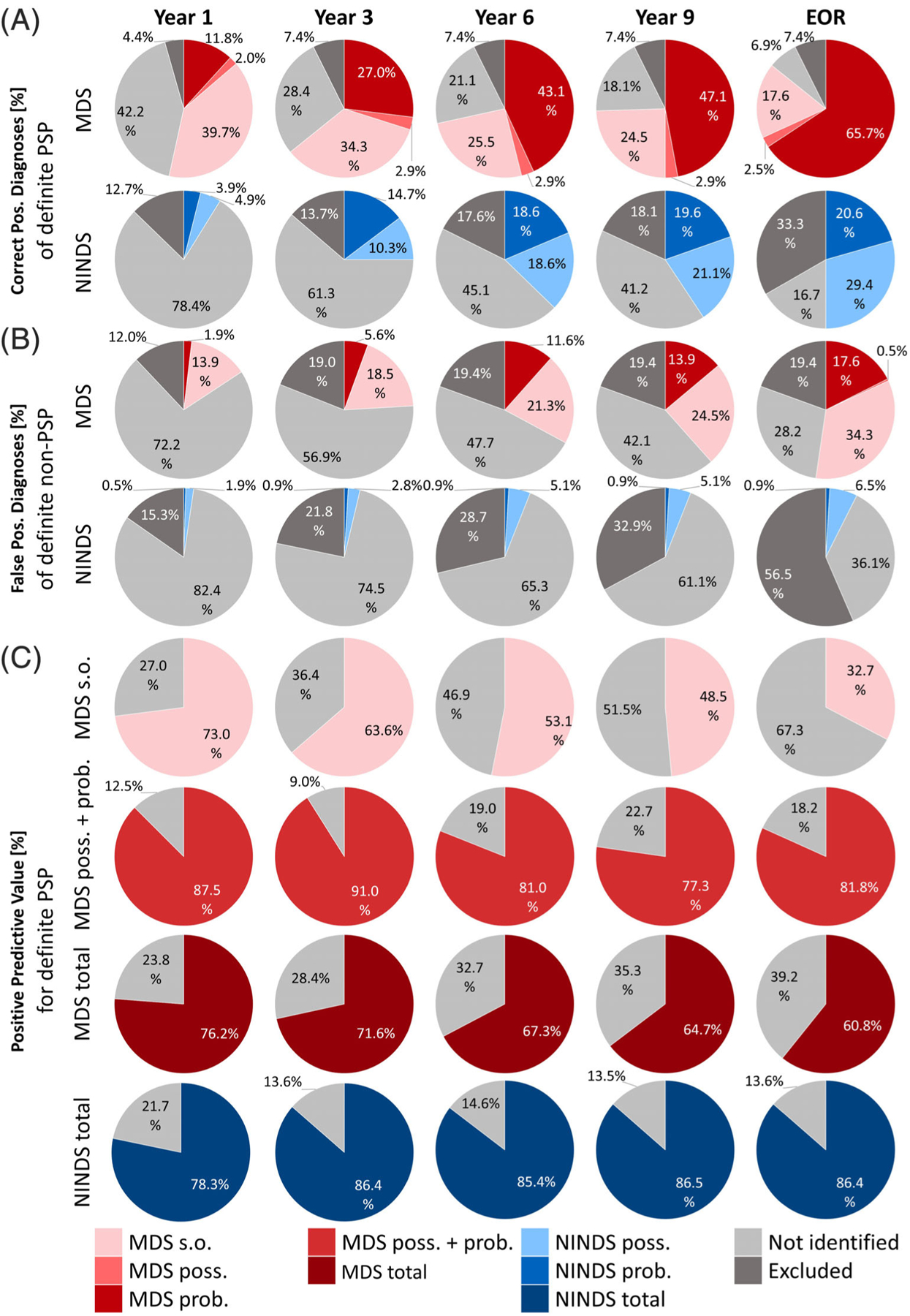
Sensitivity, specificity, and positive predictive value with application of the exclusion criteria. (A) Rate of correct positive PSP diagnoses in definite PSP (ie sensitivity) and (B) false–positive PSP diagnoses in non-4R-tauopathies (ie, 100%-specificity) with the MDS-PSP criteria (probable, possible or suggestive of PSP) and NINDS-SPSP criteria (probable or possible PSP) as a function of disease duration (1st–9th year) since onset of first symptoms. (C) Positive predictive value (PPV) for s.o. PSP (first row), possible or probable PSP combined (second row), and PSP of all certainty levels combined (third row) according to the MDS-PSP criteria; and of all certainty levels combined according to the NINDS-SPSP criteria (possible and probable PSP; forth row). Abbreviations: EOR, end of record; Prob., probable PSP; poss., possible PSP; s.o., suggestive of PSP. Not identified = patients not fulfilling the respective clinical diagnostic criteria; excluded = patients meeting the exclusion criteria of the respective clinical diagnostic criteria.
FIG. 2.
FIG. 2.
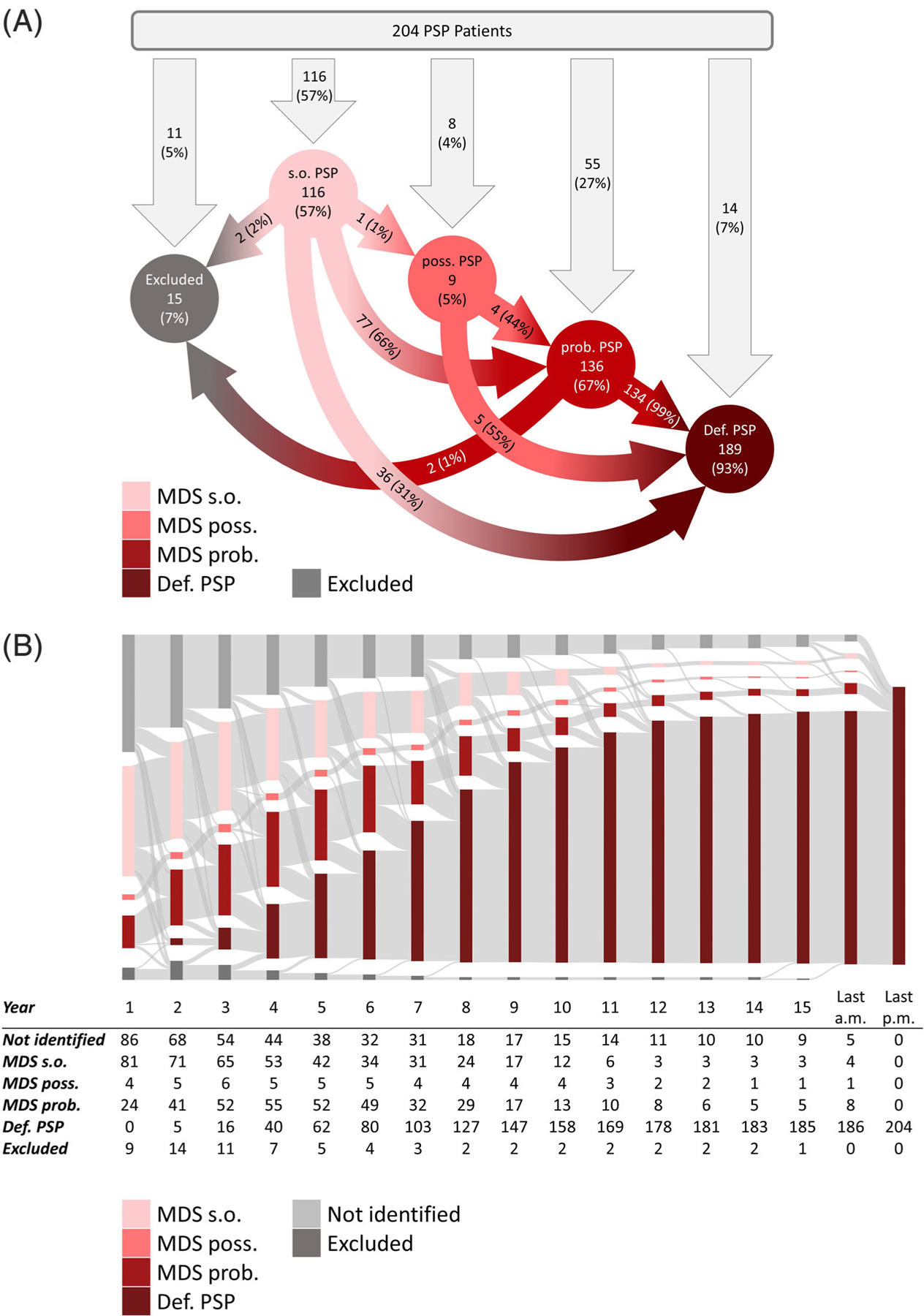
Allocation of definite PSP patients into the MDS-PSP diagnostic certainty levels. (A) Initial allocation and categorical evolution of diagnostic certainty levels of the MDS-PSP criteria showing the quantitative relevance of the s.o. PSP category as most frequent first clinical diagnosis in N = 204 definite PSP cases. Percentages in the arrows refer to the amount of patients in the circle at the beginning of the arrow. Definite PSP is a neuropathological diagnosis and therefore can only be stated post mortem. (B) Time-dependent evolution rates of diagnostic certainty levels per year of the MDS-PSP criteria showing that MDS s.o. PSP category is a highly frequent transition stage. Last a.m., last ante mortem diagnosis; last p.m., last post mortem diagnosis; Prob., probable PSP; Poss., possible PSP; S.o., suggestive of PSP; Def., definite PSP. Not identified = patients not fulfilling the diagnostic criteria; excluded = patients meeting the exclusion criteria of the clinical diagnostic criteria.
FIG. 3.
FIG. 3.
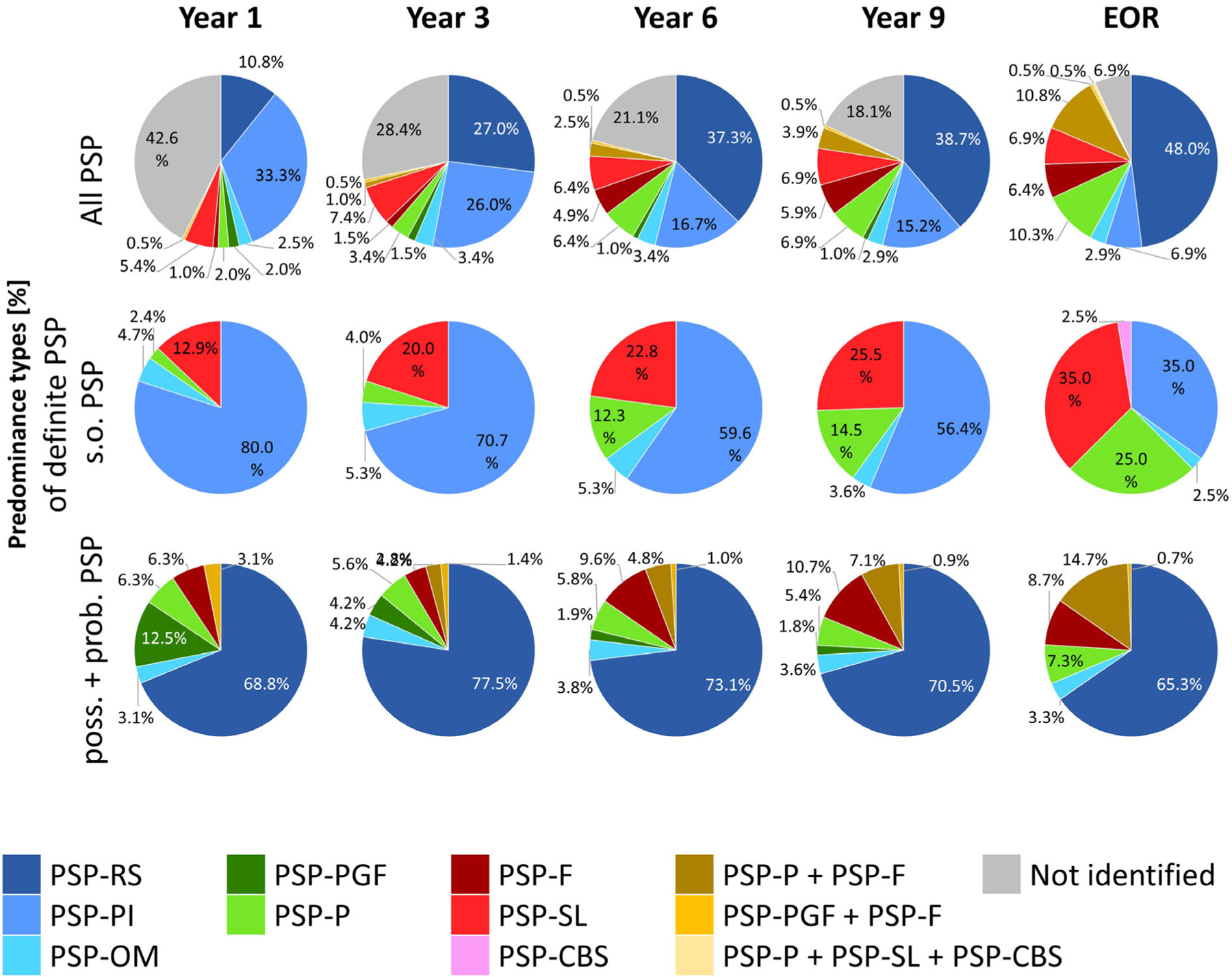
Predominance types of definite PSP patients by the MDS-criteria for the diagnosis of PSP. Data are shown as a function of disease duration (1st–9th year) since onset of first symptoms. The top row shows all patients, the middle row patients fulfilling clinical suggestive of (s.o.) PSP criteria, the lower row patients fulfilling possible or probable PSP criteria. EOR, end of record; Prob., probable PSP; poss., possible PSP; s.o., suggestive of PSP; PSP-RS, PSP with Richardson’s syndrome; PSP-PI, PSP with predominant postural instability; PSP-OM, PSP with predominant ocular motor dysfunction; PSP-PGF, PSP with progressive gait freezing; PSP-P, PSP with predominant Parkinsonism; PSP-F, PSP with predominant frontal presentation; PSP-SL, PSP with predominant speech/language disorder; PSP-CBS, PSP with predominant corticobasal syndrome. Not identified = patients not fulfilling the diagnostic criteria.
FIG. 4.
FIG. 4.
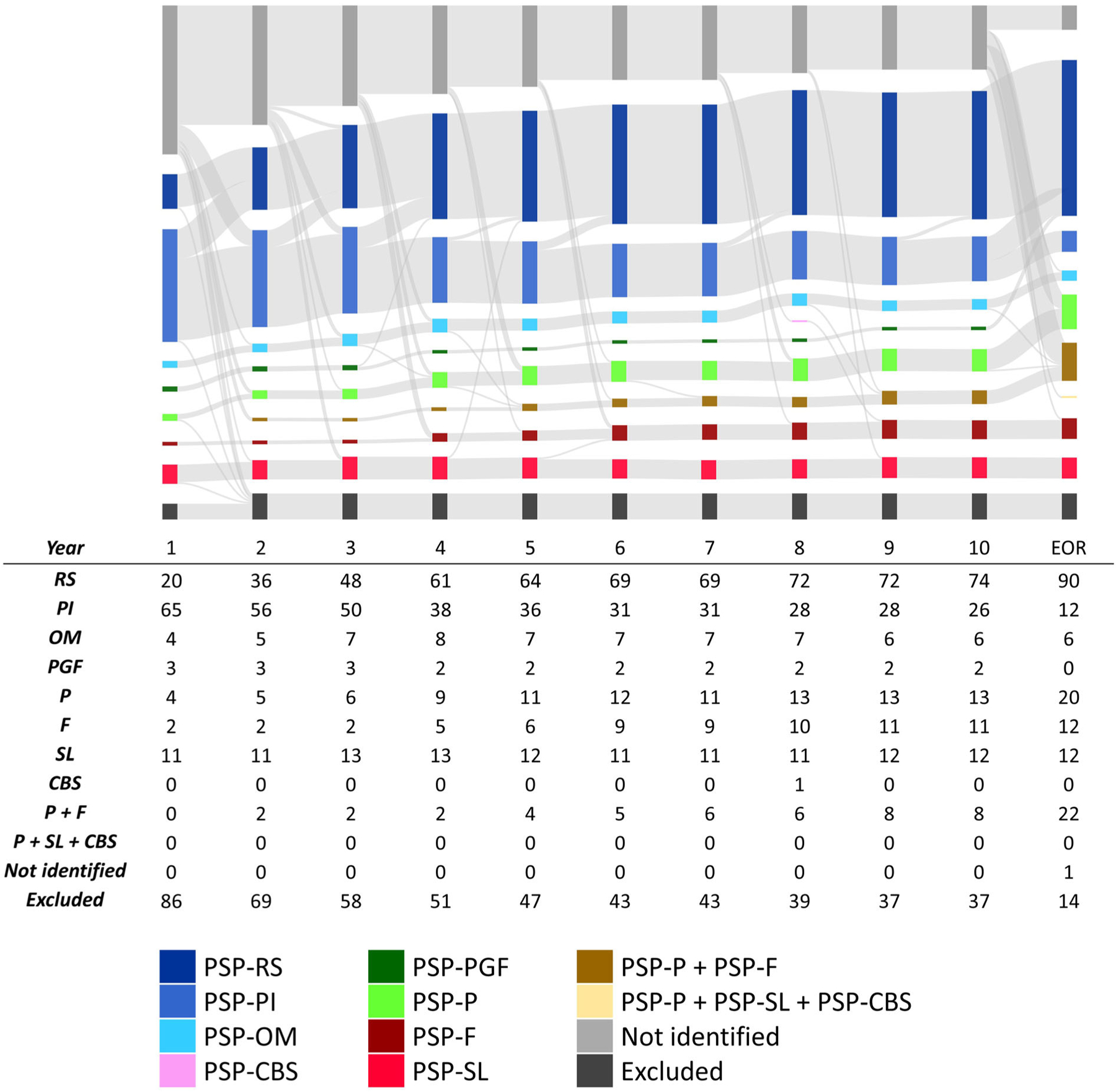
Transition of MDS predominance types between 1st and 10th year and at the end of record in N = 204 definite PSP patients. Each column represents 1 year, the size of the colored columns and the size of the connection strings is representative to the amount of patients. EOR, end of record; PSP-RS, PSP with Richardson’s syndrome; PSP-PI, PSP with predominant postural instability; PSP-OM, PSP with predominant ocular motor dysfunction; PSP-PGF, PSP with progressive gait freezing; PSP-P, PSP with predominant Parkinsonism; PSP-F, PSP with predominant frontal presentation; PSP-SL, PSP with predominant speech/language disorder; PSP-CBS, PSP with predominant corticobasal syndrome. Not identified = patients not fulfilling the diagnostic criteria; excluded = patients meeting the exclusion criteria of the clinical diagnostic criteria.

References

    1. Litvan I, Hauw JJ, Bartko JJ, et al. Validity and reliability of the preliminary NINDS neuropathologic criteria for progressive supranuclear palsy and related disorders. J Neuropathol Exp Neurol 1996;55:97–105. - PubMed
    1. Dickson DW. Neuropathologic differentiation of progressive supranuclear palsy and corticobasal degeneration. J Neurol 1999;246: 6–15. - PubMed
    1. Rosler TW, Tayaranian Marvian A, Brendel M, et al. Four-repeat tauopathies. Prog Neurobiol 2019;180:101644. - PubMed
    1. Litvan I, Agid Y, Calne D, et al. Clinical research criteria for the diagnosis of progressive supranuclear palsy (Steele-Richardson-Olszewski syndrome): report of the NINDS-SPSP international workshop. Neurology 1996;47:1–9. - PubMed
    1. Hoglinger GU, Respondek G, Stamelou M, et al. Clinical diagnosis of progressive supranuclear palsy: the Movement Disorder Society criteria. Mov Disord 2017;32:853–864. - PMC - PubMed

Publication types