


Personalized Computational Models of Tissue-Rearrangement in the Scalp Predict the Mechanical Stress Signature of Rotation Flaps
- PMID: 32914654
- PMCID: PMC8193915
- DOI: 10.1177/1055665620954094
Personalized Computational Models of Tissue-Rearrangement in the Scalp Predict the Mechanical Stress Signature of Rotation Flaps
Abstract
Objective: To elucidate the mechanics of scalp rotation flaps through 3D imaging and computational modeling. Excessive tension near a wound or sutured region can delay wound healing or trigger complications. Measuring tension in the operating room is challenging, instead, noninvasive methods to improve surgical planning are needed.
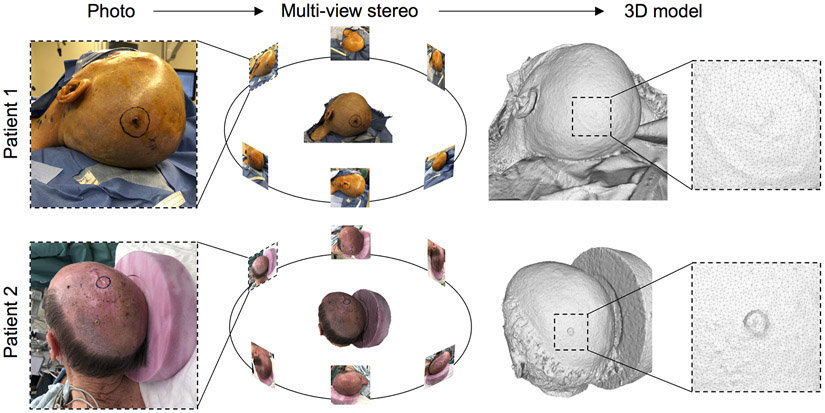
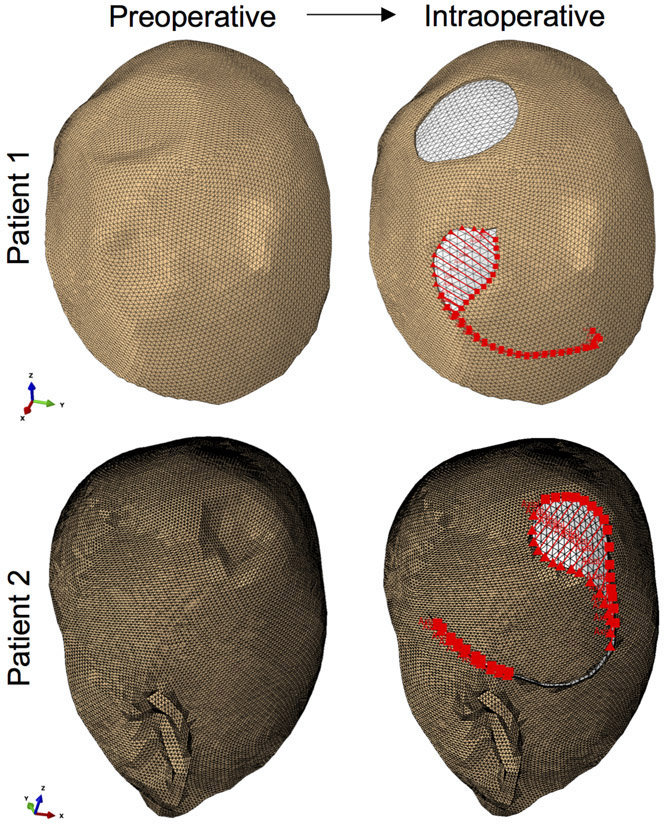
Design: Multi-view stereo allows creation of 3D patient-specific geometries based on a set of photographs. The patient-specific 3D geometry is imported into a finite element (FE) platform to perform a virtual procedure. The simulation is compared with the clinical outcome. Additional simulations quantify the effect of individual flap parameters on the resulting tension distribution.
Participants: Rotation flaps for reconstruction of scalp defects following melanoma resection in 2 cases are presented. Rotation flaps were designed without preoperative FE preparation.
Main outcome measure: Tension distribution over the operated region.
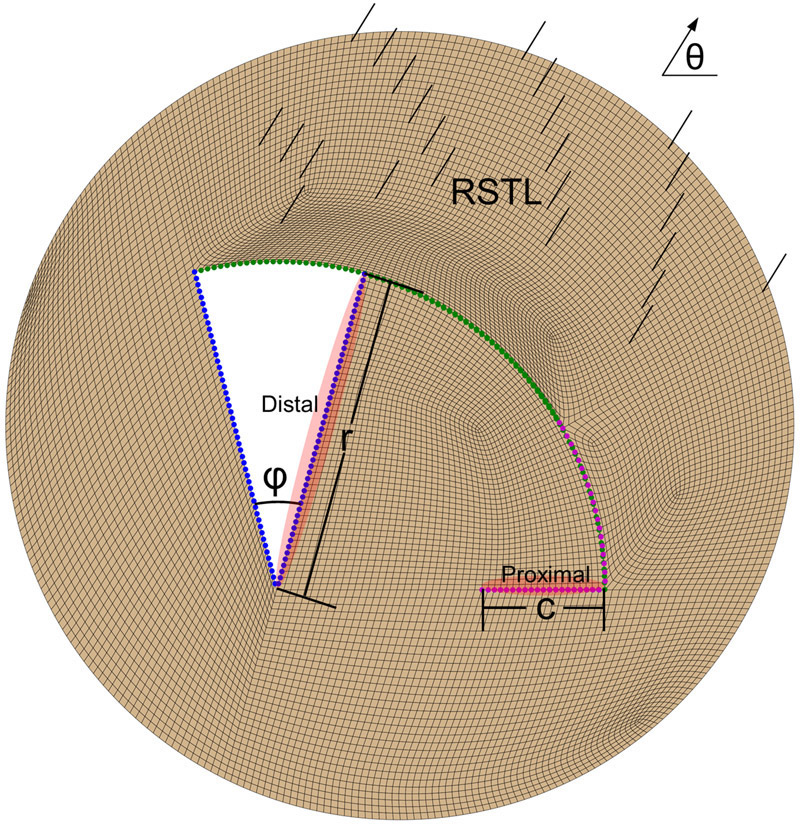
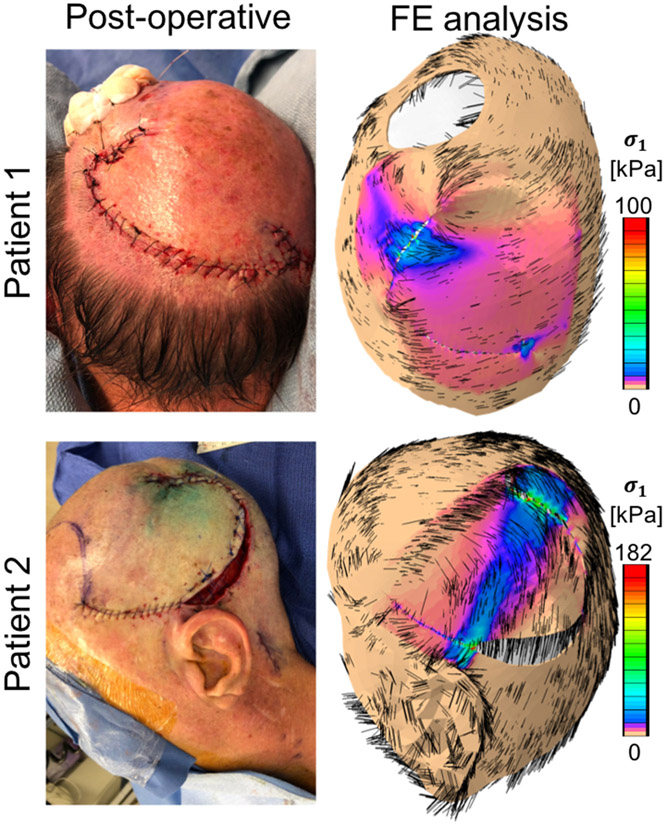
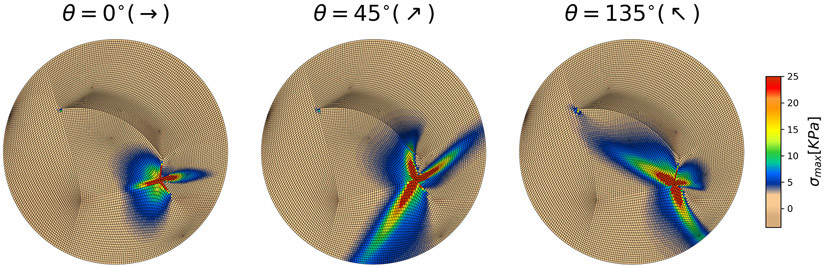
Results: The tension from FE shows peaks at the base and distal ends of the scalp rotation flap. The predicted geometry from the simulation aligns with postoperative photographs. Simulations exploring the flap design parameters show variation in the tension. Lower tensions were achieved when rotation was oriented with respect to skin tension lines (horizontal tissue fibers) and smaller rotation angles.
Conclusions: Tension distribution following rotation of scalp flaps can be predicted through personalized FE simulations. Flaps can be designed to reduce tension using FE, which may greatly improve the reliability of scalp reconstruction in craniofacial surgery, critical in complex cases when scalp reconstruction is essential for coverage of hardware, implants, and/or bone graft.
Keywords: craniofacial reconstruction; finite element analysis; multi-view stereo; skin anisotropy; tissue mechanics.
Figures
References
-
- Abe N, Kuroda S, Furutani M, and Tanaka E Data-based prediction of soft tissue changes after orthognathic surgery: Clinical assessment of new simulation software. Int. J. Oral Maxillofac. Surg 2015, 44(1), 90–96. - PubMed
-
- Cox HT The cleavage lines of the skin. Br. J. Surg 1941, 29(114), 234–240.
-
- Gurtner GC, Dauskardt RH, Wong VW, Bhatt KA, Wu K, Vial IN, Padois K, Korman JM, and Longaker MT Improving cutaneous scar formation by controlling the mechanical environment: large animal and phase I studies. Ann. Surg 2011, 254, 217–225. - PubMed
Publication types
MeSH terms
Grants and funding
LinkOut - more resources
Full Text Sources
Medical
