. 2021 Nov;268(11):4033-4065.
doi: 10.1007/s00415-020-10095-z. Epub 2020 Sep 11.

Managing disorders of consciousness: the role of electroencephalography

Affiliations

Managing disorders of consciousness: the role of electroencephalography

Yang Bai et al. J Neurol. 2021 Nov.

Abstract

Disorders of consciousness (DOC) are an important but still underexplored entity in neurology. Novel electroencephalography (EEG) measures are currently being employed for improving diagnostic classification, estimating prognosis and supporting medicolegal decision-making in DOC patients. However, complex recording protocols, a confusing variety of EEG measures, and complicated analysis algorithms create roadblocks against broad application. We conducted a systematic review based on English-language studies in PubMed, Medline and Web of Science databases. The review structures the available knowledge based on EEG measures and analysis principles, and aims at promoting its translation into clinical management of DOC patients.

Keywords: Disorders of consciousness; Electroencephalography; Event-related potential; Minimally conscious state; TMS-EEG; Unresponsive wakefulness state; Vegetative state.


Conflict of interest statement

U.Z. has received a grant from Janssen Pharmaceutica NV to support conduction of this work. In addition, he has received grants from European Research Council (ERC), German Research Foundation (DFG), German Federal Ministry of Education and Research (BMBF), Bristol Myers Squibb, Servier, Biogen Idec GmbH, and personal fees from Bayer Vital GmbH, Pfizer GmbH, CorTec GmbH, all outside of this work. Y.B. and Y.L. declare that they have no conflict of interest.

Figures
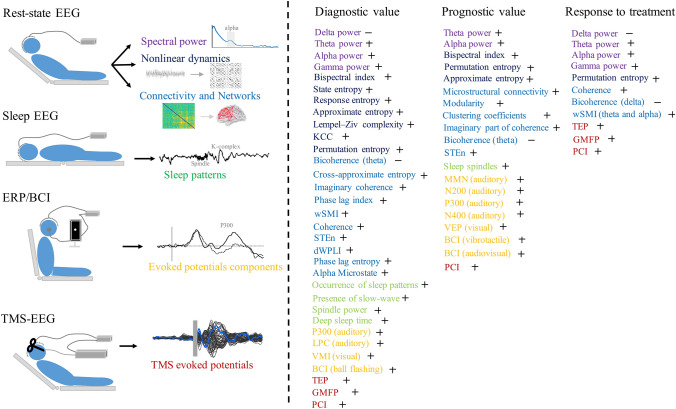
Fig. 1
Fig. 1
Main EEG measures obtained in patients with disorders of consciousness: rest-state EEG, sleep EEG, event-related potentials (ERP), brain-computer interface (BCI) and transcranial magnetic stimulation–electroencephalography (TMS-EEG). These measures provide various EEG characteristics based on different information extraction algorithms. The right panel summarizes the main EEG characteristics with respect to their potential values in classifying minimally conscious state (MCS) and vegetative state/unresponsive wakefulness syndrome (VS/UWS) (diagnostic value), outcomes prediction (prognostic value) and treatment monitoring (response to treatment). The colors identify EEG measures belonging to the main EEG techniques as indicated by the same colors in the left panel. ± in the ‘diagnostic value’ column indicate that EEG measures are larger (+)/smaller (–) in MCS than in VS/UWS. ± in the ‘prognostic value’ column indicate that larger EEG measures correspond to better (+)/worse (–) outcome. Finally, ± in the ‘response to treatment’ column means that EEG measures increased/decreased during treatment. KCC Kolmogorov–Chaitin complexity, wSMI weighted symbolic mutual information, dwPLI debiased weighted phase lag index, STEn symbolic transfer entropy, LPC late positive components, VMI visuomotor integration, VEP visual evoked potentials, MMN mismatch negativity, TEP TMS evoked potentials, GMFP global mean field power, PCI perturbational complexity index
Fig. 2
Fig. 2
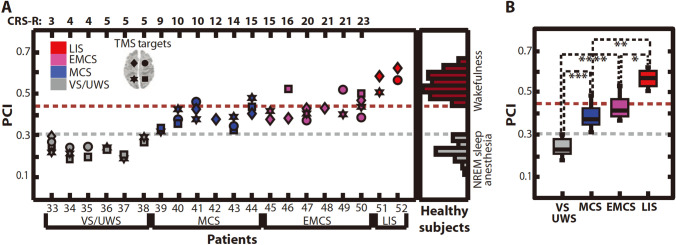
Perturbational complexity index (PCI) discriminates the level of consciousness in brain-injured patients. a PCI values for 48 TMS sessions collected from 20 severely brain-injured patients (TMS was targeted to both left and right Brodmann areas 8 and 7, as indicated at top left). Right: distribution of PCI values from healthy individuals. b Box plots for PCI in brain-injured patients with the statistical significance between pairs of conditions (Linear mixed-effects models: *P = 0.002, **P = 0.0001, ***P = 2 × 10−5, ****P = 8 × 10−7). Gray and red dashed lines in (a) and (b) represent the maximum complexity observed during unconsciousness (PCI = 0.31) and the minimum complexity observed during alert wakefulness (PCI = 0.44) in healthy subjects, respectively (with permission, from Casali et al. [110] Sci Transl Med 5:198ra105)

References

    1. Giacino JT, Fins JJ, Laureys S, Schiff ND. Disorders of consciousness after acquired brain injury: the state of the science. Nat Rev Neurol. 2014;10(2):99–114. doi: 10.1038/nrneurol.2013.279. - DOI - PubMed
    1. Schiff ND, Plum F. The role of arousal and “gating” systems in the neurology of impaired consciousness. J Clin Neurophysiol. 2000;17(5):438–452. doi: 10.1097/00004691-200009000-00002. - DOI - PubMed
    1. Marsden C. The diagnosis of stupor and coma (3rd edn) J Neurol Neurosurg Psychiatry. 1981;44(3):270–271. doi: 10.1136/jnnp.44.3.270-a. - DOI
    1. Laureys S, Celesia GG, Cohadon F, Lavrijsen J, Leon-Carrion J, Sannita WG, Sazbon L, Schmutzhard E, von Wild KR, Zeman A, Dolce G, European Task Force on Disorders of C Unresponsive wakefulness syndrome: a new name for the vegetative state or apallic syndrome. BMC Med. 2010;8:68. doi: 10.1186/1741-7015-8-68. - DOI - PMC - PubMed
    1. Giacino JT, Ashwal S, Childs N, Cranford R, Jennett B, Katz DI, Kelly JP, Rosenberg JH, Whyte J, Zafonte RD, Zasler ND. The minimally conscious state: definition and diagnostic criteria. Neurology. 2002;58(3):349–353. doi: 10.1212/wnl.58.3.349. - DOI - PubMed

Publication types

LinkOut - more resources