. 2021 Apr;36(2):207-219.
doi: 10.1007/s12250-020-00278-3. Epub 2020 Sep 11.

Porcine Immunoglobulin Fc Fused P30/P54 Protein of African Swine Fever Virus Displaying on Surface of S. cerevisiae Elicit Strong Antibody Production in Swine

Affiliations

Porcine Immunoglobulin Fc Fused P30/P54 Protein of African Swine Fever Virus Displaying on Surface of S. cerevisiae Elicit Strong Antibody Production in Swine

Chen Chen et al. Virol Sin. 2021 Apr.

Abstract

African swine fever virus (ASFV) infects domestic pigs and European wild boars with strong, hemorrhagic and high mortality. The primary cellular targets of ASFV is the porcine macrophages. Up to now, no commercial vaccine or effective treatment available to control the disease. In this study, three recombinant Saccharomyces cerevisiae (S. cerevisiae) strains expressing fused ASFV proteins-porcine Ig heavy chains were constructed and the immunogenicity of the S. cerevisiae-vectored cocktail ASFV feeding vaccine was further evaluated. To be specific, the P30-Fcγ and P54-Fcα fusion proteins displaying on surface of S. cerevisiae cells were produced by fusing the Fc fragment of porcine immunoglobulin IgG1 or IgA1 with p30 or p54 gene of ASFV respectively. The recombinant P30-Fcγ and P54-Fcα fusion proteins expressed by S. cerevisiae were verified by Western blotting, flow cytometry and immunofluorescence assay. Porcine immunoglobulin Fc fragment fused P30/P54 proteins elicited P30/P54-specific antibody production and induced higher mucosal immunity in swine. The absorption and phagocytosis of recombinant S. cerevisiae strains in IPEC-J2 cells or porcine alveolar macrophage (PAM) cells were significantly enhanced, too. Here, we introduce a kind of cheap and safe oral S. cerevisiae-vectored vaccine, which could activate the specific mucosal immunity for controlling ASFV infection.

Keywords: African swine fever virus (ASFV); P30-Fcγ/P54-Fcα fusion proteins; Porcine immunoglobulin Fc; S. cerevisiae.


Conflict of interest statement

The authors declare that they have no conflict of interest.

Figures
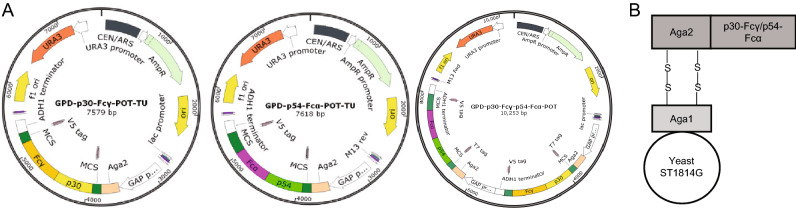
Fig. 1
Fig. 1
Construction of p30-Fcγ, p54-Fcα, p30-Fcγ-p54-Fcα expression vectors. A Diagram of the chromosomal region, including the p30-Fcγ and p54-Fcα open reading frame. GAP promoters are indicated as white arrow, ADH1 terminators are shown as white rectangle. Aga2 which would combine with Aga1 expressed on the surface of ST1814G is indicated in peach puff. B A schematic diagram showing the recombinant S. cerevisiae strain expressing ASFV proteins.
Fig. 2
Fig. 2
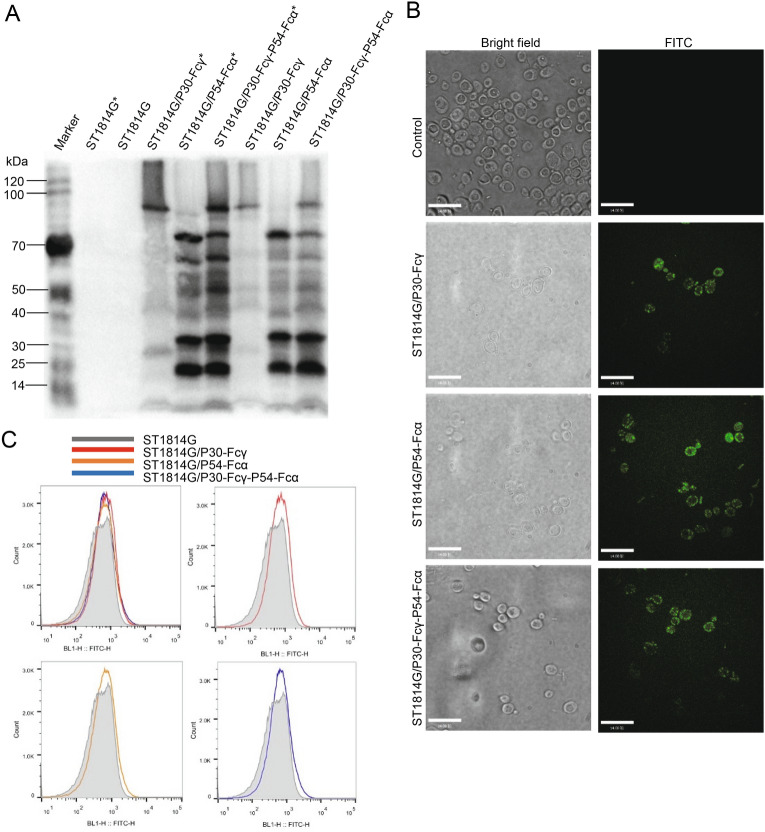
Surface displaying of P30-Fcγ and P54-Fcα fusion proteins on S. cerevisiae. A ST1814G (negative control), ST1814G/P30-Fcγ, ST1814G/P54-Fcα, ST1814G/P30-Fcγ-P54-Fcα were collected after cultivation for 24 h. The precipitated lysate were subjected to Western blot analysis. ST1814G, ST1814G/P30-Fcγ, ST1814G/P54-Fcα, ST1814G/P30-Fcγ-P54-Fcα with a normal sample preparation, while ST1814G*, ST1814G/P30-Fcγ*, ST1814G/P54-Fcα*, ST1814G/P30-Fcγ-P54-Fcα* were treated with β-mercaptoethanol to reduce the disulfide bonds. B ST1814G (negative control), ST1814G/P30-Fcγ, ST1814G/P54-Fcα, ST1814G/P30-Fcγ-P54-Fcα were collected after cultivation for 24 h. Yeast cells were fixed on glass slides and the presence of ASFV proteins were analyzed by confocal microscopy. The anti-His mouse antibody was used as the primary antibody. FITC-conjugated anti-mouse IgG was added as secondary antibody for immunofluorescence microscopy analysis. C Expression profiles of recombinant proteins were also determined by flow cytometry. Gray lines (dark shades) represent control cells, while positive cells are indicated by lines of different colors. Red, orange, blue lines stands for ST1814G/P30-Fcγ, ST1814G/P54-Fcα, ST1814G/P30-Fcγ-P54-Fcα, respectively.
Fig. 3
Fig. 3
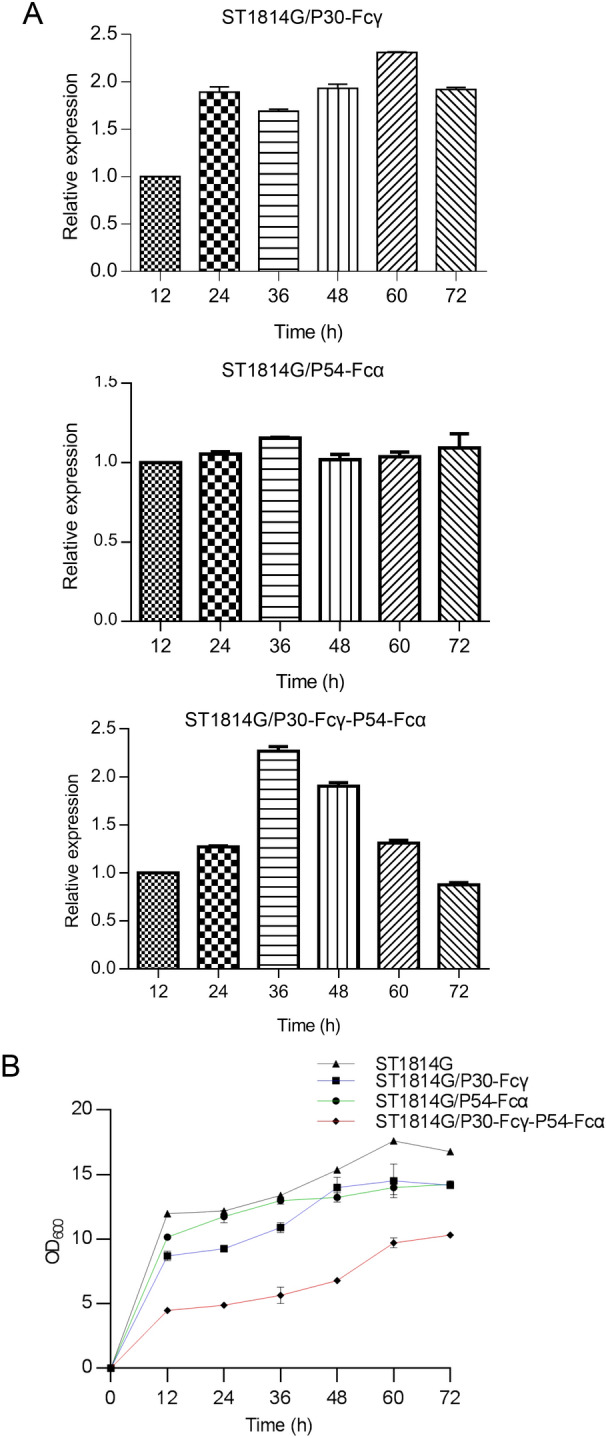
The fermentation kinetics of the recombinant S. cerevisiae strains. A The mRNA expression levels of p30 and p54 genes in the recombinant S. cerevisiae strains were quantified by qPCR. The ACT1 gene was used as internal control. B The growth curve of the three recombinant S. cerevisiae strains. The liquid OD600 nm value of the three recombinant S. cerevisiae strains cultures at the cultivation time points of 12 h, 24 h, 36 h, 48 h, 60 h, 72 h is determined by Spectrophotometer. The host S. cerevisiae strain ST1814G were set as the blank control.
Fig. 4
Fig. 4
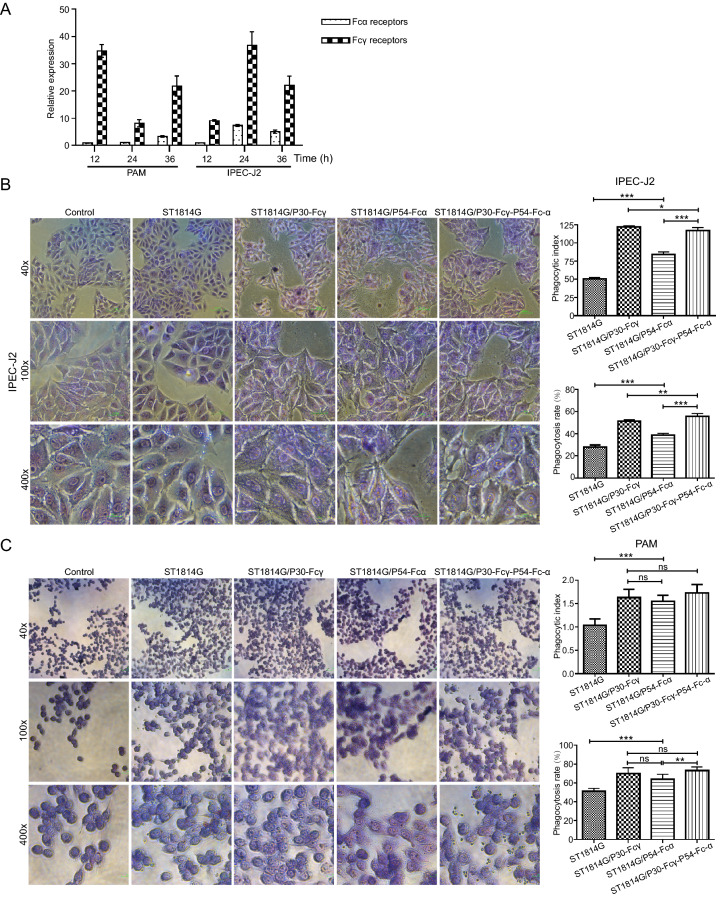
Fc fragment prompt binding and phagocytosis of the recombinant S. cerevisiae strains by porcine cells. A The mRNA expression levels of Fcγ receptor and Fcα receptor of PAM and IPEC-J2 cells were quantified by qRT-PCRβ-Actin gene was used as internal control. B, C The adsorption phagocytosis to the host S. cerevisiae strain and three recombinant S. cerevisiae strains of IPEC-J2 cells (B) and PAM cells (C) under light microscopy. PAM cells were divided into blank control group, the host S. cerevisiae strain control group and three experimental groups. ST1814G, ST1814G/P30-Fcγ, ST1814G/P54-Fcα, ST1814G/P30-Fcγ-P54-Fcα were added into the corresponding chamber in the six-well plate. The phagocytosis process was observed under a microscope, and the phagocytic rate and phagocytic index were detected. The phagocytosis rate (%) = Number of macrophages engulfing yeast cells in 200 macrophages/200; the phagocytic index (%) = Total number of yeast cells engulfed by 200 macrophages/200. *P < 0.05; **P < 0.01; and ***P < 0.001.
Fig. 5
Fig. 5
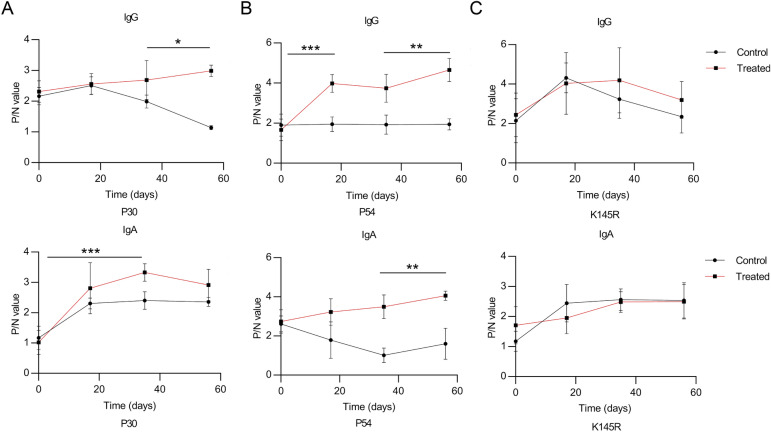
The recombinant S. cerevisiae strains stimulate specific antibody responses in vaccinated pigs. Vaccinated pigs were fed with the recombinant S. cerevisiae strains three times at 2-week interval. The titers of P30/P54/K145R-specific total IgG and IgA antibodies in serum were evaluated by ELISA. Serum samples were collected after the 1st, 2nd, and 3rd immunization. The individual animal response to each antigen was evaluated in triplicate and is depicted as the mean of the absorbance values at 450 nm minus the mean absorbance of cognate pre-immunization serum. The antigen-specific titers among the treatment groups were compared using ANOVA, followed by Tukey’s multiple-comparison test. Error bars show the standard deviation between triplicates. The mean and standard error of antibodies of each group are shown. *P < 0.05; **P < 0.01; and ***P < 0.001.

References

    1. Argilaguet JM, Pérez-Martín E, López S, Goethe M, Rodríguez F. BacMam immunization partially protects pigs against sublethal challenge with African swine fever virus. Antiviral Res. 2013;98:61–65. - PubMed
    1. Barderas MG, Rodríguez F, Gómez-Puertas P, Avilés M, Beitia F, Alonso C, Escribano JM. Antigenic and immunogenic properties of a chimera of two immunodominant African swine fever virus proteins. Arch Virol. 2001;146:1681–1691. - PubMed
    1. Chen X, Yang J, Ji Y, Okoth E, Liu B, Li X, Yin H, Zhu Q. Recombinant Newcastle disease virus expressing African swine fever virus protein 72 is safe and immunogenic in mice. Virol Sin. 2016;31:150–159. - PMC - PubMed
    1. Chen P, Zhang L, Chang N, Shi P, Gao T, Zhang L, Huang J. Preparation of virus-like particles for porcine circovirus type 2 by yeast fab assembly. Virus Genes. 2018;54:246–255. - PubMed
    1. Colgrove GS, Haelterman EO, Coggins L. Pathogenesis of African swine fever in young pigs. Am J Vet Res. 1969;30:1343–1359. - PubMed

Substances

LinkOut - more resources