The relationship between circulating lipids and breast cancer risk: A Mendelian randomization study
- PMID: 32915777
- PMCID: PMC7485834
- DOI: 10.1371/journal.pmed.1003302
The relationship between circulating lipids and breast cancer risk: A Mendelian randomization study
Abstract
Background: A number of epidemiological and genetic studies have attempted to determine whether levels of circulating lipids are associated with risks of various cancers, including breast cancer (BC). However, it remains unclear whether a causal relationship exists between lipids and BC. If alteration of lipid levels also reduced risk of BC, this could present a target for disease prevention. This study aimed to assess a potential causal relationship between genetic variants associated with plasma lipid traits (high-density lipoprotein, HDL; low-density lipoprotein, LDL; triglycerides, TGs) with risk for BC using Mendelian randomization (MR).
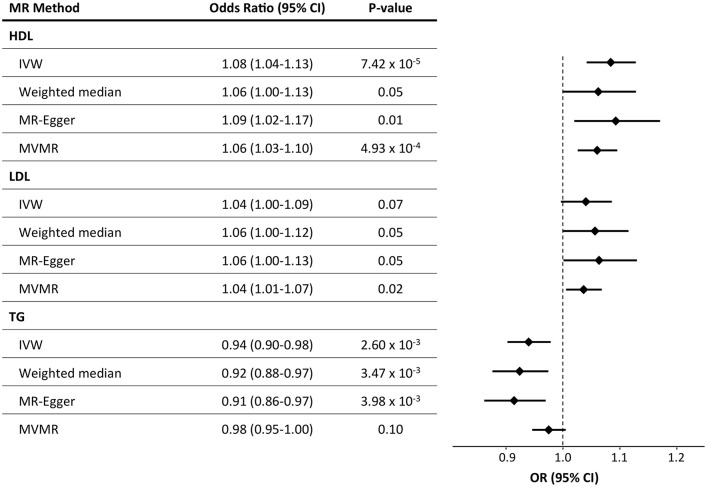
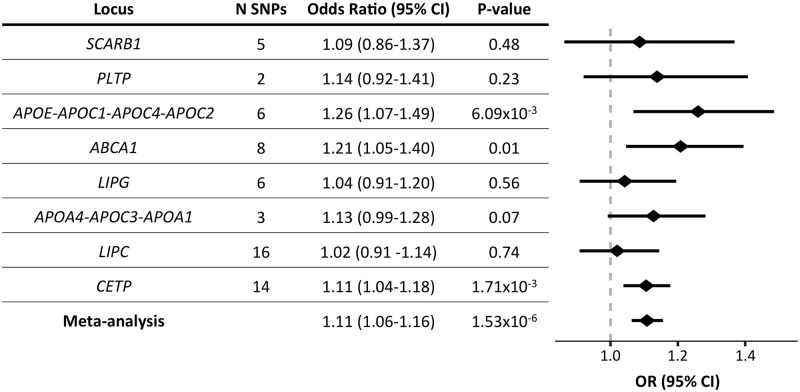
Methods and findings: Data from genome-wide association studies in up to 215,551 participants from the Million Veteran Program (MVP) were used to construct genetic instruments for plasma lipid traits. The effect of these instruments on BC risk was evaluated using genetic data from the BCAC (Breast Cancer Association Consortium) based on 122,977 BC cases and 105,974 controls. Using MR, we observed that a 1-standard-deviation genetically determined increase in HDL levels is associated with an increased risk for all BCs (HDL: OR [odds ratio] = 1.08, 95% confidence interval [CI] = 1.04-1.13, P < 0.001). Multivariable MR analysis, which adjusted for the effects of LDL, TGs, body mass index (BMI), and age at menarche, corroborated this observation for HDL (OR = 1.06, 95% CI = 1.03-1.10, P = 4.9 × 10⁻⁴) and also found a relationship between LDL and BC risk (OR = 1.03, 95% CI = 1.01-1.07, P = 0.02). We did not observe a difference in these relationships when stratified by breast tumor estrogen receptor (ER) status. We repeated this analysis using genetic variants independent of the leading association at core HDL pathway genes and found that these variants were also associated with risk for BCs (OR = 1.11, 95% CI = 1.06-1.16, P = 1.5 × 10⁻⁶), including locus-specific associations at ABCA1 (ATP Binding Cassette Subfamily A Member 1), APOE-APOC1-APOC4-APOC2 (Apolipoproteins E, C1, C4, and C2), and CETP (Cholesteryl Ester Transfer Protein). In addition, we found evidence that genetic variation at the ABO locus is associated with both lipid levels and BC. Through multiple statistical approaches, we minimized and tested for the confounding effects of pleiotropy and population stratification on our analysis; however, the possible existence of residual pleiotropy and stratification remains a limitation of this study.
Conclusions: We observed that genetically elevated plasma HDL and LDL levels appear to be associated with increased BC risk. Future studies are required to understand the mechanism underlying this putative causal relationship, with the goal of developing potential therapeutic strategies aimed at altering the cholesterol-mediated effect on BC risk.
Conflict of interest statement
I have read the journal's policy and the authors of this manuscript have the following competing interests: SMD declares research support to institution from Renalytix AI and a patent application filed by VA on drug repurposing for lipid reduction.
Figures
References
Publication types
MeSH terms
Substances
Grants and funding
- R56 DK101478/DK/NIDDK NIH HHS/United States
- T32 HG000046/HG/NHGRI NIH HHS/United States
- MC_PC_15018/MRC_/Medical Research Council/United Kingdom
- IK2 CX001780/CX/CSRD VA/United States
- I01 BX003362/BX/BLRD VA/United States
- R01 HG010067/HG/NHGRI NIH HHS/United States
- WT_/Wellcome Trust/United Kingdom
- T32 GM008216/GM/NIGMS NIH HHS/United States
- G9815508/MRC_/Medical Research Council/United Kingdom
- S06 GM008216/GM/NIGMS NIH HHS/United States
- MC_PC_19009/MRC_/Medical Research Council/United Kingdom
- R01 DK101478/DK/NIDDK NIH HHS/United States
- WT091310/WT_/Wellcome Trust/United Kingdom
LinkOut - more resources
Full Text Sources
Medical
Miscellaneous