


A Review on 3D-Printed Templates for Precontouring Fixation Plates in Orthopedic Surgery
- PMID: 32916844
- PMCID: PMC7565448
- DOI: 10.3390/jcm9092908
A Review on 3D-Printed Templates for Precontouring Fixation Plates in Orthopedic Surgery
Abstract
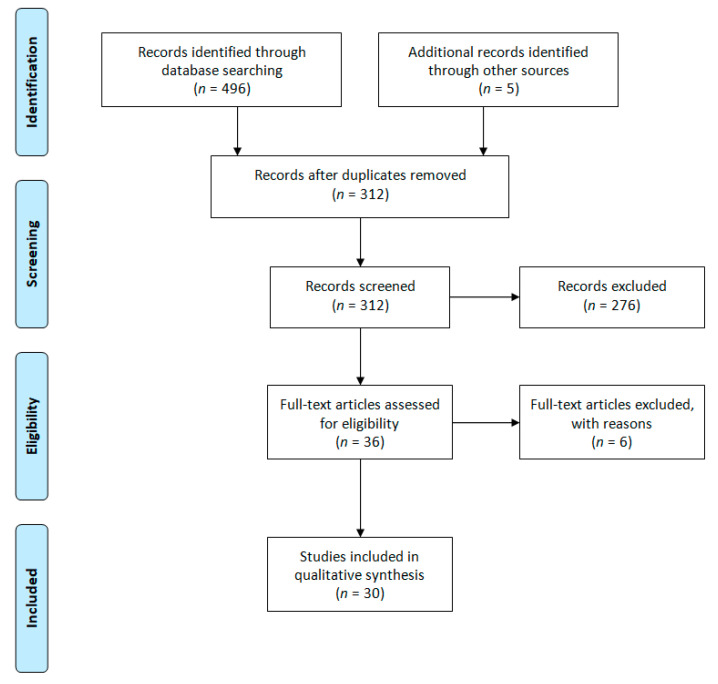
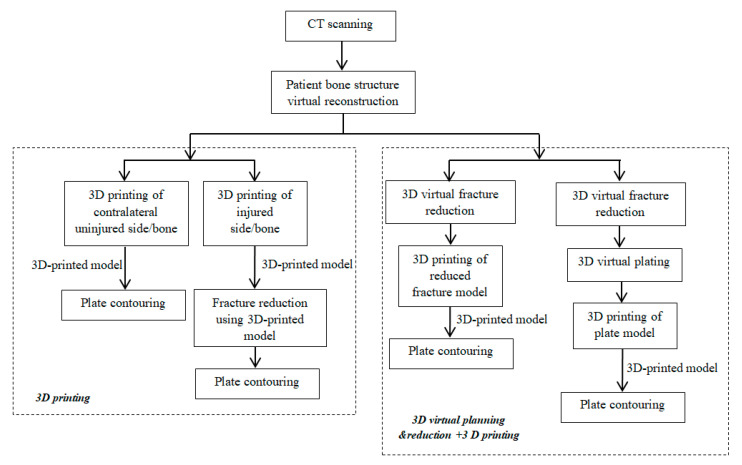
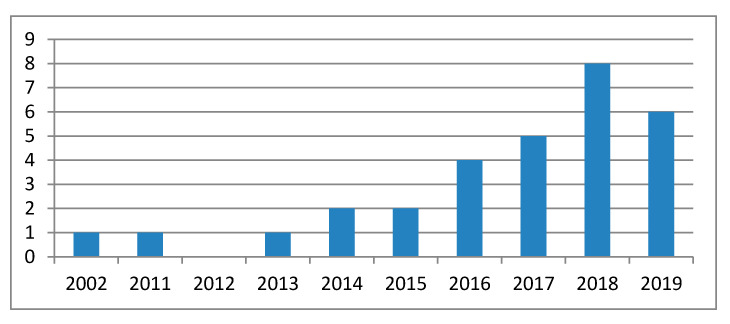
This paper is a systematic review of the literature on 3D-printed anatomical replicas used as templates for precontouring the fixation plates in orthopedic surgery. Embase, PubMed, Cochrane, Scopus and Springer databases were consulted for information on design study, fracture anatomical location, number of patients, surgical technique, virtual modeling approach and 3D printing process. The initial search provided a total of 496 records. After removing the duplicates, the title and abstract screening, and applying exclusion criteria and citations searching, 30 papers were declared eligible and included in the final synthesis. Seven studies were identified as focusing on retrospective non-randomized series of clinical cases, while two papers presented randomized case control studies. Two main approaches were highlighted in developing 3D-printed anatomical models for precontouring fixation plates: (a.) medical reconstruction, virtual planning and fracture reduction followed by 3D printing the model; (b.) medical reconstruction followed by 3D printing the model of the mirrored uninjured side. Revised studies reported advantages such as surgical time and blood loss reduction, while the reduction quality is similar with that of the conventional surgery. During the last couple of years there was an increase in the number of studies focused on precontouring orthopedic plates using 3D printing technology. Three-dimensionally-printed templates for plate precontouring were mostly used for acetabular fractures. Knowledge on medical virtual modeling and reconstruction is mandatory.
Keywords: 3D printing; fixation plate; fractures; orthopedic surgery; precontouring.
Conflict of interest statement
The authors declare no conflict of interest.
Figures
References
-
- Jin Y., Li X., Campbell I.R., Ji S. Visualizing the hotspots and emerging trends of 3D printing through scientometrics. Rapid Prototyp. J. 2018;24:801–812. doi: 10.1108/RPJ-05-2017-0100. - DOI
-
- Ramola M., Yadav V., Jain R. On the adoption of additive manufacturing in healthcare: A literature review. J. Manuf. Technol. Manag. 2019;30:48–69. doi: 10.1108/JMTM-03-2018-0094. - DOI
-
- Pereira T., Kennedy J.V., Potgieter J. A comparison of traditional manufacturing vs. additive manufacturing, the best method for the job. Procedia Manuf. 2019;30:11–18. doi: 10.1016/j.promfg.2019.02.003. - DOI
Publication types
LinkOut - more resources
Full Text Sources
