


Application of Noninvasive Vagal Nerve Stimulation to Stress-Related Psychiatric Disorders
- PMID: 32916852
- PMCID: PMC7563188
- DOI: 10.3390/jpm10030119
Application of Noninvasive Vagal Nerve Stimulation to Stress-Related Psychiatric Disorders
Abstract
Background: Vagal Nerve Stimulation (VNS) has been shown to be efficacious for the treatment of depression, but to date, VNS devices have required surgical implantation, which has limited widespread implementation.
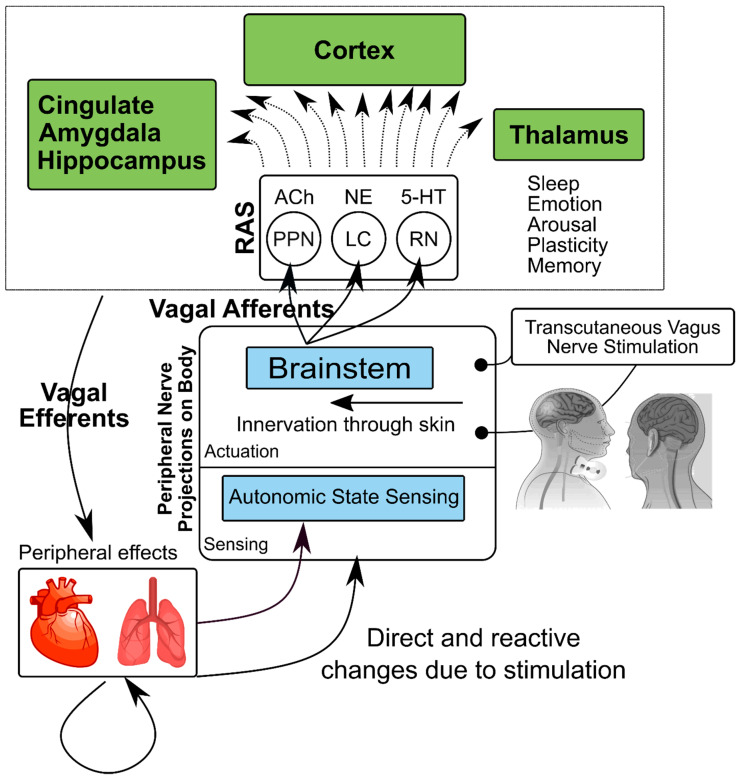
Methods: New noninvasive VNS (nVNS) devices have been developed which allow external stimulation of the vagus nerve, and their effects on physiology in patients with stress-related psychiatric disorders can be measured with brain imaging, blood biomarkers, and wearable sensing devices. Advantages in terms of cost and convenience may lead to more widespread implementation in psychiatry, as well as facilitate research of the physiology of the vagus nerve in humans. nVNS has effects on autonomic tone, cardiovascular function, inflammatory responses, and central brain areas involved in modulation of emotion, all of which make it particularly applicable to patients with stress-related psychiatric disorders, including posttraumatic stress disorder (PTSD) and depression, since dysregulation of these circuits and systems underlies the symptomatology of these disorders.
Results: This paper reviewed the physiology of the vagus nerve and its relevance to modulating the stress response in the context of application of nVNS to stress-related psychiatric disorders.
Conclusions: nVNS has a favorable effect on stress physiology that is measurable using brain imaging, blood biomarkers of inflammation, and wearable sensing devices, and shows promise in the prevention and treatment of stress-related psychiatric disorders.
Keywords: PTSD; VNS; depressive disorders; inflammation; interferon; interleukin-6; posttraumatic; stress; stress disorders; sympathetic; vagal nerve stimulation; vagus nerve.
Conflict of interest statement
J.D.B. has research funding support from ElectroCore LLC who also donated devices used in the research reviewed here.
Figures

Similar articles
-
Quantifying acute physiological biomarkers of transcutaneous cervical vagal nerve stimulation in the context of psychological stress.Brain Stimul. 2020 Jan-Feb;13(1):47-59. doi: 10.1016/j.brs.2019.08.002. Epub 2019 Aug 6. Brain Stimul. 2020. PMID: 31439323 Free PMC article. Clinical Trial.
-
Vagus nerve stimulation for primary headache disorders: An anatomical review to explain a clinical phenomenon.Cephalalgia. 2019 Aug;39(9):1180-1194. doi: 10.1177/0333102419833076. Epub 2019 Feb 20. Cephalalgia. 2019. PMID: 30786731 Free PMC article.
-
Vagus nerve stimulation and Neurotrophins: a biological psychiatric perspective.Neurosci Biobehav Rev. 2020 Jun;113:338-353. doi: 10.1016/j.neubiorev.2020.03.034. Epub 2020 Apr 9. Neurosci Biobehav Rev. 2020. PMID: 32278791 Review.
-
A pilot study of vagus nerve stimulation (VNS) for treatment-resistant anxiety disorders.Brain Stimul. 2008 Apr;1(2):112-21. doi: 10.1016/j.brs.2008.02.001. Epub 2008 Mar 28. Brain Stimul. 2008. PMID: 20633378
-
Non-invasive vagal nerve stimulation decreases brain activity during trauma scripts.Brain Stimul. 2020 Sep-Oct;13(5):1333-1348. doi: 10.1016/j.brs.2020.07.002. Epub 2020 Jul 10. Brain Stimul. 2020. PMID: 32659483 Free PMC article. Clinical Trial.
Cited by
-
Transcutaneous vagal nerve stimulation for the treatment of trauma- and stressor-related disorders: systematic review of randomised controlled studies.BJPsych Open. 2025 Aug 1;11(5):e165. doi: 10.1192/bjo.2025.10057. BJPsych Open. 2025. PMID: 40746136 Free PMC article. Review.
-
Efficacy of pranayama in preventing COVID-19 in exposed healthcare professionals: A quasi-randomized clinical trial.J Ayurveda Integr Med. 2023 Jan-Feb;14(1):100586. doi: 10.1016/j.jaim.2022.100586. Epub 2022 May 6. J Ayurveda Integr Med. 2023. PMID: 35541985 Free PMC article.
-
Non-invasive cervical vagus nerve stimulation effects on reaction time and valence image anticipation response.Brain Stimul. 2022 Jul-Aug;15(4):946-956. doi: 10.1016/j.brs.2022.06.006. Epub 2022 Jun 20. Brain Stimul. 2022. PMID: 35738468 Free PMC article.
-
The Future Is Noninvasive: A Brief Review of the Evolution and Clinical Utility of Vagus Nerve Stimulation.Focus (Am Psychiatr Publ). 2022 Jan;20(1):3-7. doi: 10.1176/appi.focus.20210023. Epub 2022 Jan 25. Focus (Am Psychiatr Publ). 2022. PMID: 35746934 Free PMC article. Review.
-
High-resolution computational modeling of the current flow in the outer ear during transcutaneous auricular Vagus Nerve Stimulation (taVNS).Brain Stimul. 2021 Nov-Dec;14(6):1419-1430. doi: 10.1016/j.brs.2021.09.001. Epub 2021 Sep 10. Brain Stimul. 2021. PMID: 34517143 Free PMC article.
References
-
- Anda R.F., Felitti V.J., Walker J., Whitfield C., Bremner J.D., Perry B.D., Dube S.R., Giles W.H. The enduring effects of childhood abuse and related experiences in childhood: A convergence of evidence from neurobiology and epidemiology. Eur. Arch. Psychiatry Clin. Neurosci. 2006;256:174–186. doi: 10.1007/s00406-005-0624-4. - DOI - PMC - PubMed
-
- Weathers F.W., Bovin M.J., Lee D.J., Sloan D.M., Schnurr P.P., Kaloupek D.G., Keane T.M., Marx B.P. The Clinician-Administered PTSD Scale for DSM-5 (CAPS-5): Development and initial psychometric evaluation in military veterans. Psychol. Assess. 2018;30:383–395. doi: 10.1037/pas0000486. - DOI - PMC - PubMed
-
- Kessler R.C., McGonagle K.A., Zhao S., Nelson C.B., Hughes M., Eschleman S., Wittchen H.-U., Kendler K. Lifetime and 12-month prevalence of DSM-III-R psychiatric disorders in the United States: Results from the National Comorbidity Study. Arch. Gen. Psychiatry. 1994;51:8–19. doi: 10.1001/archpsyc.1994.03950010008002. - DOI - PubMed
Publication types
Grants and funding
LinkOut - more resources
Full Text Sources
Medical
