


Towards Win-Win Policies for Healthy and Sustainable Diets in Switzerland
- PMID: 32916882
- PMCID: PMC7551606
- DOI: 10.3390/nu12092745
Towards Win-Win Policies for Healthy and Sustainable Diets in Switzerland
Abstract
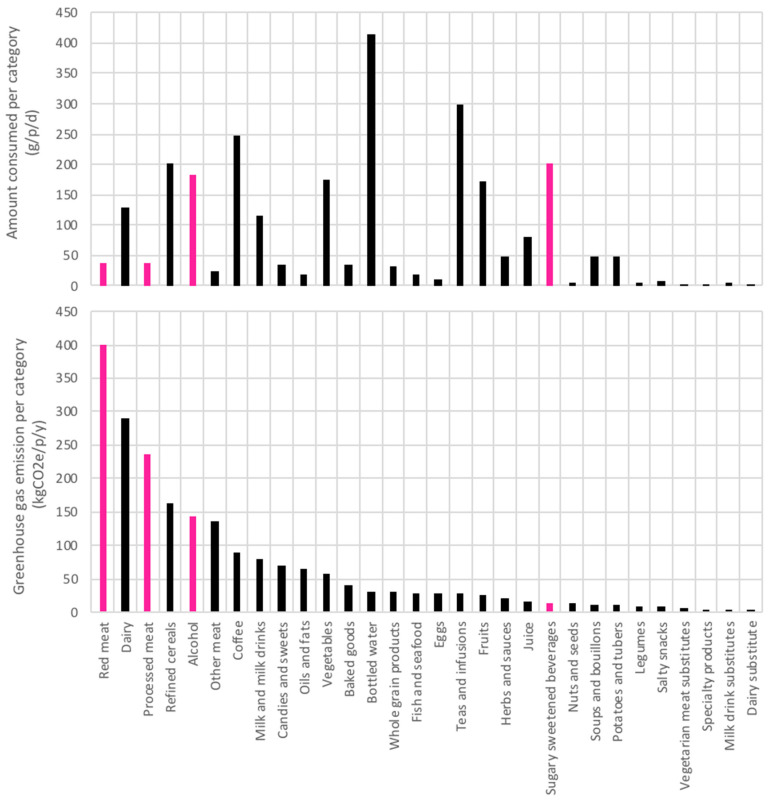
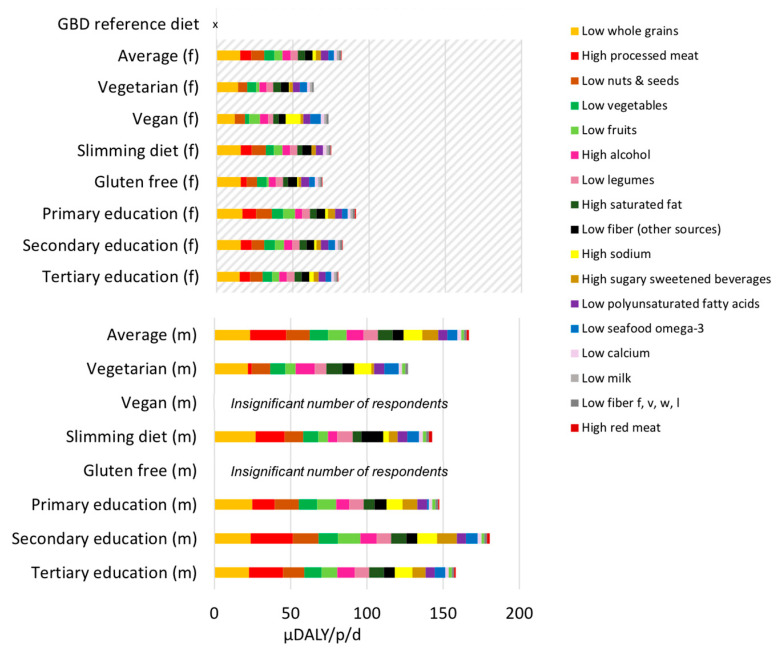
The first Swiss national dietary survey (MenuCH) was used to screen disease burdens and greenhouse gas emissions (GHG) of Swiss diets (vegan, vegetarian, gluten-free, slimming), with a focus on gender and education level. The Health Nutritional Index (HENI), a novel disease burden-based nutritional index built on the Global Burden of Disease studies, was used to indicate healthiness using comparable, relative disease burden scores. Low whole grain consumption and high processed meat consumption are priority risk factors. Non-processed red meat and dairy make a nearly negligible contribution to disease burden scores, yet are key drivers of diet-related GHGs. Swiss diets, including vegetarian, ranged between 1.1-2.6 tons of CO2e/person/year, above the Swiss federal recommendation 0.6 ton CO2e/person/year for all consumption categories. This suggests that only changing food consumption practices will not suffice towards achieving carbon reduction targets: Systemic changes to food provisioning processes are also necessary. Finally, men with higher education had the highest dietary GHG emissions per gram of food, and the highest disease burden scores. Win-win policies to improve health and sustainability of Swiss diets would increase whole grain consumption for all, and decrease alcohol and processed meat consumption especially for men of higher education levels.
Keywords: climate; diet survey; disease burden; gender; sustainability; vegan; vegetarian.
Conflict of interest statement
While there is no direct conflict of interest and this research was carried out independently of any influence, Quantis international and University of Michigan have developed databases and performed other analyses in interaction with multiple public and private actors of the food sector.
Figures



References
-
- Springmann M., Wiebe K., Mason-D’Croz D., Sulser T.B., Rayner M., Scarborough P. Health and nutritional aspects of sustainable diet strategies and their association with environmental impacts: A global modelling analysis with country-level detail. Lancet Planet. Health. 2018;2:e451–e461. doi: 10.1016/S2542-5196(18)30206-7. - DOI - PMC - PubMed
-
- Willett W., Rockström J., Loken B., Springmann M., Lang T., Vermeulen S., Garnett T., Tilman D., Declerck F., Wood A., et al. Food in the Anthropocene: The EAT–Lancet Commission on healthy diets from sustainable food systems. Lancet. 2019;393:447–492. doi: 10.1016/S0140-6736(18)31788-4. - DOI - PubMed
-
- Moodie R., Stuckler D., Monteiro C., Sheron N., Neal B., Thamarangsi T., Lincoln P., Casswell S., Moodie R. Profits and pandemics: Prevention of harmful effects of tobacco, alcohol, and ultra-processed food and drink industries. Lancet. 2013;381:670–679. doi: 10.1016/S0140-6736(12)62089-3. - DOI - PubMed
MeSH terms
Substances
Grants and funding
LinkOut - more resources
Full Text Sources
Miscellaneous
