Comparative Study
. 2020 Nov;184(3):1407-1423.
doi: 10.1104/pp.20.00816. Epub 2020 Sep 11.

Premeiotic, 24-Nucleotide Reproductive PhasiRNAs Are Abundant in Anthers of Wheat and Barley But Not Rice and Maize

Affiliations
Comparative Study

Premeiotic, 24-Nucleotide Reproductive PhasiRNAs Are Abundant in Anthers of Wheat and Barley But Not Rice and Maize

Sébastien Bélanger et al. Plant Physiol. 2020 Nov.

Abstract

Two classes of premeiotic (21-nucleotides [nt]) and meiotic (24-nt) phased small interfering RNAs (phasiRNAs) and their patterns of accumulation have been described in maize (Zea mays) and rice (Oryza sativa) anthers. Their precise function remains unclear, but studies have shown that they support male fertility. The important role of phasiRNAs in anthers underpins our present study to characterize these small RNAs in wheat (Triticum aestivum) and barley (Hordeum vulgare) anthers. We staged anthers at every 0.2 mm of development for one wheat and two barley varieties. We isolated premeiotic (0.2, 0.4, and 0.6 mm), meiotic (0.8, 1.0, and 1.4 mm), and postmeiotic (1.8 mm) anthers, for which we then investigated accumulation patterns of RNAs, including reproductive phasiRNAs. We annotated a total of 12,821 and 2,897 PHAS loci in the wheat and barley genomes, respectively. By comparing the total number of PHAS loci in genomes of maize, rice, barley, and wheat, we identified an expansion of reproductive PHAS loci in the genomes of Poaceae subfamilies from Panicoideae to Oryzoideae and to Poideae. In addition to the two classes of premeiotic (21-nt) and meiotic (24-nt) phasiRNAs, previously described in maize and rice anthers, we characterized a group of 24-nt phasiRNAs that accumulate in premeiotic anthers. The absence of premeiotic 24-nt phasiRNAs in maize and rice suggests a divergence in grass species of the Poideae subfamily. Additionally, we performed a gene coexpression analysis describing the regulation of phasiRNA biogenesis in wheat and barley anthers. We highlight Argonaute 9 (AGO9) and Argonaute 6 (AGO6) as candidate binding partners of premeiotic and meiotic 24-nt phasiRNAs, respectively.


Figures

Figure 1.
Figure 1.
Transverse sections of wheat and barley anthers ranging in size from 0.2 mm anther to the stage of pollen maturation. A, Cross-sections of anthers were performed in the middle of anthers (red arrows at left), and one lobe of the anther was captured for images, at right; the anther length was determined as indicated at left. B, Anthers were obtained from the wheat ‘Fielder’ and barley ‘Golden Promise’ and ‘Morex’. Anthers were fixed with a 2% paraformaldehyde:glutaraldehyde solution and embedded using the Monostep HM20 polar resin, sectioned to 1.0 µm and stained using 1.0% toluidine blue O. Scale bars = 20 µm.
Figure 2.
Figure 2.
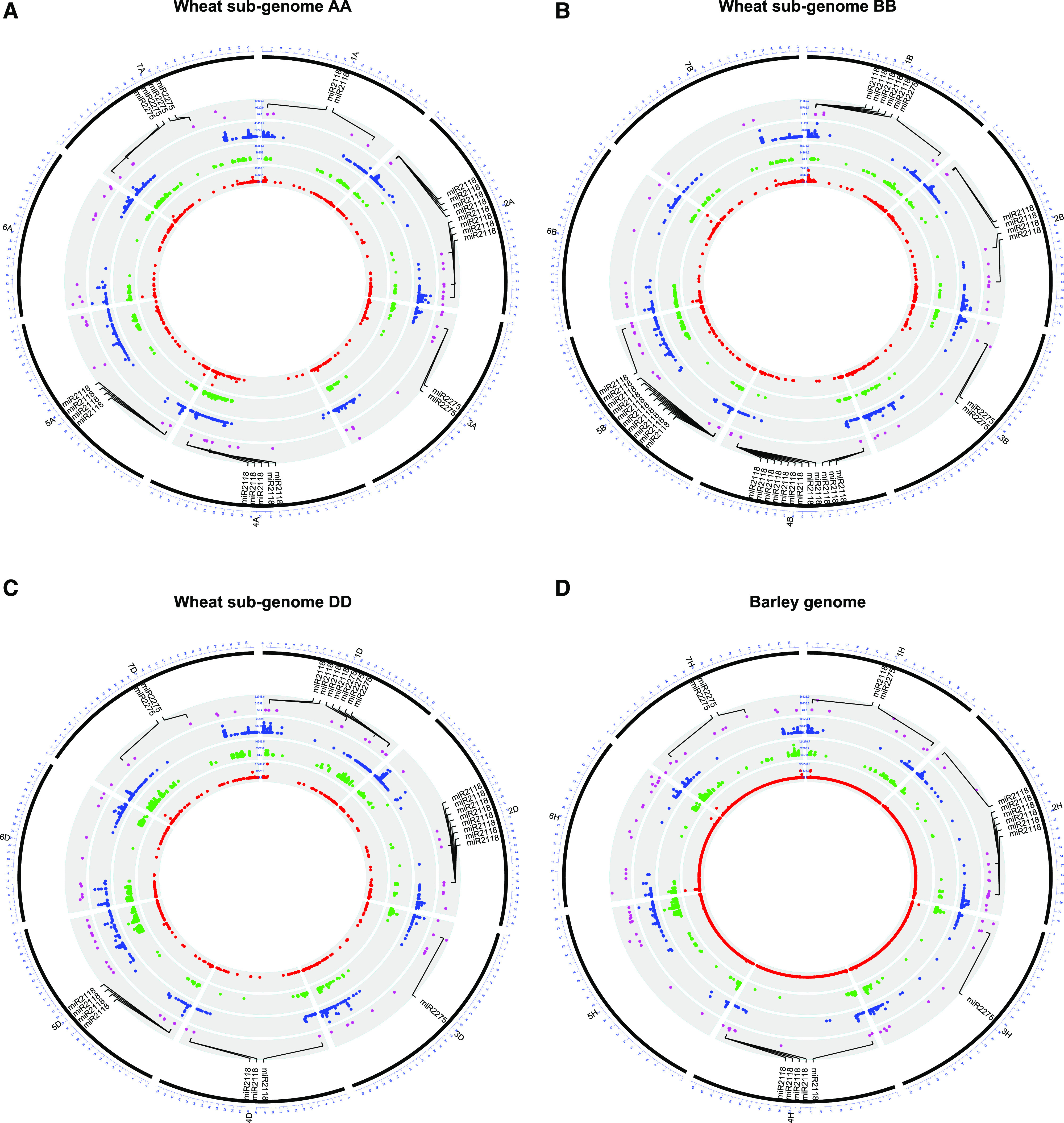
Circular plot showing the distribution and abundance of heterochromatic siRNAs (red), 21-nt (green), and 24-nt (blue) phasiRNAs as well as miRNAs (purple) annotated in wheat subgenomes A (A), B (B), and D (C) and in barley (D) genomes. The genomic distribution of miRNA triggers for 21-PHAS (miR2118) and 24-PHAS (miR2275) transcript cleavage are labeled. Normalized in reads per million mapped, the total abundance includes all sequencing libraries (21 total) covering seven stages of development in three replicates each.
Figure 3.
Figure 3.
Phylogenic tree showing annotated wheat and barley orthologous genes to AGO proteins. Clades of AGO proteins are indicated. Yellow boxes highlight two groups of AGO proteins expanded in wheat and barley. Protein orthologous groups were identified using OrthoFinder and SonicParanoid. Protein alignments and phylogeny analysis were done using MUSCLE and IQ-TREE.
Figure 4.
Figure 4.
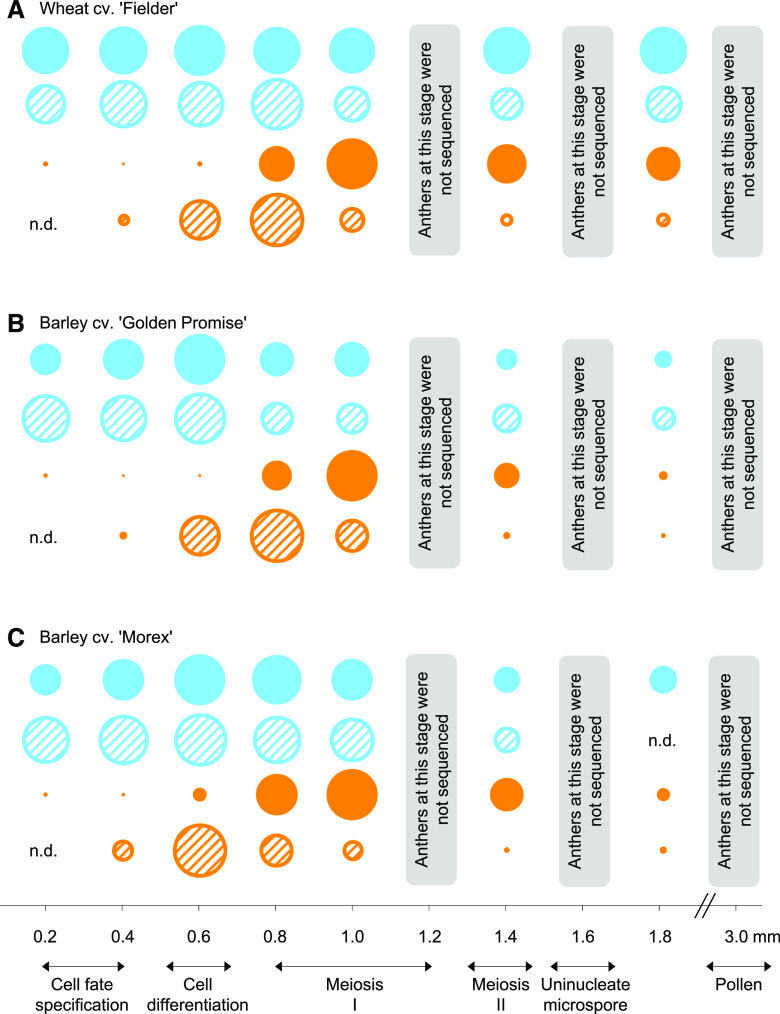
The relative accumulation of reproductive phasiRNAs and their miRNA triggers. The triggers of 21- (blue circle) and 24-nt (orange circle) phasiRNAs are, respectively, miR2118 (blue-hatched circle) and miR2275 (orange-hatched circle). These were characterized during the development of anthers in wheat ‘Fielder’ (A) and barley ‘Golden Promise’ (B) and ‘Morex’ (C). n.d., Not detected.
Figure 5.
Figure 5.
Premeiotic 24-nt reproductive phasiRNAs found in wheat ‘Fielder’. We show the accumulation pattern of 24-nt phasiRNAs illustrated by the heatmap in which the scale bar indicates the relative abundance change comparing one column and another as a relative change (A), or as a box plot for an absolute measurement (B). C, two conserved motifs found in putative PHAS transcripts for premeiotic (lower; new motif) and meiotic (upper; miR2275 motif) phasiRNAs. D, Alignment of candidate sRNA triggers for premeiotic 24-PHAS loci. The degree of conservation is denoted by the shading of blue color and consensus sequence is shown with sequence logos. E, Sequence logo denoting conservation of target site (upper). Nucleotide sequence alignment for 100 premeiotic 24-PHAS loci showing the conservation of the candidate miRNA triggers target sites (lower). F, Two tracks showing the abundance (RP10M) of small RNAs in both strands of a representative premeiotic 24-PHAS loci (upper). sRNA sizes are indicated by different color as shown. Two tracks showing the phasing score of each read for both strands in this locus (lower). The red arrow indicates the candidate cleavage site from which the first phasiRNA is generated.
Figure 6.
Figure 6.
Coexpressed genes in anthers of wheat ‘Fielder’ (A) and barley ‘Golden Promise’ (B) and ‘Morex’ (C). For each, we present a heatmap showing relative abundance of gene expression modules and DCL, DRB, and AGO genes annotated in those modules. Coexpression analysis were performed using the R package WGCNA.

References

    1. Axtell MJ, Meyers BC(2018) Revisiting criteria for plant miRNA annotation in the era of big data. Plant Cell 30: 272–284 - PMC - PubMed
    1. Bailey TL, Boden M, Buske FA, Frith M, Grant CE, Clementi L, Ren J, Li WW, Noble WS(2009) MEME SUITE: tools for motif discovery and searching. Nucleic Acids Res 37: W202-8 - PMC - PubMed
    1. Bailey TL, Johnson J, Grant CE, Noble WS(2015) The MEME suite. Nucleic Acids Res 43(W1): W39-49 - PMC - PubMed
    1. Borges F, Martienssen RA(2015) The expanding world of small RNAs in plants. Nat Rev Mol Cell Biol 16: 727–741 - PMC - PubMed
    1. Browne RG, Iacuone S, Li SF, Dolferus R, Parish RW(2018) Anther morphological development and stage determination in Triticum aestivum. Front Plant Sci 9: 228. - PMC - PubMed

Publication types