Mid-Term Results of Totally Thoracoscopic Ablation in Patients with Recurrent Atrial Fibrillation after Catheter Ablation
- PMID: 32919447
- PMCID: PMC7553833
- DOI: 10.5090/kjtcs.19.059
Mid-Term Results of Totally Thoracoscopic Ablation in Patients with Recurrent Atrial Fibrillation after Catheter Ablation
Abstract
Background: We investigated the impact of previous catheter ablation (CA) on the midterm outcomes of totally thoracoscopic ablation in patients with lone atrial fibrillation (AF).
Methods: Between February 2012 and July 2018, 332 patients underwent totally thoracoscopic ablation for the treatment of AF (persistent AF; n=264, 80%). The patients were stratified into CA (n=47, 14%) and non-CA (nCA; n=285, 86%) groups according to their CA history.
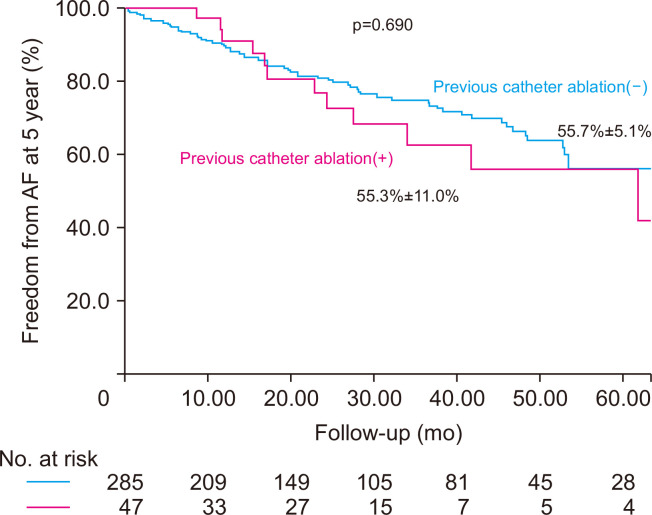
Results: All the baseline clinical characteristics and risk factors were similar between the groups except for age, percentage of male patients, prevalence of paroxysmal AF, prior percutaneous coronary intervention, and left atrial volume index (LAVI). No significant intergroup differences were observed in the incidence of early and late complications. At late follow-up, normal sinus rhythm was observed in 92% (43 of 47) of the patients in the CA group and 85% (242 of 285) of the patients in the nCA group (p=0.268). The rate of freedom from AF recurrence at 5 years was 55.3%±11.0% in the CA group, which was similar to that in the nCA group (55.7%±5.1%, p=0.690). In Cox regression analysis, preoperative brain natriuretic peptide levels and LAVI were associated with AF recurrence, but CA history was not significant.
Conclusion: Totally thoracoscopic ablation was safe and effective in treating AF irrespective of CA history. A history of CA did not appear to affect the procedural complexity.
Keywords: Atrial fibrillation; Radiofrequency catheter ablation; Totally thoracoscopic ablation.
Conflict of interest statement
No potential conflict of interest relevant to this article was reported.
Figures

References
LinkOut - more resources
Full Text Sources