


Post-publication promotion in rheumatology: a survey focusing on social media
- PMID: 32920728
- PMCID: PMC7487072
- DOI: 10.1007/s00296-020-04700-7
Post-publication promotion in rheumatology: a survey focusing on social media
Abstract
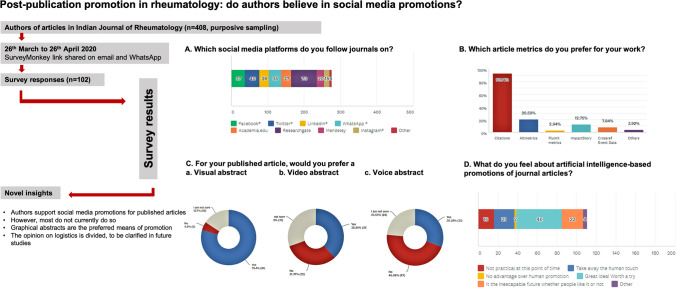
The use of social media platforms (SMPs) in the field of scientific literature is a new and evolving realm. The past few years have seen many novel strategies to promote engagement of readers with articles. The aim of this study was to gauge the acceptance, opinion, and willingness to partake in the creation of online social media educative material among authors. We conducted a validated and anonymized cross-sectional e-survey with purposive sampling among authors of the Indian Journal of Rheumatology journal over a cloud-based platform (SurveyMonkey). Descriptive statistics are used and values expressed as the number of respondents (n) against each answer. Of 408 authors, 102 responded. We found that a large majority (74) supported promotions on SMPs. Visual abstracts (81) were the most preferred means for promotion. A reasonable proportion (54) of the authors held the view that they could make these materials for themselves, with little guidance. However, currently only a few (47) were doing so. Awareness on social media editors in rheumatology was dismal (4). Citations were the preferred metric of article visibility (95), followed by altmetrics (21). These findings suggest that authors support article promotions on SMPs, although most do not promote their articles. Graphical abstracts are the preferred means of promotions. Further, the opinion on logistics is divided, calling for larger studies to understand the factors that need to be addressed to bridge the gap.
Keywords: Artificial intelligence; Information dissemination; Publications; Rheumatology; Scholarly communication; Social media.
Conflict of interest statement
LG is the social media editor (SME) of the Journal of Clinical Rheumatology and the Indian Journal of Rheumatology. VA is the editor in chief of the Indian Journal of Rheumatology. The authors declare that there is no conflict of interest relevant to the manuscript.
Figures
References
MeSH terms
LinkOut - more resources
Full Text Sources
Miscellaneous
