


What is the "weight" of body mass index on sexual functioning in women? A mediation model
- PMID: 32920775
- PMCID: PMC8292239
- DOI: 10.1007/s40519-020-00995-4
What is the "weight" of body mass index on sexual functioning in women? A mediation model
Abstract
Purpose: It is well known that body mass index (BMI) affects how individuals perceive their well-being and that obese individuals tend to report poorer levels of subjective health status. The aim of this study was to compare subjects with and without FSD and to examine the direct and indirect impact of BMI on female sexual dysfunction (FSD) in overweight/obese and normal-weight women.
Methods: A cross-sectional study was conducted on 186 overweight/obese and 233 normal-weight women. FSD assessed with the Female Sexual Function Index (FSFI) was investigated in relation to body satisfaction assessed with the Body Uneasiness Test (BUT-A) and self-esteem assessed with the Rosenberg Self-Esteem scale (RSE).
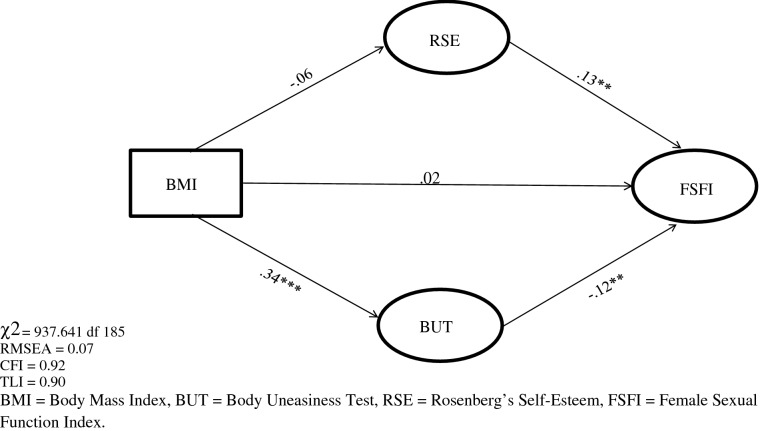
Results: No difference in the prevalence of FSD was found between overweight/obese (44.4%) and normal-weight women (55.6%), even though significant between-group differences in body image were found. Structural Equation Modelling (SEM) showed that BMI contribute to FSD only through the mediating role of body dissatisfaction and self-esteem.
Conclusions: The present results support the notion that sexual functioning is not related directly to BMI in women but to a more complex interactions of body weight, satisfaction with one's own body image, and levels of self-esteem. Clinicians should take into account that for women having a good sexual life seems not related to body weight but to the way their body weight is perceived within the context of self-image.
Level of evidence: Level III, case-control analytic study.
Keywords: BMI; Body Image; Female sexual functioning; Obesity; Self-esteem.
© 2020. The Author(s).
Conflict of interest statement
The authors declare that the research was conducted in the absence of any competing interests (financial and non-financial) that could be construed as a potential conflict of interest.
Figures
References
-
- Ponholzer A, Roehlich M, Racz U, Temml C, Madersbacher S. Female sexual dysfunction in a healthy Austrian cohort: prevalence and risk factors. Eur Urol. 2005;47(3):366–375. - PubMed
-
- Basson R, Berman J, Burnett A, Derogatis L, Ferguson D, Fourcroy J, Leiblum S. Report of the international consensus development conference on female sexual dysfunction: definitions and classifications. J Urol. 2000;163(3):888–893. - PubMed
-
- Brotto L, Atallah S, Johnson-Agbakwu C, Rosenbaum T, Abdo C, Byers ES, Wylie K. Psychological and interpersonal dimensions of sexual function and dysfunction. J Sex Med. 2016;13(4):538–571. - PubMed
-
- Crisp C, Vaccaro C, Fellner A, Kleeman S, Pauls R. The influence of personality and coping on female sexual function: A population survey. J Sex Med. 2015;12(1):109–115. - PubMed
MeSH terms
LinkOut - more resources
Full Text Sources
Research Materials
