


Conspicuity of prostate cancer on multiparametric magnetic resonance imaging: A cross-disciplinary translational hypothesis
- PMID: 32920937
- PMCID: PMC8436756
- DOI: 10.1096/fj.202001466R
Conspicuity of prostate cancer on multiparametric magnetic resonance imaging: A cross-disciplinary translational hypothesis
Abstract
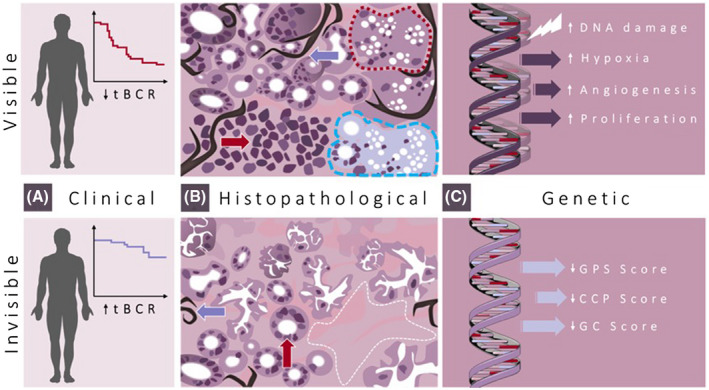
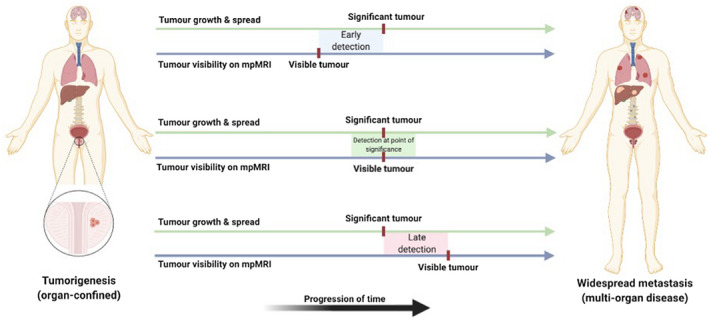
Pre-biopsy multiparametric magnetic resonance imaging (mpMRI) has transformed the risk stratification and diagnostic approach for suspected prostate cancer. The majority of clinically significant prostate cancers are visible on pre-biopsy mpMRI, however, there are a subset of significant tumors that are not detected by mpMRI. The radiobiological mechanisms underpinning mpMRI-visibility and invisibility of these cancers remain uncertain. Emerging evidence suggests that mpMRI-visible tumors are enriched with molecular features associated with increased disease aggressivity and poor clinical prognosis, which is supported by short-term endpoints, such as biochemical recurrence following surgery. Furthermore, at the histopathological level, mpMRI-visible tumors appear to exhibit increased architectural and vascular density compared to mpMRI-invisible disease. It seems probable that the genomic, pathological, radiological, and clinical features of mpMRI-visible and mpMRI-invisible prostate cancers are interrelated. Here, we propose a novel cross-disciplinary theory that links genomic and molecular evidence with cellular and histopathological appearances, elucidating both the mpMRI visibility and clinical status of significant prostate cancer.
Keywords: conspicuity theory; multiparametric MRI; prostate cancer.
© 2020 The Authors. The FASEB Journal published by Wiley Periodicals LLC on behalf of Federation of American Societies for Experimental Biology.
Conflict of interest statement
Norris receives funding from the MRC. Simpson receives funding from the Rosetrees Trust. Whitaker receives funding from Prostate Cancer UK, the Urology Foundation and the Rosetrees Trust. Emberton, Freeman, and Kirkham have stock interest in Nuada Medical Ltd. Emberton receives funding from NIHR‐i4i, MRC, Sonacare Inc, Trod Medical, Cancer Vaccine Institute and Sophiris Biocorp for trials in prostate cancer. Emberton is a medical consultant to Sonacare Inc, Sophiris Biocorp, Steba Biotech, GSK, Exact Imaging and Profound Medical. Travel allowance was previously provided from Sanofi Aventis, Astellas, GSK, and Sonacare. Emberton is a proctor for HIFU with Sonacare Inc and is paid for training other surgeons in this procedure.
Figures
References
-
- Ahmed HU, El‐Shater Bosaily A, Brown LC, et al. Diagnostic accuracy of multi‐parametric MRI and TRUS biopsy in prostate cancer (PROMIS): a paired validating confirmatory study. Lancet. 2017;389:815‐822. - PubMed
-
- Wise J. NICE recommends MRI for suspected prostate cancer to reduce biopsies. BMJ. 2018;363:k5290. - PubMed
-
- Radtke JP, Kuru TH, Boxler S, et al. Comparative analysis of transperineal template saturation prostate biopsy versus magnetic resonance imaging targeted biopsy with magnetic resonance imaging‐ultrasound fusion guidance. J Urol. 2015;193:87‐94. - PubMed
Publication types
MeSH terms
Grants and funding
LinkOut - more resources
Full Text Sources
Medical
