


Hypervirulent Klebsiella pneumoniae is emerging as an increasingly prevalent K. pneumoniae pathotype responsible for nosocomial and healthcare-associated infections in Beijing, China
- PMID: 32921250
- PMCID: PMC7549996
- DOI: 10.1080/21505594.2020.1809322
Hypervirulent Klebsiella pneumoniae is emerging as an increasingly prevalent K. pneumoniae pathotype responsible for nosocomial and healthcare-associated infections in Beijing, China
Abstract
Objectives: Hypervirulent Klebsiella pneumoniae(hvKp) is an increasingly important pathogen. Tracking its epidemiology and evolving antimicrobial resistance will facilitate care.
Methods: A retrospective study was conducted in two hospitals. We collected the clinical data. Antimicrobial and virulence-associated phenotype and genotype, sequence type, and whole genome sequencing of selected strains were performed. HvKp was defined by the presence of some combination of prmpA, prmpA2, iucA, iroB, and peg-344, genes shown to accurately identify hvKp.
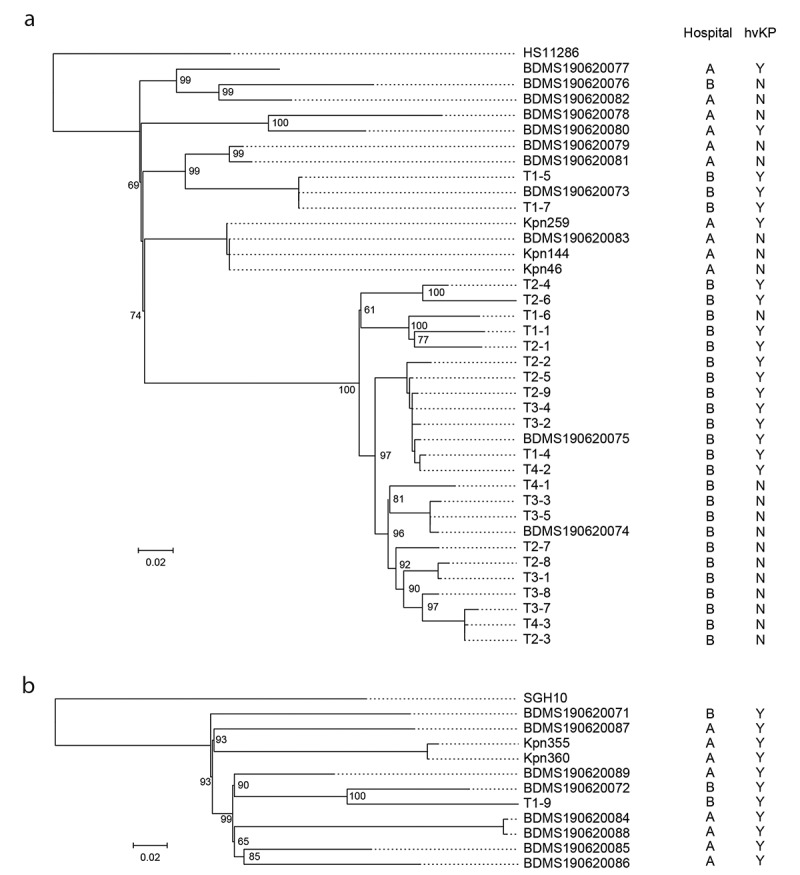
Results: Of 158 Kp clinical isolates, 79 (50%) were hvKp. Interestingly, 53/79 (67.1%) of hvKp strains were isolated from patients with nosocomial infection and 19/79 (24.1%) from patients with healthcare-associated infection, but only 7/79 (8.8%) from patients with community-acquired infections. Importantly, 27/53 (50.9%) and 4/19 (21.1%) of hvKp nosocomial and healthcare-associated isolates, respectively, were multi-drug-resistant (MDR); 25/53 (47.2%) and 5/19 (26.3%) expressed ESBLs and 14/53 (26.4%) and 2/19 (10.5%) were carbapenem-resistant. Of the hvKp isolates from community-acquired infection, 0/7 (0%) were MDR and 0/7 (0%) were carbapenem-resistant. Additionally, unique characteristics of nosocomial, healthcare-associated, and community-acquired hvKp infection were identified. In summary, 50% of K. pneumoniae infections were caused by hvKp. A concerning, novel finding from this report is a major shift in hvKp epidemiology. Ninety-one percent of hvKp infections were nosocomial or healthcare-associated, and 43.1% of these isolates were MDR.
Conclusions: These data suggest that hvKp may be replacing classical K. pneumoniae as the dominant nosocomial and healthcare-associated pathotype. Ongoing surveillance is needed to determine if this trend is occurring elsewhere.
Keywords: Hypervirulent Klebsiella pneumoniae; carbapenemase; clinical characteristics; epidemiology; multi drug resistance; nosocomial infection; risk factor.
Conflict of interest statement
No potential conflict of interest was reported by the authors.
Figures
References
Publication types
MeSH terms
Substances
Grants and funding
LinkOut - more resources
Full Text Sources
Other Literature Sources
