


How Information on a Motive to Lie Influences CBCA-Based Ratings and Veracity Judgments
- PMID: 32922341
- PMCID: PMC7457127
- DOI: 10.3389/fpsyg.2020.02021
How Information on a Motive to Lie Influences CBCA-Based Ratings and Veracity Judgments
Abstract
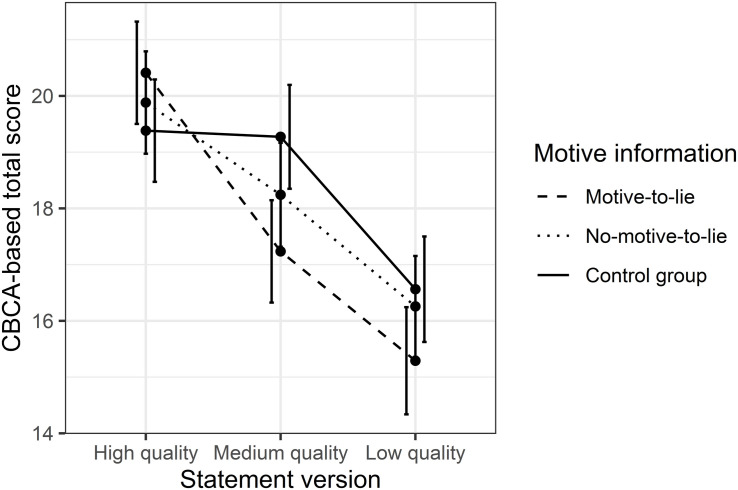
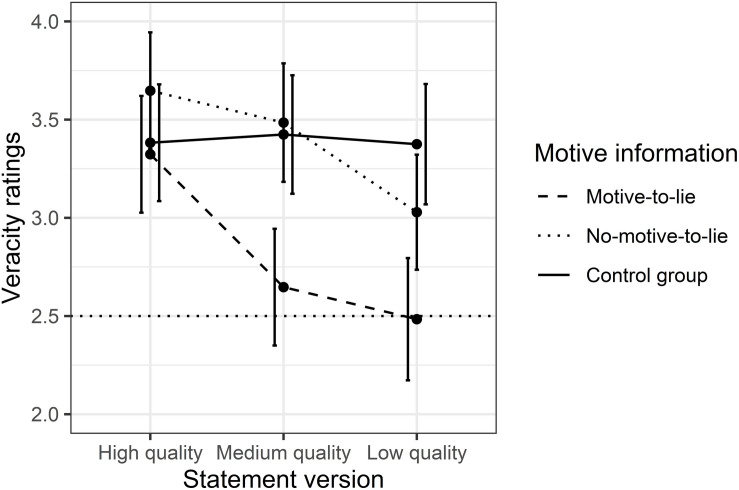
We investigated how information on a motive to lie impacts on the perceived content quality of a statement and its subsequent veracity rating. In an online study, 300 participants rated a statement about an alleged sexual harassment on a scale based on Criteria-based Content Analysis (CBCA) and judged its veracity. In a 3 × 3 between-subjects design, we varied prior information (motive to lie, no motive to lie, and no information on a motive), and presented three different statement versions of varying content quality (high, medium, and low). In addition to anticipating main effects of both independent variables (motive information and statement version), we predicted that the impact of motive information on both ratings would be highest for medium quality statements, because their assessment is especially ambiguous (interaction effect). Contrary to our hypotheses, results showed that participants were unaffected by motive information and accurately reproduced the manipulated quality differences between statement versions in their CBCA-based judgments. In line with the expected interaction effect, veracity ratings decreased in the motive-to-lie group compared to controls, but only when the medium- and the low-quality statements were rated (truth ratings dropped from approximately 80 to 50%). Veracity ratings in both the no-motive-to-lie group and controls did not differ across statement versions (≥82% truth ratings). In sum, information on a motive to lie thus encouraged participants to consider content quality in their veracity judgments by being critical only of statements of medium and low quality. Otherwise, participants judged statements to be true irrespective of content quality.
Keywords: Criteria-based Content Analysis; contextual information; credibility assessment; motive to lie; truth bias; truth-default theory.
Copyright © 2020 Schemmel, Steinhagen, Ziegler and Volbert.
Figures
References
-
- Akehurst L., Manton S., Quandte S. (2011). Careful calculation or a leap of faith? A field study of the translation of CBCA ratings to final credibility judgements. Appl. Cogn. Psychol. 25 236–243. 10.1002/acp.1669 - DOI
-
- Amado B. G., Arce R., Farina F. (2015). Undeutsch hypothesis and criteria based content analysis: a meta-analytic review. Eur. J. Psychol. Appl. Legal Context 7 3–12. 10.1016/j.ejpal.2014.11.002 - DOI
LinkOut - more resources
Full Text Sources
