. 2019 Jun 19:5:16.
doi: 10.1186/s41016-019-0163-x. eCollection 2019.

Clipping versus coiling in posterior circulation intracranial aneurysms: a meta-analysis

Affiliations

Clipping versus coiling in posterior circulation intracranial aneurysms: a meta-analysis

Eleni Tsianaka et al. Chin Neurosurg J. .

Abstract

Background: Posterior circulation intracranial aneurysm (IA) treatment remains challenging, due to the anatomy of the area and the high rupture possibility. Endovascular treatment seems to be more suitable for these aneurysms, but studies focused on endovascular treatment demonstrate a high rate of re-intervention needing. A meta-analysis might offer a clearer view, being useful in a more effective treatment planning.

Methods: A systematic search was performed, using the PubMed database platform. The final article pool contained 20 articles. Studied parameters were operative mortality, late mortality, permanent neurologic deficit (PND), and the need for re-intervention (Re-int). We divided patients into two subgroups, those with ruptured and those with unruptured aneurysm. Statistical analysis was performed using appropriate software.

Results: In the total population (645 patients), there was a superiority of coiling over clipping in terms of PND and of coiling in terms of Re-int. As regards mortality, there was no clear superiority of one method over the other.

Conclusions: The current study came to the conclusion that there is a superiority of coiling over clipping in terms of PND. On the other hand, clipping seems to be superior to coiling in terms of the need for re-intervention. As regards mortality (both operative and late), there is no clear superiority of one method over the other. Studying subgroups of patients (ruptured and unruptured posterior circulation IAs), in terms of PND, there is no superiority of one method over the other. The same goes for Op-Mo on ruptured aneurysms.

Keywords: Clipping; Coiling; Intracranial aneurysms; Meta-analysis; Posterior circulation.


Conflict of interest statement

Competing interestsThe authors declare that they have no competing interests.

Figures
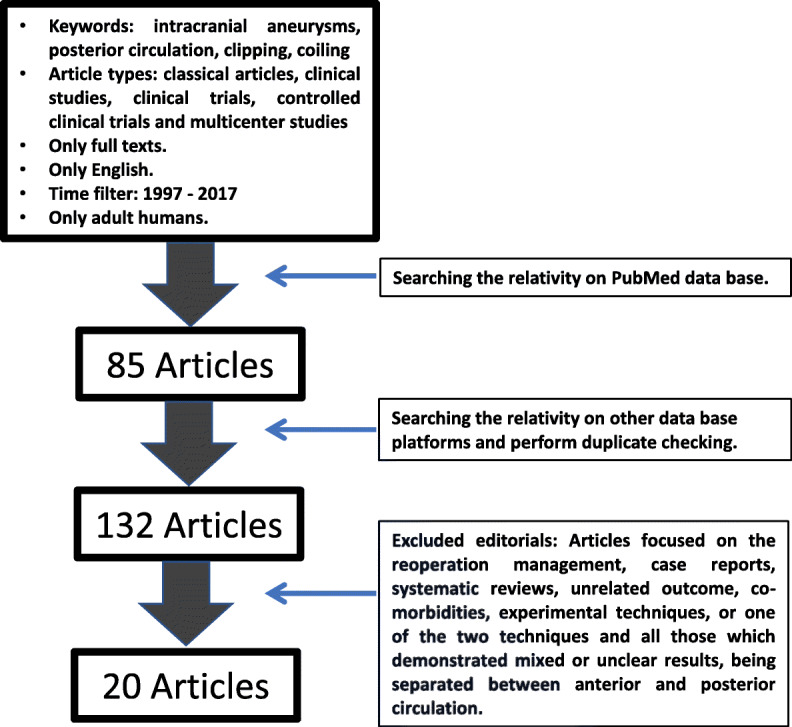
Fig. 1
Fig. 1
Article selection algorithm
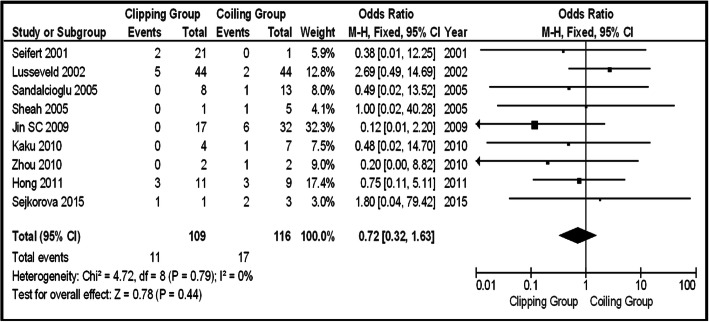
Fig. 2
Fig. 2
OR forest plot, showing Op-Mo in clipping versus coiling, on posterior circulation IAs (unruptured and ruptured)
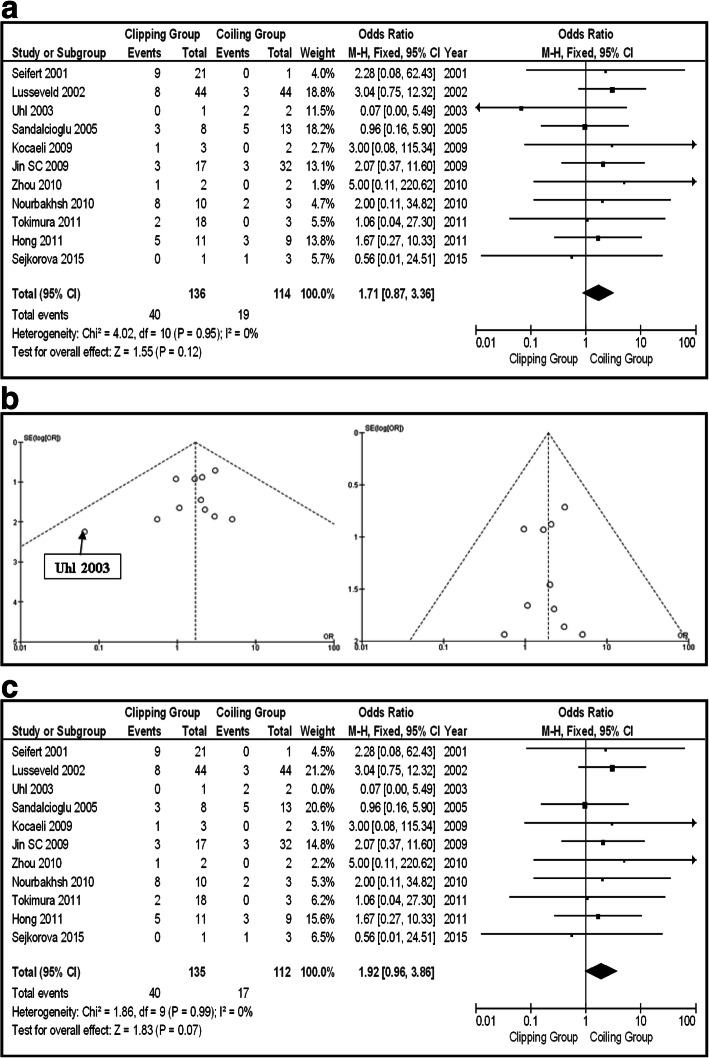
Fig. 3
Fig. 3
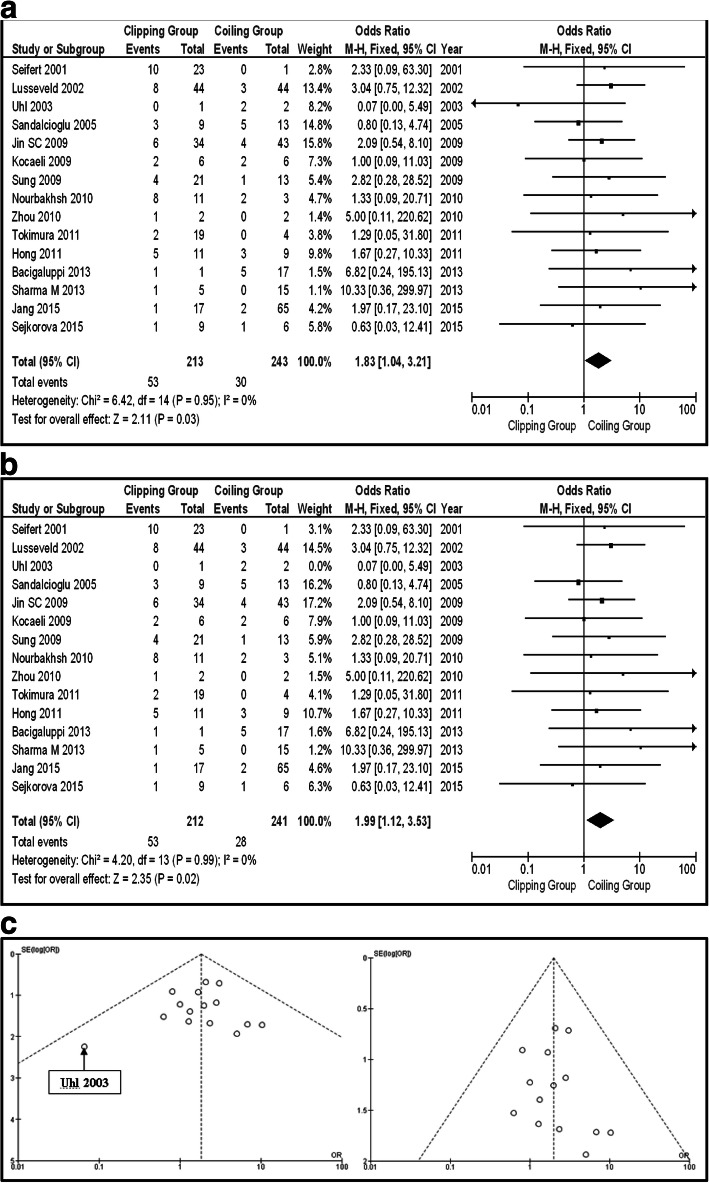
a OR forest plot, showing PND in clipping versus coiling, on posterior circulation IAs (unruptured and ruptured). b OR forest plot, showing PND in clipping versus coiling, on posterior circulation IAs (unruptured and ruptured), excluding “Uhl 2003” study. c Funnel plots of the PND in the total group of patients (unruptured and ruptured aneurysms), with (left) and without (right) “Uhl 2003” article
Fig. 4
Fig. 4
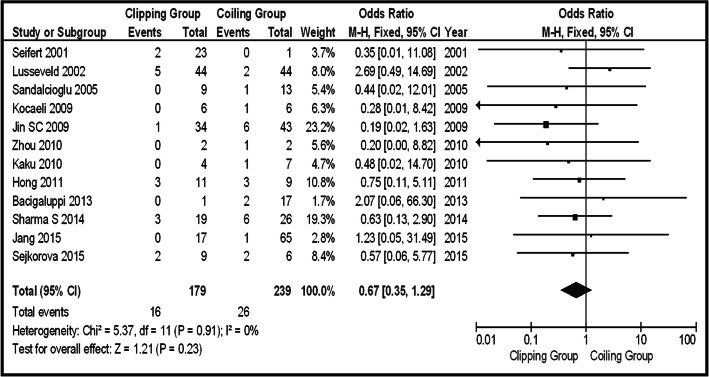
OR forest plot, showing La-Mo in clipping versus coiling, on posterior circulation IAs (unruptured and ruptured)
Fig. 5
Fig. 5
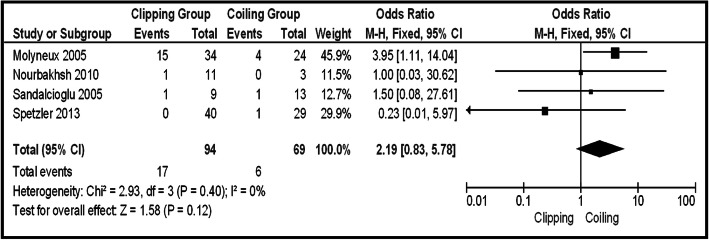
a OR forest plot, showing Re-int in clipping versus coiling, on posterior circulation IAs (unruptured and ruptured). b OR forest plot, showing Re-int in clipping versus coiling, on posterior circulation IAs (unruptured and ruptured), excluding “Jin 2009” study
Fig. 6
Fig. 6
OR forest plot, showing PND in clipping versus coiling, on posterior circulation unruptured IAs
Fig. 7
Fig. 7
OR forest plot, showing Op-Mo in clipping versus coiling, on posterior circulation ruptured IAs
Fig. 8
Fig. 8
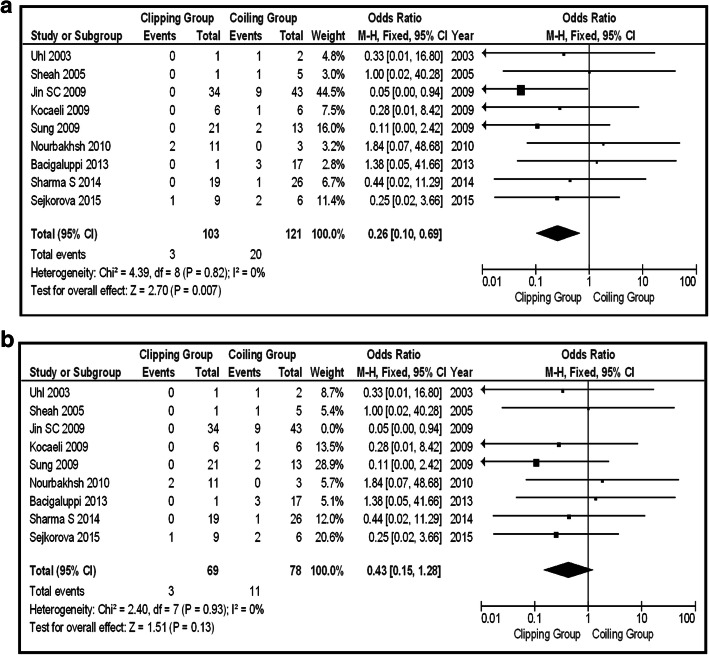
a OR forest plot, showing PND in clipping versus coiling, on posterior circulation ruptured IAs. b Funnel plots of the PND in the group of patients with ruptured aneurysms, with (left) and without (right) “Uhl 2003” article. c OR forest plot, showing PND in clipping versus coiling, on posterior circulation ruptured IAs, without “Uhl 2003” series

References

    1. Linn FH, Rinkel GJ, Algra A, van Gijn J. Incidence of subarachnoid hemorrhage: role of region, year, and rate of computed tomography: a meta-analysis. Stroke. 1996;27(4):625–629. doi: 10.1161/01.STR.27.4.625. - DOI - PubMed
    1. Brown RD. Unruptured intracranial aneurysms. Semin Neurol. 2010;30(5):537–544. doi: 10.1055/s-0030-1268858. - DOI - PubMed
    1. Zhao J, Wang S, Yang L, Zhao Y. Clinical experience of 153 patients with posterior circulation aneurysms. J Clin Neurosci. 2005;12:17–20. doi: 10.1016/j.jocn.2003.12.021. - DOI - PubMed
    1. Bonneville F, Sourour N, Biondi A. Intracranial aneurysms: an overview. Neuroimaging Clin N Am. 2006;16(3):371–382. doi: 10.1016/j.nic.2006.05.001. - DOI - PubMed
    1. International Study of Unruptured Intracranial Aneurysms Investigators Unruptured intracranial aneurysms – risk of rupture and risks of surgical intervention. N Engl J Med. 1998;339:1725–1733. doi: 10.1056/NEJM199812103392401. - DOI - PubMed

LinkOut - more resources