. 2020 Aug 26;6(35):eabb5938.
doi: 10.1126/sciadv.abb5938. eCollection 2020 Aug.

Global and local envelope protein dynamics of hepatitis C virus determine broad antibody sensitivity

Affiliations

Global and local envelope protein dynamics of hepatitis C virus determine broad antibody sensitivity

Elias H Augestad et al. Sci Adv. .

Abstract

Broad antibody sensitivity differences of hepatitis C virus (HCV) isolates and their ability to persist in the presence of neutralizing antibodies (NAbs) remain poorly understood. Here, we show that polymorphisms within glycoprotein E2, including hypervariable region 1 (HVR1) and antigenic site 412 (AS412), broadly affect NAb sensitivity by shifting global envelope protein conformation dynamics between theoretical "closed," neutralization-resistant and "open," neutralization-sensitive states. The conformational space of AS412 was skewed toward β-hairpin-like conformations in closed states, which also depended on HVR1, assigning function to these enigmatic E2 regions. Scavenger receptor class B, type I entry dependency of HCV was associated with NAb resistance and correlated perfectly with decreased virus propensity to interact with HCV co-receptor CD81, indicating that decreased NAb sensitivity resulted in a more complex entry pathway. This link between global E1/E2 states and functionally distinct AS412 conformations has important implications for targeting AS412 in rational HCV vaccine designs.


Figures

Fig. 1
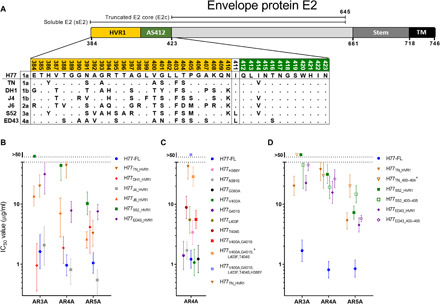
Fig. 1. NAb sensitivity of HCV is regulated by polymorphisms within positions 400 to 404 in HVR1.
(A) Alignment of the N-terminal part of the E2 protein against genotype 1a H77 reference genome (GenBank accession no. AF009606) for HCV isolates of genotypes 1 to 4 (Mega 7), identical with the H77C genome used in the present study. Dots indicate homology with H77. (B to D) Neutralization by the human monoclonal NAbs AR3A (B and D), AR4A (B to D), and AR5A (B and D) of the indicated HCVcc recombinants. The data were analyzed using three-parameter dose-response regression to calculate median inhibitory concentration (IC50) values and 95% confidence intervals (GraphPad Prism 8.0.0). *HCVcc recombinants with the same combinations of TN polymorphisms (TN_400–404 used in subsequent figures). TM, transmembrane domain; Stem, a stalk-like structure that connects the rest of the E2 ectodomain with the TM.
Fig. 2
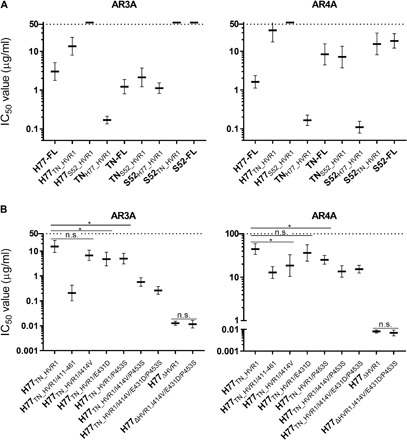
Fig. 2. Global NAb sensitivity of HCV is regulated by polymorphisms both within and outside of HVR1.
(A and B) Neutralization by the human monoclonal NAbs AR3A and AR4A of HVR1-swapped H77-, TN-, and S52-based recombinants (A) or H77-based recombinants with TN polymorphisms (B). The data were analyzed as described in Fig. 1B. Differences between IC50 values were compared in two-tailed t tests (GraphPad Prism 8.0.0) with Welch’s correction. Testing was done at the 95% confidence level and corrected for multiple testing by adjusting the P value accordingly (tested P values, 0.017). *Neutralization sensitivity was statistically significantly different. n.s., neutralization sensitivity was not statistically significantly different.
Fig. 3
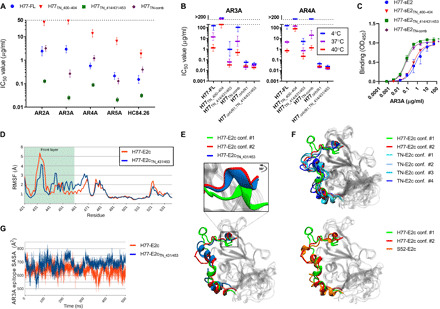
Fig. 3. Protective envelope polymorphisms within positions 400 to 404 in HVR1 or outside HVR1 at positions 414, 431, and 453 influence global E1/E2 conformation dynamics.
(A) Neutralization using the indicated NAbs of H77 HCVcc recombinants. (B) Neutralization of H77 HCVcc recombinants performed at 4°, 37°, or 40°C. Data were analyzed as described in Fig. 1, except that four-parameter dose-response regression was used in (B). H77TN_400–404 and H77TN-comb harbored N391S, which increased viral infectivity without affecting neutralization (fig. S3, A and B). (C) sE2 binding to AR3A (positions 384 to 645; see Fig. 1A) in ELISA. Values are means of duplicates ± SD. OD450, optical density at 450 nm. (D) Peptide backbone residue flexibility [root mean square fluctuation (RMSF)] was calculated for all α carbons along 500-ns MD simulations of H77-E2c and H77-E2cTN_431/453 (positions 421 to 647); residues 421 to 535 are depicted (full RMSF plots; see fig. S3D). E2 front layer (positions 421 to 461) highlighted in color. (E and F) The two most visited conformations of H77-E2c compared to the main conformation of H77-E2cTN_431/453 (E), TN-E2c (F), or S52-E2c (F), all identified by PCA and FEL calculation on the first two principal PCs (see fig. S3E). (G) Exposure of the AR3A epitope in H77-E2c and H77TN_431/453-E2c during 500-ns MD simulation by computing the SASA of AR3A epitope residues.
Fig. 4
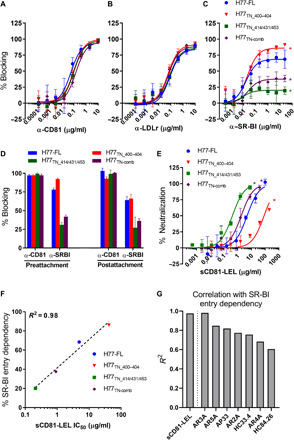
Fig. 4. Polymorphisms that protect HCV from NAbs also increase the need for SR-BI to mediate subsequent CD81 interactions.
(A to C) Receptor blocking of the entry of indicated HCV recombinants using a dilution series of antibody against CD81 (A), LDLr (B), and SR-BI (C). (D) Receptor blocking of the entry of indicated recombinants pre- and postviral attachment. (E) Neutralization of the indicated H77 recombinants with a dilution series of sCD81-LEL. (F) IC50 values against sCD81-LEL for the indicated H77 recombinants plotted against SR-BI entry dependency calculated as outlined in (C) (Bmax). The data were analyzed as described in Fig. 1 to estimate maximum attainable effect, Bmax (C), or to calculate IC50 values (E). (G) R2 values from IC50 values for the indicated monoclonal NAbs against H77 recombinants from (A) to (F) plotted against their corresponding SR-BI entry dependency calculated as outlined in (C) (Bmax) (see fig. S4B for correlation plots). All error bars represent SD. *Receptor blocking or neutralization sensitivity of the HCV recombinant was statistically significantly different from H77-FL.
Fig. 5
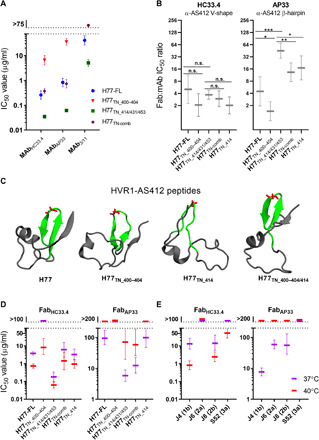
Fig. 5. The conformational space of AS412 is skewed toward β-hairpin–like conformations in closed HCV E1/E2 states.
(A) Neutralization using the mAb 3/11, HC33.4, or AP33 of indicated H77 HCVcc recombinants. Data were analyzed as described in Fig. 1. (B) Ratio of Fab:mAb neutralization IC50 values for HC33.4 and AP33 of the indicated H77 recombinants [values calculated from fig. S5 (A and B) dose-response data]. The ratios were compared in two-tailed t tests (GraphPad Prism 8.0.0) with Welch’s correction. Testing was done at the 95% confidence level (*P < 0.05, **P < 0.01, and ***P < 0.001), and the P value was adjusted for multiple testing (*P < 0.025, **P < 0.005, and ***P < 0.0005). (C) Ribbon structures of the most-visited conformations of HVR1-AS412 systems (residues 384 to 426) based on PCA performed on backbone atoms from MD simulations followed by FEL calculations. AS412 is highlighted in green. Residue G418, at the AS412 β-hairpin apex, is highlighted in red. (D and E) Neutralization by HC33.4 and AP33 Fabs against the indicated H77 HCVcc recombinants (D) or HCVcc recombinants with E1/E2 of J4, J6, J8, S52 (E) at 37° or 40°C. Data were analyzed as described in Fig. 1, except using four-parameter dose-response regression (see fig. S6 for dose-response curves).

References

    1. Bartenschlager R., Baumert T. F., Bukh J., Houghton M., Lemon S. M., Lindenbach B. D., Lohmann V., Moradpour D., Pietschmann T., Rice C. M., Thimme R., Wakita T., Critical challenges and emerging opportunities in hepatitis C virus research in an era of potent antiviral therapy: Considerations for scientists and funding agencies. Virus Res. 248, 53–62 (2018). - PubMed
    1. Gerold G., Moeller R., Pietschmann T., Hepatitis C virus entry: Protein interactions and fusion determinants governing productive hepatocyte invasion. Cold Spring Harb. Perspect. Med. 10, a036830 (2020). - PMC - PubMed
    1. Bailey J. R., Wasilewski L. N., Snider A. E., El-Diwany R., Osburn W. O., Keck Z., Foung S. K. H., Ray S. C., Naturally selected hepatitis C virus polymorphisms confer broad neutralizing antibody resistance. J. Clin. Invest. 125, 437–447 (2015). - PMC - PubMed
    1. Yost S. A., Wang Y., Marcotrigiano J., Hepatitis C virus envelope glycoproteins: A balancing act of order and disorder. Front. Immunol. 9, 1917 (2018). - PMC - PubMed
    1. Bankwitz D., Steinmann E., Bitzegeio J., Ciesek S., Friesland M., Herrmann E., Zeisel M. B., Baumert T. F., Keck Z.-y., Foung S. K. H., Pécheur E.-I., Pietschmann T., Hepatitis C virus hypervariable region 1 modulates receptor interactions, conceals the CD81 binding site, and protects conserved neutralizing epitopes. J. Virol. 84, 5751–5763 (2010). - PMC - PubMed

Publication types

Substances