


High prevalence of food intolerances among US internet users
- PMID: 32924902
- PMCID: PMC9459363
- DOI: 10.1017/S1368980020003298
High prevalence of food intolerances among US internet users
Abstract
Objective: Food intolerances are commonly reported and are predicted to have gastrointestinal health implications. We aimed to quantify the prevalence of food intolerances among US adults and identify culprit foods through a brief web-based survey.
Design: We invited participation in an online cross-sectional survey involving a single questionnaire. Data were summarised using percentages or medians and interquartile range. Participant characteristics by self-reported food intolerance were compared using the Wilcoxon rank sum test and Pearson's χ2 test. Adjusted analyses were performed using multivariable logistic regression.
Setting: The survey was internet-based via Amazon's mechanical Turk, a crowdsourcing website for the completion of requester directed tasks.
Participants: Adults who were US-based internet users were invited at ages 18-80.
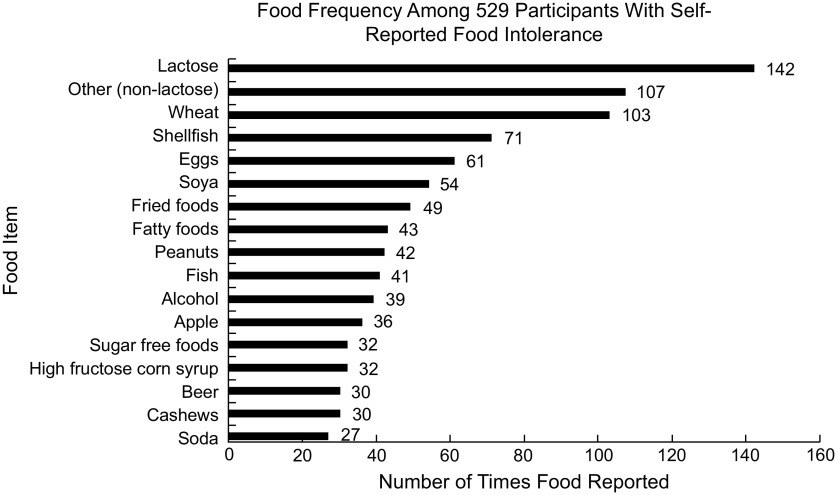
Results: We collected 2133 survey responses (ages 18-79 years). The rate of food intolerance was 24·8 % (95 % CI 23·0, 26·6) in US adults. Younger (P < 0·01), female (P = 0·05) and Asian, African American or multiple race individuals (P < 0·01) predominated. Lactose intolerance was most common. Frequency of a non-lactose food intolerance was 18·1 % (95 % CI 16·5, 19·8). When categorised broadly, grains, fruit, lactose, fish, vegetables, alcohol and nuts were most troublesome for individuals in that order.
Conclusions: Self-reported food intolerance is common in US internet users. The effect of food on gastrointestinal symptoms and avoidant behaviours deserves further attention.
Keywords: Food; Food intolerance; Lactose intolerance; Prevalence; Survey.
Figures
References
-
- Young E, Stoneham MD, Petruckevitch A et al. (1994) A population study of food intolerance. Lancet 343, 1127–1130. - PubMed
-
- Woods RK, Abramson M, Bailey M et al. (2001) International prevalences of reported food allergies and intolerances. Comparisons arising from the European Community Respiratory Health Survey (ECRHS) 1991–1994. Eur J Clin Nutr 55, 298–304. - PubMed
-
- Gislason D, Bjoernsson E & Gislason T (2000) Allergy and intolerance to food in an Icelandic urban population 20–44 years of age. Laeknabladid 86, 851–857. - PubMed
-
- Puente-Fernandez C, Maya-Hernandez RL, Flores-Merino MV et al. (2016) Self-reported prevalence and risk factors associated with food hypersensitivity in Mexican young adults. Ann Allergy Asthma Immunol 523–527, e3. - PubMed
-
- Lomer MC (2015) Review article: the aetiology, diagnosis, mechanisms and clinical evidence for food intolerance. Aliment Pharmacol Ther 41, 262–275. - PubMed
Publication types
MeSH terms
Grants and funding
LinkOut - more resources
Full Text Sources
Medical
