


Increased Internet Searches for Insomnia as an Indicator of Global Mental Health During the COVID-19 Pandemic: Multinational Longitudinal Study
- PMID: 32924951
- PMCID: PMC7508633
- DOI: 10.2196/22181
Increased Internet Searches for Insomnia as an Indicator of Global Mental Health During the COVID-19 Pandemic: Multinational Longitudinal Study
Abstract
Background: Real-time global mental health surveillance is urgently needed for tracking the long-term impact of the COVID-19 pandemic.
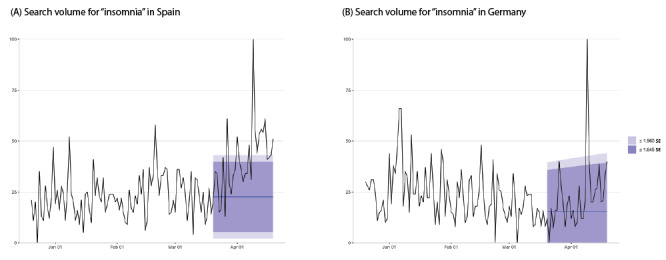
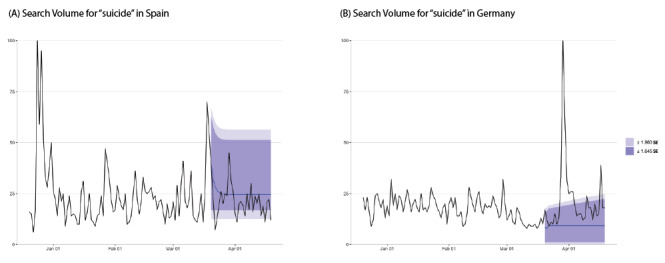
Objective: This study aimed to use Google Trends data to investigate the impact of the pandemic on global mental health by analyzing three keywords indicative of mental distress: "insomnia," "depression," and "suicide."
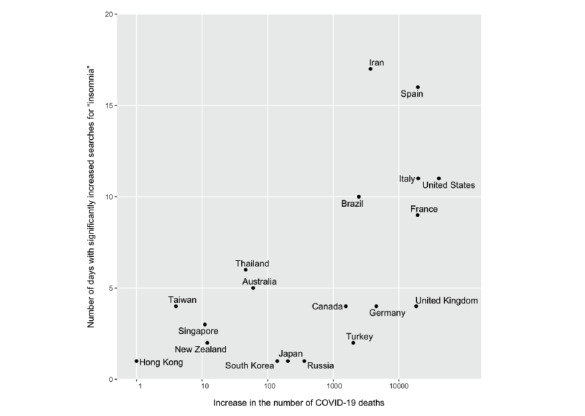
Methods: We examined increases in search queries for 19 countries. Significant increases were defined as the actual daily search value (from March 20 to April 19, 2020) being higher than the 95% CIs of the forecast from the 3-month baseline via ARIMA (autoregressive integrated moving average) modeling. We examined the correlation between increases in COVID-19-related deaths and the number of days with significant increases in search volumes for insomnia, depression, and suicide across multiple nations.
Results: The countries with the greatest increases in searches for insomnia were Iran, Spain, the United States, and Italy; these countries exhibited a significant increase in insomnia searches on more than 10 of the 31 days observed. The number of COVID-19-related deaths was positively correlated to the number of days with an increase in searches for insomnia in the 19 countries (ρ=0.64, P=.003). By contrast, there was no significant correlation between the number of deaths and increases in searches for depression (ρ=-0.12, P=.63) or suicide (ρ=-0.07, P=.79).
Conclusions: Our analysis suggests that insomnia could be a part of routine mental health screening during the COVID-19 pandemic.
Keywords: COVID-19; Google Trends; infodemiology; infoveillance; insomnia; internet search; mental health.
©Yu-Hsuan Lin, Ting-Wei Chiang, Yu-Lun Lin. Originally published in the Journal of Medical Internet Research (http://www.jmir.org), 21.09.2020.
Conflict of interest statement
Conflicts of Interest: None declared.
Figures
References
-
- COVID-19 Dashboard. The Center for Systems Science and Engineering JHU. 2020. [2020-05-18]. https://coronavirus.jhu.edu/map.html.
-
- Mental health and psychosocial considerations during the COVID-19 outbreak. World Health Organization. 2020. Mar 18, [2020-05-18]. https://www.who.int/docs/default-source/coronaviruse/mental-health-consi....
-
- Chew NW, Lee GK, Tan BY, Jing M, Goh Y, Ngiam NJ, Yeo LL, Ahmad A, Ahmed Khan F, Napolean Shanmugam G, Sharma AK, Komalkumar R, Meenakshi P, Shah K, Patel B, Chan BP, Sunny S, Chandra B, Ong JJ, Paliwal PR, Wong LY, Sagayanathan R, Chen JT, Ying Ng AY, Teoh HL, Tsivgoulis G, Ho CS, Ho RC, Sharma VK. A multinational, multicentre study on the psychological outcomes and associated physical symptoms amongst healthcare workers during COVID-19 outbreak. Brain Behav Immun. 2020 Aug;88:559–565. doi: 10.1016/j.bbi.2020.04.049. http://europepmc.org/abstract/MED/32330593 - DOI - PMC - PubMed
-
- Wang C, Pan R, Wan X, Tan Y, Xu L, McIntyre RS, Choo FN, Tran B, Ho R, Sharma VK, Ho C. A longitudinal study on the mental health of general population during the COVID-19 epidemic in China. Brain Behav Immun. 2020 Jul;87:40–48. doi: 10.1016/j.bbi.2020.04.028. http://europepmc.org/abstract/MED/32298802 - DOI - PMC - PubMed
Publication types
MeSH terms
LinkOut - more resources
Full Text Sources
Medical
Miscellaneous
