


The Coronavirus Disease 2019 Pandemic's Effect on Critical Care Resources and Health-Care Providers: A Global Survey
- PMID: 32926870
- PMCID: PMC7484703
- DOI: 10.1016/j.chest.2020.09.070
The Coronavirus Disease 2019 Pandemic's Effect on Critical Care Resources and Health-Care Providers: A Global Survey
Abstract
Background: The coronavirus disease 2019 (COVID-19) pandemic has severely affected ICUs and critical care health-care providers (HCPs) worldwide.
Research question: How do regional differences and perceived lack of ICU resources affect critical care resource use and the well-being of HCPs?
Study design and methods: Between April 23 and May 7, 2020, we electronically administered a 41-question survey to interdisciplinary HCPs caring for patients critically ill with COVID-19. The survey was distributed via critical care societies, research networks, personal contacts, and social media portals. Responses were tabulated according to World Bank region. We performed multivariate log-binomial regression to assess factors associated with three main outcomes: limiting mechanical ventilation (MV), changes in CPR practices, and emotional distress and burnout.
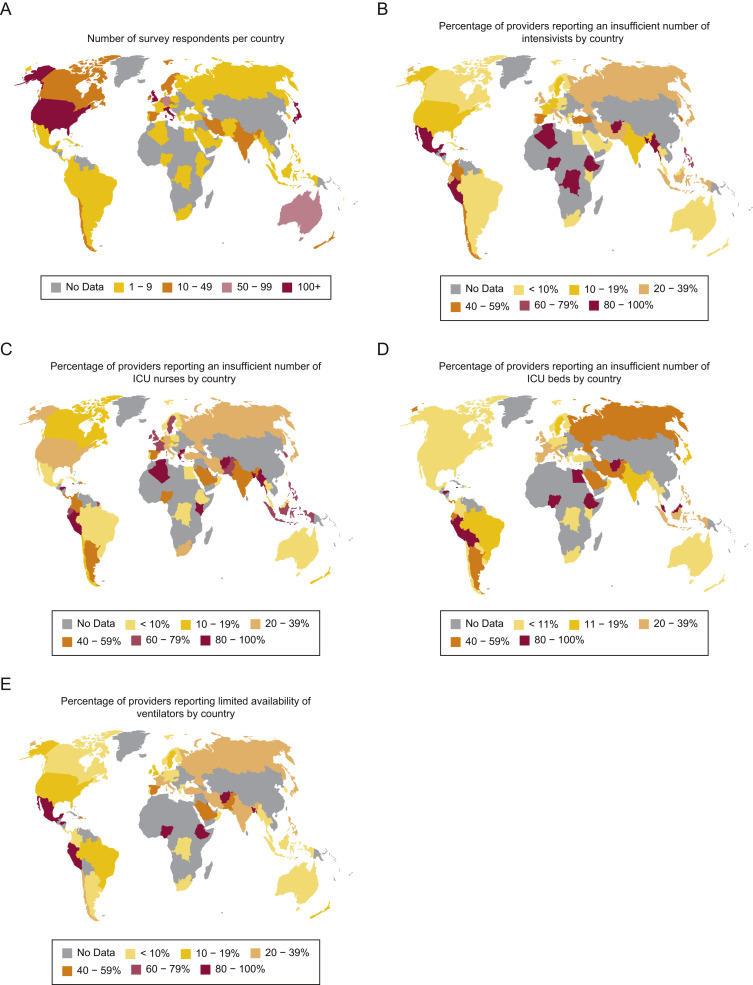
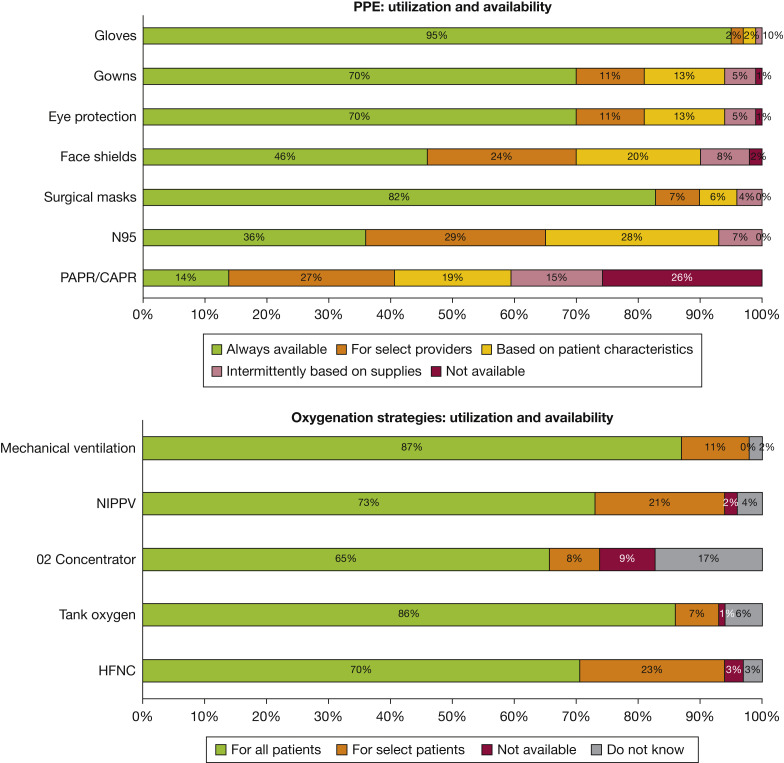
Results: We included 2,700 respondents from 77 countries, including physicians (41%), nurses (40%), respiratory therapists (11%), and advanced practice providers (8%). The reported lack of ICU nurses was higher than that of intensivists (32% vs 15%). Limiting MV for patients with COVID-19 was reported by 16% of respondents, was lowest in North America (10%), and was associated with reduced ventilator availability (absolute risk reduction [ARR], 2.10; 95% CI, 1.61-2.74). Overall, 66% of respondents reported changes in CPR practices. Emotional distress or burnout was high across regions (52%, highest in North America) and associated with being female (mechanical ventilation, 1.16; 95% CI, 1.01-1.33), being a nurse (ARR, 1.31; 95% CI, 1.13-1.53), reporting a shortage of ICU nurses (ARR, 1.18; 95% CI, 1.05-1.33), reporting a shortage of powered air-purifying respirators (ARR, 1.30; 95% CI, 1.09-1.55), and experiencing poor communication from supervisors (ARR, 1.30; 95% CI, 1.16-1.46).
Interpretation: Our findings demonstrate variability in ICU resource availability and use worldwide. The high prevalence of provider burnout and its association with reported insufficient resources and poor communication from supervisors suggest a need for targeted interventions to support HCPs on the front lines.
Keywords: COVID-19; burnout; critical care; emotional distress; mechanical ventilation; resource use; survey.
Copyright © 2020 American College of Chest Physicians. Published by Elsevier Inc. All rights reserved.
Figures
Comment in
-
Looking to the Past, Learning From the Present, and Preparing for the Future: Toward Understanding Critical Care Strain During a Global Pandemic.Chest. 2021 Feb;159(2):469-470. doi: 10.1016/j.chest.2020.10.035. Chest. 2021. PMID: 33563430 Free PMC article. No abstract available.
References
-
- WHO coronavirus disease (COVID-19) dashboard. https://covid19.who.int/
-
- Johns Hopkins University & Medicine Coronavirus resource center. https://coronavirus.jhu.edu/
MeSH terms
Grants and funding
LinkOut - more resources
Full Text Sources
Other Literature Sources
Medical
Miscellaneous
