


Genetics in Light of Transcriptional Adaptation
- PMID: 32928563
- PMCID: PMC7612536
- DOI: 10.1016/j.tig.2020.08.008
Genetics in Light of Transcriptional Adaptation
Abstract
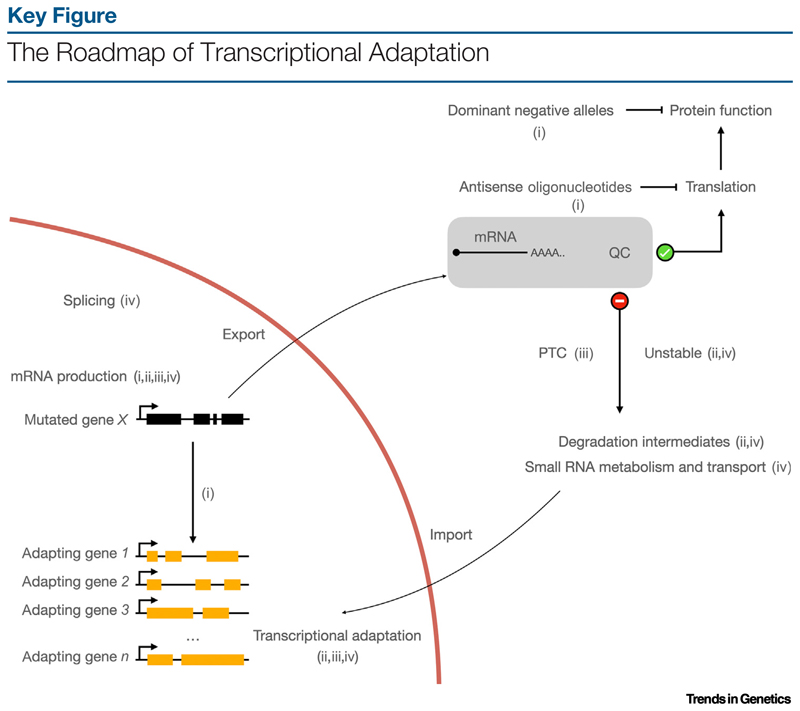
Genetics has recently benefited from the genome engineering revolution: genes can be knocked out, knocked down, or activated more easily than ever before. This range of genetic manipulations has also provided a range of outcomes, sometimes contradictory. But how much interesting biology hides within these discrepancies? Recent studies have shown that genetic compensation can be activated by some gene perturbations and not others, hinting that this phenomenon might skew our understanding of the genotype-phenotype relationship. We review the main findings regarding transcriptional adaptation, a newly discovered form of genetic compensation, and discuss their possible implications for establishing and analyzing animal and plant models to study gene function. We also touch upon how this new knowledge could benefit our understanding of disease-causing mutations and help explain cases of low penetrance or variable expressivity in human genetics.
Keywords: animal models; gene expression; genetic compensation; genome engineering; transcriptional adaptation.
Copyright © 2020 Elsevier Ltd. All rights reserved.
Figures
References
-
- Driever W, et al. A genetic screen for mutations affecting embryogenesis in zebrafish. Development. 1996;123:37–46. - PubMed
-
- Johnston D. The art and design of genetic screens: Drosophila melanogaster. Nat Rev Genet. 2002;3:176–188. - PubMed
-
- Hartenstein V, Jan YN. Studying Drosophila embryogenesis with P-lacZ enhancer trap lines. Roux Arch Dev Biol. 1992;201:194–220. - PubMed
Publication types
MeSH terms
Substances
Grants and funding
LinkOut - more resources
Full Text Sources
