. 2020 Oct 6;117(40):24900-24908.
doi: 10.1073/pnas.2003976117. Epub 2020 Sep 14.

A new malaria vector in Africa: Predicting the expansion range of Anopheles stephensi and identifying the urban populations at risk

Affiliations

A new malaria vector in Africa: Predicting the expansion range of Anopheles stephensi and identifying the urban populations at risk

M E Sinka et al. Proc Natl Acad Sci U S A. .

Abstract

In 2012, an unusual outbreak of urban malaria was reported from Djibouti City in the Horn of Africa and increasingly severe outbreaks have been reported annually ever since. Subsequent investigations discovered the presence of an Asian mosquito species; Anopheles stephensi, a species known to thrive in urban environments. Since that first report, An. stephensi has been identified in Ethiopia and Sudan, and this worrying development has prompted the World Health Organization (WHO) to publish a vector alert calling for active mosquito surveillance in the region. Using an up-to-date database of published locational records for An. stephensi across its full range (Asia, Arabian Peninsula, Horn of Africa) and a set of spatial models that identify the environmental conditions that characterize a species' preferred habitat, we provide evidence-based maps predicting the possible locations across Africa where An. stephensi could establish if allowed to spread unchecked. Unsurprisingly, due to this species' close association with man-made habitats, our maps predict a high probability of presence within many urban cities across Africa where our estimates suggest that over 126 million people reside. Our results strongly support the WHO's call for surveillance and targeted vector control and provide a basis for the prioritization of surveillance.

Keywords: ensemble modeling; invasive species; species distribution model; urban malaria; vector.


Conflict of interest statement

The authors declare no competing interest.

Figures
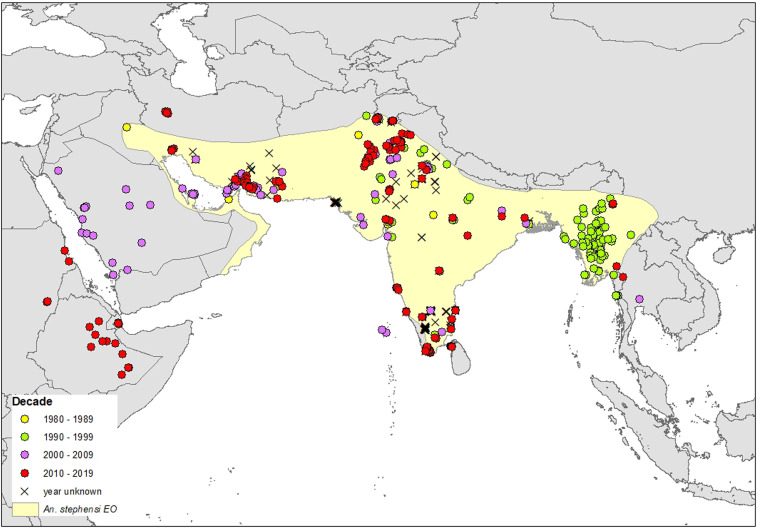
Fig. 1.
Fig. 1.
The new “out of range” occurrence of An. stephensi in the Arabian Peninsula and Horn of Africa showing the 358 An. stephensi site locations used in our final species distribution models (SDMs) color coded by the decade in which they were sampled. The yellow shaded area shows the 2011 expert opinion range based on data published up to 31 October 2009 (9). Data showing the presence of An. stephensi more westerly across the Arabian peninsula (sampled in 2005 to 2006) were published after 2010. Thus An. stephensi may have been present but unreported or been expanding its range into western areas of the Arabian peninsula over the last 30 y.
Fig. 2.
Fig. 2.
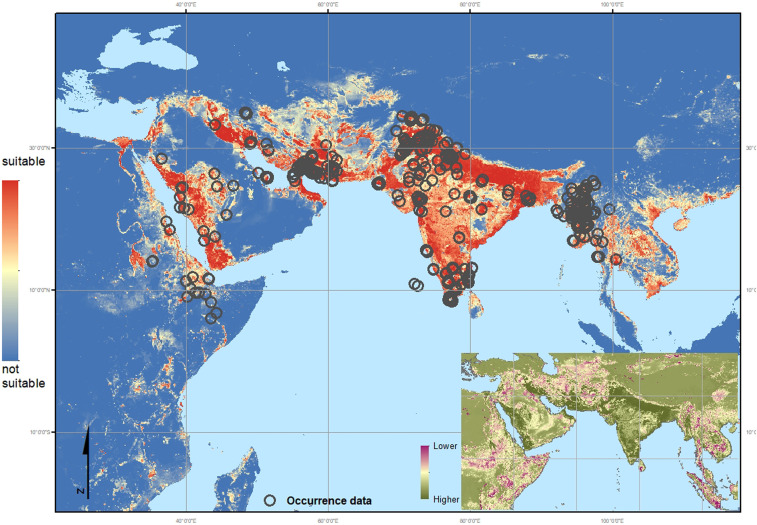
Exclusive map: Environmental suitability map of An. stephensi using the updated occurrence database but without African sites. Red indicates a higher probability of environmental suitability whereas the blue indicates environments with a lower probability, i.e., more likely to be unsuitable for the species to occur. The environmental variables selected by the model as relevant to An. stephensi habitat suitability, in descending order (based on correlation score): Ann. Mean Temp. = 0.459, Human Popn Dens. = 0.325, Precip (season) = 0.171, enhanced vegetation index (EVI) = 0.161, Irrigation= 0.155, tasselled cap wetness (TCW) = 0.110, Crop mosaic = 0.011. Dark gray circles indicate the location of all 358 occurrence data used in the final inclusive map (Fig. 3) including those in Africa (not used in this exclusive model).The thumbnail map shows the coefficient of variation calculated per pixel across the predicted range, indicating where the ensemble model provides the most reliable (higher confidence: dark green) and least reliable (lower confidence: red) predictions.
Fig. 3.
Fig. 3.
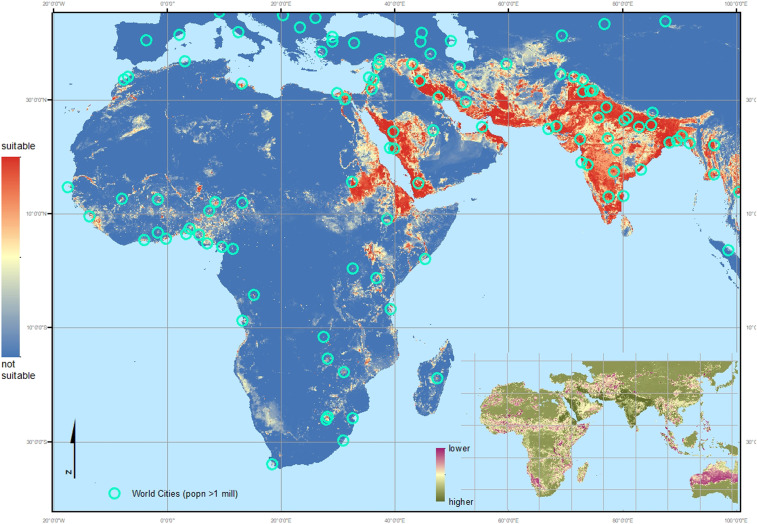
Inclusive map: Environmental suitability map of An. stephensi using the updated occurrence database including all African sites. Red indicates a higher probability of environmental suitability whereas the blue indicates environments with a lower probability, i.e., more likely to be unsuitable for the species to occur. The environmental variables selected by the model as relevant to An. stephensi habitat suitability, in descending order (based on correlation score): Ann. Mean Temp. = 0.461, Human Popn Dens. = 0.370, EVI = 0.174, Precip (season) = 0.161, TCW = 0.134, Irrigation= 0.130, Crop mosaic = 0.010. Turquoise circles indicate the location of cities with a population > 1 million. The thumbnail map shows the coefficient of variation calculated per pixel across the predicted range, indicating where the ensemble model provides the most reliable (higher confidence: dark green) and least reliable (lower confidence: red) predictions.
Fig. 4.
Fig. 4.
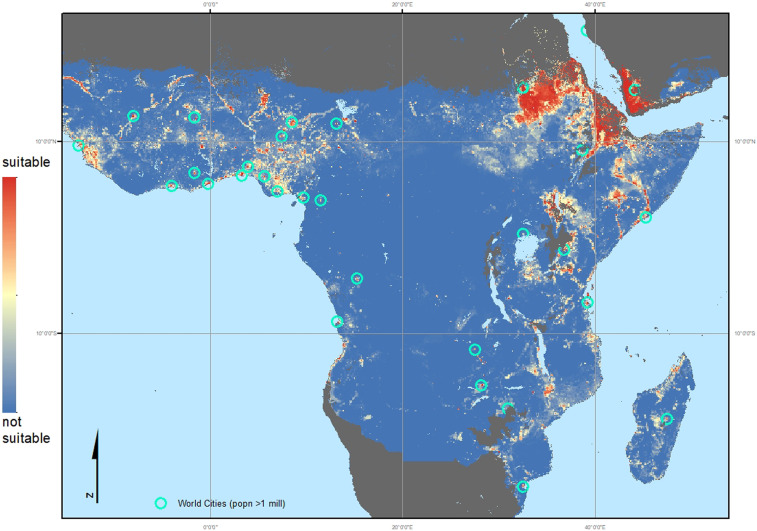
The inclusive map focusing on the malaria (P. falciparum and P. vivax [PfPv]) endemic areas in Africa: Environmental suitability map of An. stephensi using the updated occurrence database including all African sites, masked (dark gray) using the Malaria Atlas Project (MAP) PfPv endemicity mask (16). Red indicates a higher probability of environmental suitability whereas the blue indicates environments with a lower probability, i.e., more likely to be unsuitable for the species to occur. Turquoise circles indicate the location of cities with a population > 1 million.
Fig. 5.
Fig. 5.
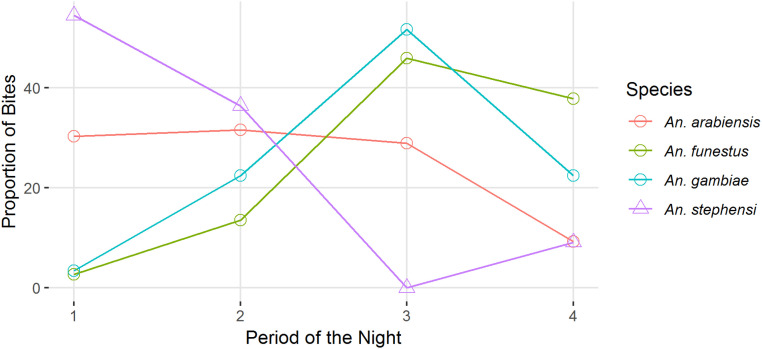
Mosquito biting activity summarized from published studies (MAP bionomics database) comparing the Asian (open triangles) An. stephensi with the African (open circles) DVS (An. arabiensis, An. gambiae, and An. funestus) showing the peak activity periods as the proportion of mosquitoes biting in the first, second, third and fourth quarters of the night (from 6 PM to 6 AM).

References

    1. World Health Organization , World Malaria Report, (World Health Organization, Geneva, 2018), p. 210.
    1. Coetzee M., Distribution of the African malaria vectors of the Anopheles gambiae complex. Am. J. Trop. Med. Hyg. 70, 103–104 (2004). - PubMed
    1. Coluzzi M., The clay feet of the malaria giant and its African roots: Hypotheses and inferences about origin, spread and control of Plasmodium falciparum. Parassitologia 41, 277–283 (1999). - PubMed
    1. Gillies M. T., de Meillon B., The Anophelinae of Africa South of the Sahara (Ethiopian Zoogeographical Region), (The South African Institute for Medical Research, Johannesburg, ed. 2, 1968).
    1. Sinka M. E. et al. ., The dominant Anopheles vectors of human malaria in Africa, Europe and the Middle East: Occurrence data, distribution maps and bionomic précis. Parasit. Vectors 3, 117 (2010). - PMC - PubMed

Publication types