


Risk factors for bisphosphonate-associated osteonecrosis of the jaw in the prospective randomized trial of adjuvant bisphosphonates for early-stage breast cancer (SWOG 0307)
- PMID: 32929540
- PMCID: PMC7956914
- DOI: 10.1007/s00520-020-05748-8
Risk factors for bisphosphonate-associated osteonecrosis of the jaw in the prospective randomized trial of adjuvant bisphosphonates for early-stage breast cancer (SWOG 0307)
Abstract
Purpose: Bisphosphonates reduce bone metastases in postmenopausal women with early-stage breast cancer but carry the risk of bisphosphonate-related osteonecrosis of the jaw (BRONJ). We describe risk factors for BRONJ and compare BRONJ provoked by infection or trauma with spontaneous lesions, which carry a better prognosis.
Methods: SWOG 0307 randomized women with stage I-III breast cancer to receive zoledronic acid (ZA), clodronate (CL), or ibandronate (IB) for 3 years, implemented BRONJ prevention guidelines, and collected information about dental health and development of BRONJ. All statistical tests were two-sided.
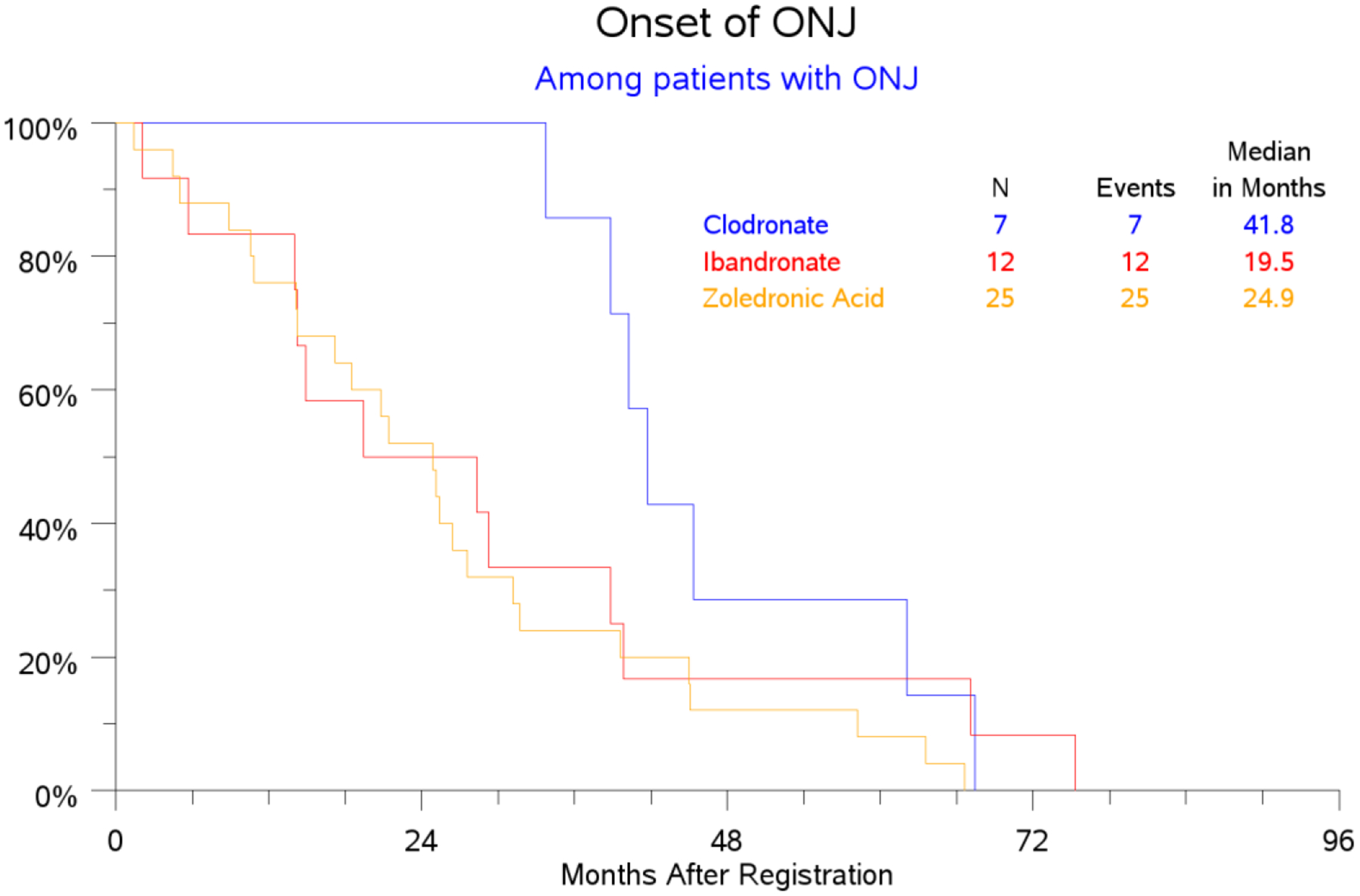
Results: Of 6018 women, 48 developed BRONJ. Infection was present in 21 (43.8%). Median time to BRONJ was 2.1 years for ZA, 2.0 years for IB, and 3.4 years for clodronate (p = 0.04). BRONJ was associated with bisphosphonate type (28/2231 (1.26%) for ZA, 8/2235 (0.36%) for CL, 12/1552 (0.77%) for IB), dental calculus (OR 2.03), gingivitis (OR 2.11), moderate/severe periodontal disease (OR 2.87), and periodontitis > 4 mm (OR 2.20) (p < 0.05). Of 57 lesions, BRONJ occurred spontaneously in 20 (35.1%) and was provoked by dental extraction in 20 (35.1%), periodontal disease in 14 (24.6%), denture trauma in 6 (10.5%), and dental surgery in 2 (3.5%). Spontaneous BRONJ occurred more frequently at the mylohyoid ridge. There were no differences in dental disease, infection, or bisphosphonate type between spontaneous and provoked BRONJ.
Conclusion: ZA and worse dental health were associated with increased incidence of BRONJ, with a trend toward additive risk when combined. BRONJ incidence was lower than in similar studies, with prevention strategies likely linked to this.
Clinical trial number: NCT00127205 REGISTRATION DATE: July 2005.
Keywords: Bisphosphonate; Breast cancer; Clinical trials; Osteonecrosis of the jaw.
Conflict of interest statement
Figures
References
-
- Early Breast Cancer Trialists’ Collaborative Group (EBCTCG). Adjuvant bisphosphonate treatment in early breast cancer: meta-analyses of individual patient data from randomised trials. Lancet. 2015;386(10001):1353–1361. - PubMed
-
- Dhesy-Thind S, Fletcher GG, Blanchette PS et al. Use of Adjuvant Bisphosphonates and Other Bone-Modifying Agents in Breast Cancer: A Cancer Care Ontario and American Society of Clinical Oncology Clinical Practice Guideline. Clin Oncol. 2017;35(18):2062–2081. - PubMed
-
- Cardoso F, Kyriakides S, Ohno S, Penault-Llorca F, Poortmans P, Rubio IT, Zackrisson S, Senkus E; ESMO Guidelines Committee. Early breast cancer: ESMO Clinical Practice Guidelines for diagnosis, treatment and follow-up. Ann Oncol. 2019. August 1;30(8):1194–1220. - PubMed
-
- Hadji P, Coleman RE, Wilson C, Powles TJ, Clézardin P, Aapro M, Costa L, Body JJ, Markopoulos C, Santini D, Diel I, Di Leo A, Cameron D, Dodwell D, Smith I, Gnant M, Gray R, Harbeck N, Thurlimann B, Untch M, Cortes J, Martin M, Albert US, Conte PF, Ejlertsen B, Bergh J, Kaufmann M, Holen I. Adjuvant bisphosphonates in early breast cancer: consensus guidance for clinical practice from a European Panel. Ann Oncol. 2016. March;27(3):379–90. - PubMed
-
- Guise T. Examining the metastatic niche: targeting the microenvironment. Semin Oncol. 2010;37 Suppl 2:S2–14. - PubMed
Publication types
MeSH terms
Substances
Associated data
Grants and funding
LinkOut - more resources
Full Text Sources
Medical
