


Comparative Accuracy and Efficiency of Four Delirium Screening Protocols
- PMID: 32930409
- PMCID: PMC7814654
- DOI: 10.1111/jgs.16711
Comparative Accuracy and Efficiency of Four Delirium Screening Protocols
Abstract
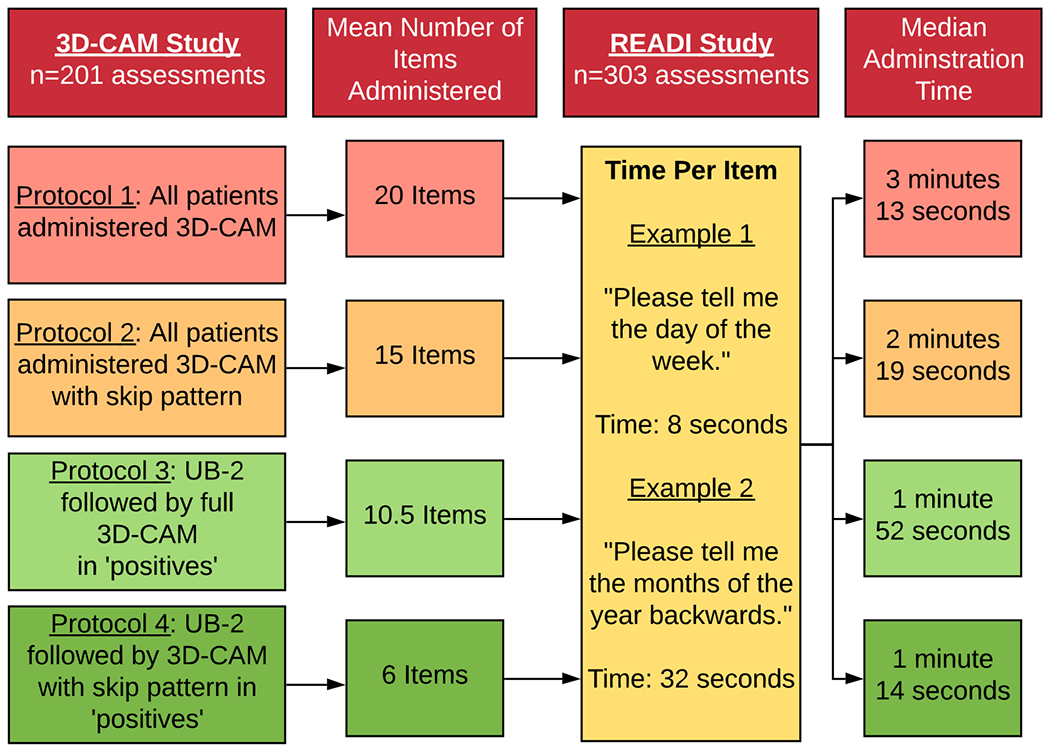
Background/objectives: Systematic screening can improve detection of delirium, but lack of time is often cited as why such screening is not performed. We investigated the time required to implement four screening protocols that use the Ultra-Brief two-item screener for delirium (UB-2) and the 3-Minute Diagnostic Interview for Confusion Assessment Method (CAM)-defined Delirium (3D-CAM), with and without a skip pattern that can further shorten the assessment. Our objective was to compare the sensitivity, specificity, and time required to complete four protocols: (1) full 3D-CAM on all patients, (2) 3D-CAM with skip on all patients, (3) UB-2, followed by the full 3D-CAM in "positives," and (4) UB-2, followed by the 3D-CAM with skip in "positives."
Design: Comparative efficiency simulation study using secondary data.
Setting: Two studies (3D-CAM and Researching Efficient Approaches to Delirium Identification (READI)) conducted at a large academic medical center (3D-CAM and READI) and a small community hospital (READI only).
Participants: General medicine inpatients, aged 70 years and older (3D-CAM, n = 201; READI, n = 330).
Measurements: We used 3D-CAM data to simulate the items administered under each protocol and READI data to calculate median administration time per item. We calculated sensitivity, specificity, and total administration time for each of the four protocols.
Results: The 3D-CAM and READI samples had similar characteristics, and all four protocols had similar simulated sensitivity and specificity. Mean administration times were 3 minutes 13 seconds for 3D-CAM, 2 minutes 19 seconds for 3D-CAM with skip, 1 minute 52 seconds for UB-2 + 3D-CAM in positives, and 1 minute 14 seconds for UB-2 + 3D-CAM with skip in positives, which was 1 minute 59 seconds faster than the 3D-CAM (P < .001).
Conclusion: The UB-CAM, consisting of the UB-2, followed in positives by the 3D-CAM with skip pattern, is a time-efficient delirium screening protocol that holds promise for increasing systematic screening for delirium in hospitalized older adults.
Keywords: delirium; implementation science; screening tools.
© 2020 The American Geriatrics Society.
Conflict of interest statement
Figures
References
-
- Marcantonio ER. Delirium. Ann Int Med 2011;154:ITC6-1. - PubMed
-
- Siddiqi N, House AO, Holmes JD. Occurrence and outcome of delirium in medical in-patients: A systematic literature review. Age Ageing 2006;35:350–364. - PubMed
-
- Inouye SK, Van Dyck CH, Alessi CA, Balkin S, Siegal AP, Horwitz RI. Clarifying confusion: The confusion assessment method: A new method for detection of delirium. Ann Int Med 1990;113:941–948. - PubMed
Publication types
MeSH terms
Grants and funding
LinkOut - more resources
Full Text Sources
Medical
