


20th Pollutant Responses in Marine Organisms (PRIMO 20): Global issues and fundamental mechanisms caused by pollutant stress in marine and freshwater organisms
- PMID: 32932042
- PMCID: PMC11106729
- DOI: 10.1016/j.aquatox.2020.105620
20th Pollutant Responses in Marine Organisms (PRIMO 20): Global issues and fundamental mechanisms caused by pollutant stress in marine and freshwater organisms
Abstract
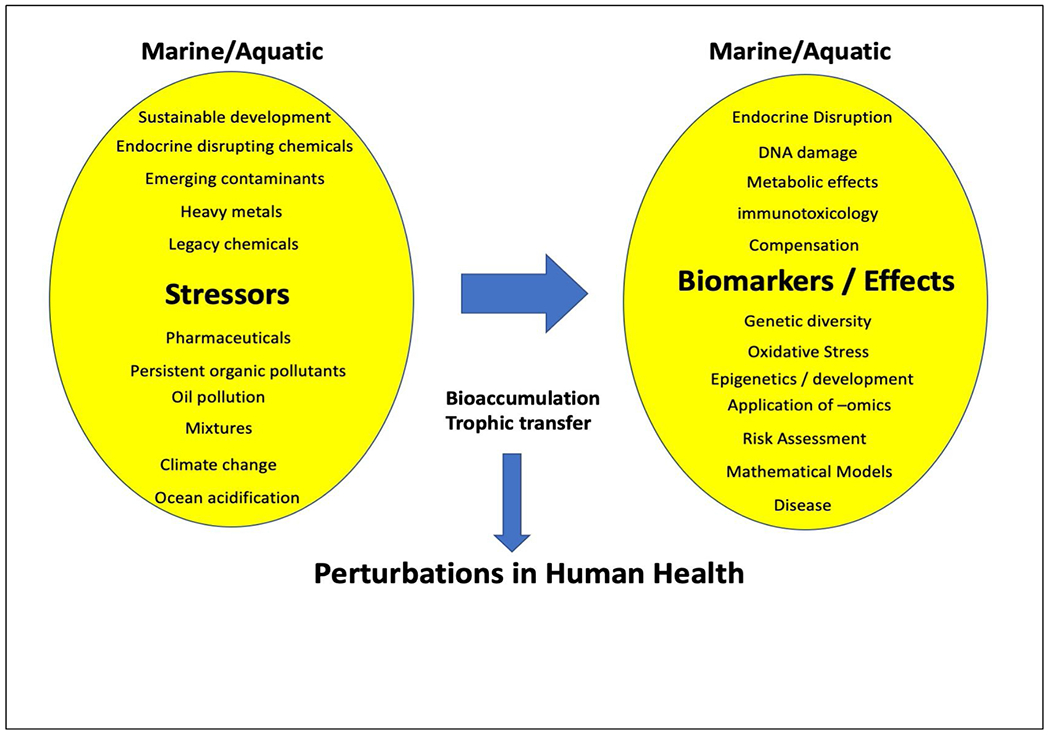
The 20th Pollutant Responses in Marine Organisms (PRIMO 20) conference provided a forum for scientists from around the world to communicate novel toxicological research findings specifically focused on aquatic organisms, by combining applied and basic research at the intersection of environmental and mechanistic toxicology. The work highlighted in this special issue of Aquatic Toxicology, a special issue of Marine Environmental Research, and presented through posters and presentations, encompass important and emerging topics in freshwater and marine toxicology. This includes multiple types of emerging contaminants including microplastics and UV filtering chemicals. Other studies aimed to further our understanding of the effects of endocrine disrupting chemicals, pharmaceuticals, and personal care products. Further research presented in this virtual issue examined the interactive effects of chemicals and pathogens, while the final set of manuscripts demonstrates continuing efforts to combine traditional biomonitoring, data from -omic technologies, and modeling for use in risk assessment and management. An additional goal of PRIMO meetings is to address the link between environmental and human health. Several articles in this issue of Aquatic Toxicology describe the appropriateness of using aquatic organisms as models for human health, while the keynote speakers, as described in the editorial below, presented research that highlighted bioaccumulation of contaminants such as PFOS and mercury from fish to marine mammals and coastal human populations such as the Gullah/GeeChee near Charleston, South Carolina, USA.
Copyright © 2020 Elsevier B.V. All rights reserved.
Figures
References
-
- Alvarez DA, Cranor WL, Perkins SD, Schroeder VL, Iwanowicz LR, Clark RC, Guy CP, Pinkney AE, Blazer VS, Mullican JE, 2009. Reproductive health of bass in the Potomac, U.S.A., drainage: part 2. Seasonal occurrence of persistent and emerging organic contaminants. Environ. Toxicol. Chem 28, 1084–1095. - PubMed
-
- Andrady AL, 2011. Microplastics in the marine environment. Mar. Pollut. Bull 62, 1596–1605. - PubMed
-
- Antczak P, Jo HJ, Seonock W, Scanlan L, Poynton H, Loguinov A, Chan S, Falciani F, Vulpe C, 2013. Molecular toxicity identification evaluation (mTIE) approach predicts chemical exposure in Daphnia magna. Environ. Sci. Technol 47, 11747–11756. - PubMed
-
- Arukwe A, Eggen T, Möder M, 2012. Solid waste deposits as a significant source of contaminants of emerging concern to the aquatic and terrestrial environments—a developing country case study from Owerri. Nigeria.. Sci Total Environ 438, 94–102. - PubMed
Publication types
MeSH terms
Substances
Grants and funding
LinkOut - more resources
Full Text Sources
