Review
. 2020 Sep 12;21(18):6677.
doi: 10.3390/ijms21186677.

Prion Protein at the Leading Edge: Its Role in Cell Motility

Affiliations
Review

Prion Protein at the Leading Edge: Its Role in Cell Motility

Mariana Brandão Prado et al. Int J Mol Sci. .

Abstract

Cell motility is a central process involved in fundamental biological phenomena during embryonic development, wound healing, immune surveillance, and cancer spreading. Cell movement is complex and dynamic and requires the coordinated activity of cytoskeletal, membrane, adhesion and extracellular proteins. Cellular prion protein (PrPC) has been implicated in distinct aspects of cell motility, including axonal growth, transendothelial migration, epithelial-mesenchymal transition, formation of lamellipodia, and tumor migration and invasion. The preferential location of PrPC on cell membrane favors its function as a pivotal molecule in cell motile phenotype, being able to serve as a scaffold protein for extracellular matrix proteins, cell surface receptors, and cytoskeletal multiprotein complexes to modulate their activities in cellular movement. Evidence points to PrPC mediating interactions of multiple key elements of cell motility at the intra- and extracellular levels, such as integrins and matrix proteins, also regulating cell adhesion molecule stability and cell adhesion cytoskeleton dynamics. Understanding the molecular mechanisms that govern cell motility is critical for tissue homeostasis, since uncontrolled cell movement results in pathological conditions such as developmental diseases and tumor dissemination. In this review, we discuss the relevant contribution of PrPC in several aspects of cell motility, unveiling new insights into both PrPC function and mechanism in a multifaceted manner either in physiological or pathological contexts.

Keywords: adhesion; cell motility; invasiveness; metastasis; prion protein.


Conflict of interest statement

The authors declare no conflict of interest.

Figures
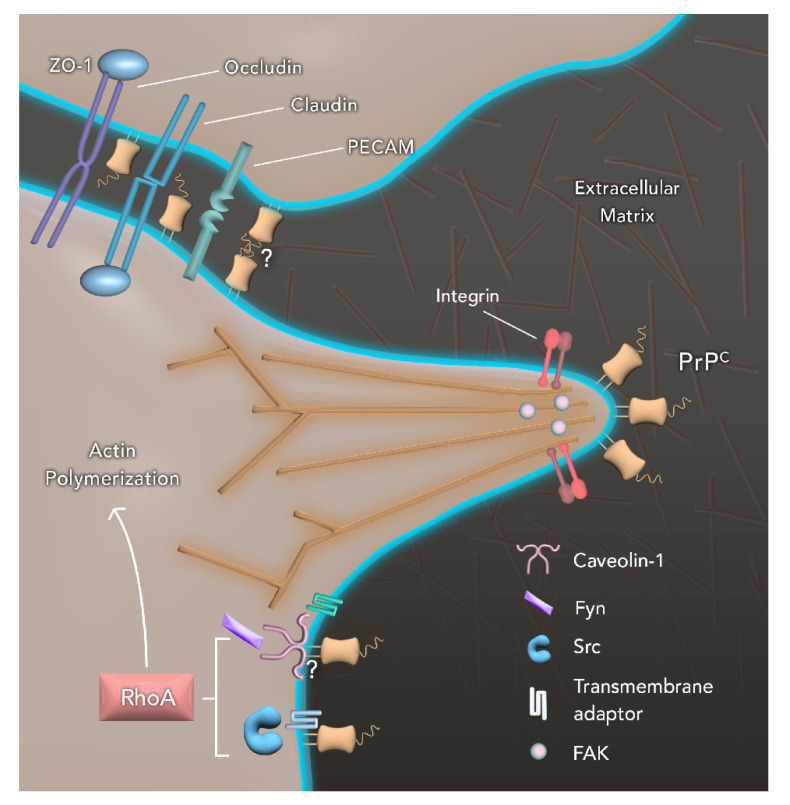
Figure 1
Figure 1
Cellular prion protein (PrPC) participates in cell motility through interaction with several partners. PrPC can promote the activation of Fyn in a caveolin-1-dependent manner, although the exact mechanism is unknown. Additionally, PrPC can also modulate the activation of Scr. Since PrPC is a glycophosphatidylinositol (GPI)-anchored protein and all the aforementioned proteins are cytosolic, it is postulated the existence of a transmembrane adaptor that acts as an intermediator. Both Fyn and Src are essential for the regulation of Ras homolog family member A (RhoA) activity. In turn, RhoA has a role in the actin polymerization and assembly of F-actin, as well as the formation of cell protrusions such as focal adhesions (FA) with the presence of focal adhesion kinase (FAK), a central regulator of FA. At the tip of FAs is observed an agglomeration of PrPC, as well as integrins and, since PrPC is known to interact with molecules from the extracellular matrix (ECM), it is postulated that both proteins have an important role in adhesion to the extracellular matrix during cell movement. Additionally, PrPC is also known to modulate adhesiveness, being found at the tip of FA and co-localizing with key proteins in cell–cell adhesion domains such as occludin, claudin, PECAM and ZO-1. It is not yet clear if PrPC can interact homophilically with other PrPC molecules from the neighboring cells, although a co-localization is observed.
Figure 2
Figure 2
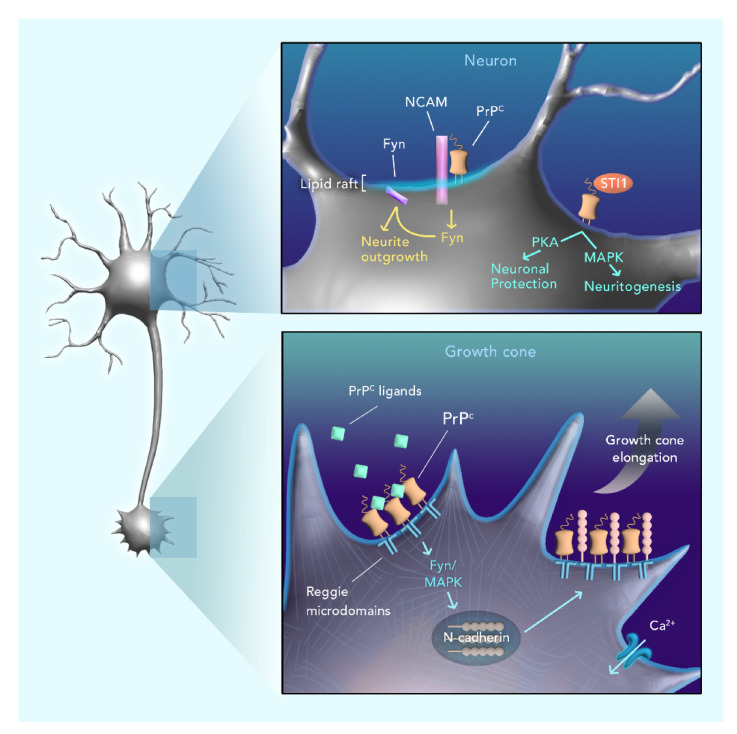
Role of PrPC in neuronal plasticity. Upper panel: PrPC seems to interact with neural cell adhesion molecule (NCAM), promoting the recruitment of Fyn to lipid rafts and stimulating neurite outgrowth. Additionally, PrPC interaction with its well-known ligand, STI1, is able to modulate both Protein kinase A (PKA) and Mitogen-activated protein kinase (MAPK) pathways. The first one is shown to promote neuronal protection, while the second one promotes neuritogenesis. Lower panel: PrPC activated through a ligand or through antibody-mediated crosslinking is able to cluster in reggie microdomains, promoting the activation of Fyn and MAPK. Both of those proteins have an important role in the polarized transport of N-cadherin to regions of growth cone elongation, where it associates with reggie. Additionally, Ca2+ intake is also important to the modulation of this process.

References

    1. Hohmann T., Dehghani F. The Cytoskeleton—A Complex Interacting Meshwork. Cells. 2019;8:362. doi: 10.3390/cells8040362. - DOI - PMC - PubMed
    1. Aman A., Piotrowski T. Cell migration during morphogenesis. Dev. Biol. 2010;341:20–33. doi: 10.1016/j.ydbio.2009.11.014. - DOI - PubMed
    1. Lamalice L., Le Boeuf F., Huot J. Endothelial cell migration during angiogenesis. Circ. Res. 2007;100:782–794. doi: 10.1161/01.RES.0000259593.07661.1e. - DOI - PubMed
    1. Gerthoffer W.T. Mechanisms of vascular smooth muscle cell migration. Circ. Res. 2007;100:607–621. doi: 10.1161/01.RES.0000258492.96097.47. - DOI - PubMed
    1. Cramer L.P., Mitchison T.J., Theriot J.A. Actin-dependent motile forces and cell motility. Curr. Opin. Cell Biol. 1994;6:82–86. doi: 10.1016/0955-0674(94)90120-1. - DOI - PubMed