Review
. 2020 Sep 11;21(18):6644.
doi: 10.3390/ijms21186644.

The Molecular Mechanisms by Which Vitamin D Prevents Insulin Resistance and Associated Disorders

Affiliations
Review

The Molecular Mechanisms by Which Vitamin D Prevents Insulin Resistance and Associated Disorders

Izabela Szymczak-Pajor et al. Int J Mol Sci. .

Abstract

Numerous studies have shown that vitamin D deficiency is very common in modern societies and is perceived as an important risk factor in the development of insulin resistance and related diseases such as obesity and type 2 diabetes (T2DM). While it is generally accepted that vitamin D is a regulator of bone homeostasis, its ability to counteract insulin resistance is subject to debate. The goal of this communication is to review the molecular mechanism by which vitamin D reduces insulin resistance and related complications. The university library, PUBMED, and Google Scholar were searched to find relevant studies to be summarized in this review article. Insulin resistance is accompanied by chronic hyperglycaemia and inflammation. Recent studies have shown that vitamin D exhibits indirect antioxidative properties and participates in the maintenance of normal resting ROS level. Appealingly, vitamin D reduces inflammation and regulates Ca2+ level in many cell types. Therefore, the beneficial actions of vitamin D include diminished insulin resistance which is observed as an improvement of glucose and lipid metabolism in insulin-sensitive tissues.

Keywords: adipose tissue; epigenetic modification; insulin resistance; oxidative stress; sub-inflammation; vitamin D deficiency.


Conflict of interest statement

The authors declare no conflict of interest.

Figures
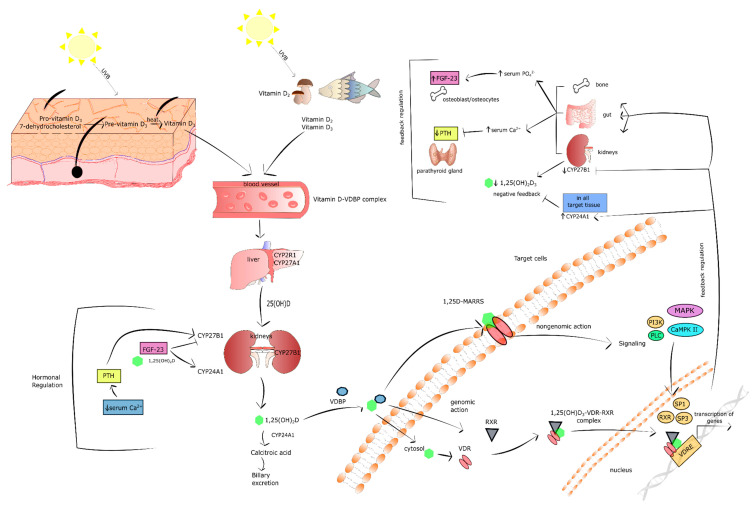
Figure 1
Figure 1
The overview of vitamin D. Stimulatory interactions are expressed by arrows and inhibition by T-bars. ↓ denotes decrease ↑ denotes increase.
Figure 2
Figure 2
The insulin resistance mechanism in skeletal muscle. Stimulatory interactions are expressed by arrows and inhibition by T-bars, red color of arrow and T-bars denotes insulin resistance state, whereas black physiological state. ↓ denotes decrease ↑ denotes increase.
Figure 3
Figure 3
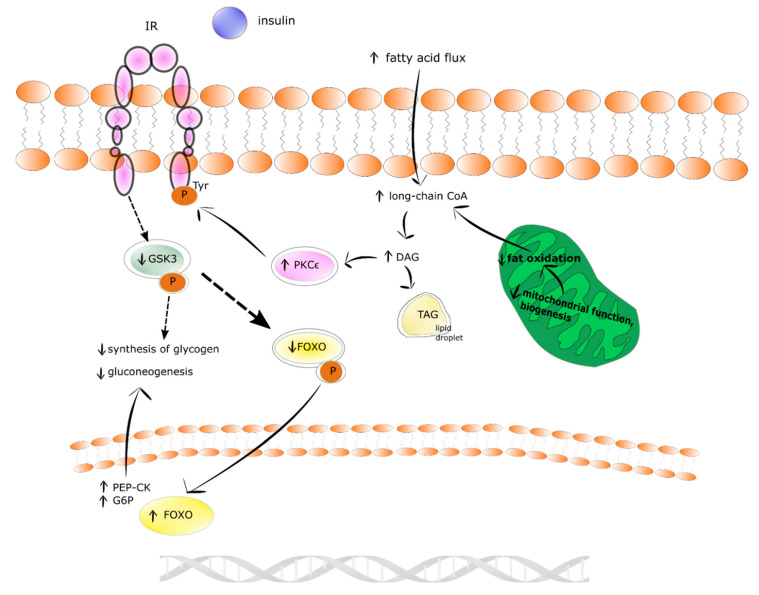
The insulin resistance mechanism in human liver. Physiological state is denoted by solid arrows and insulin resistant state by dotted arrows. ↓ denotes decrease ↑ denotes increase.
Figure 4
Figure 4
The effect of vitamin D on pancreatic β-cells. Stimulatory interactions are indicated by solid arrows and attenuation by dotted arrows. Enhancement is expressed by +. ↑ denotes increase.
Figure 5
Figure 5
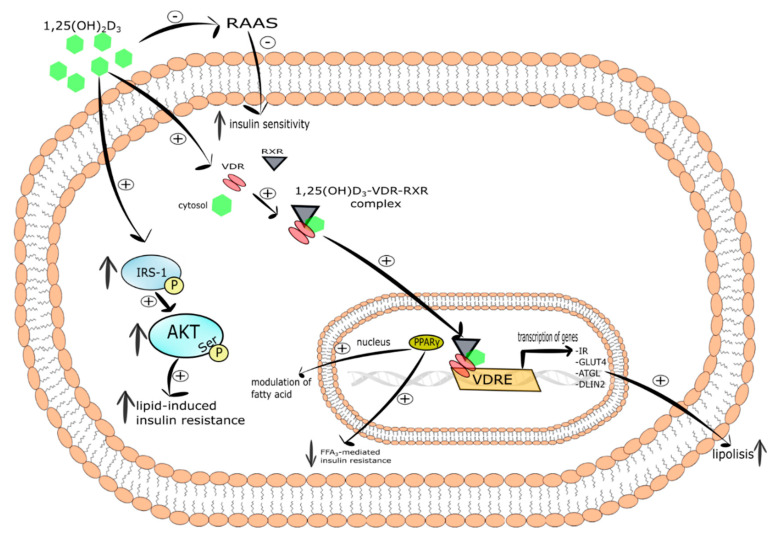
The effect of vitamin D on adipocyte function. Stimulatory interactions are indicated by + and inhibition by -; ↓ denotes decrease ↑ denotes increase.
Figure 6
Figure 6
The mechanism of vitamin D action in myocyte. Stimulatory interactions are indicated by + and inhibition by -; ↓ denotes decrease ↑denotes increase.
Figure 7
Figure 7
The action of vitamin D in hepatocyte. Stimulatory interactions are indicated by + and inhibition by -; ↓ denotes decrease ↑ denotes increase.

References

    1. Wang H., Chen W., Li D., Yin X., Zhang X., Olsen N., Zheng S.G. Vitamin D and Chronic Diseases. Aging Dis. 2017;8:346–353. doi: 10.14336/AD.2016.1021. - DOI - PMC - PubMed
    1. Berridge M.J. Vitamin D deficiency and diabetes. Biochem. J. 2017;474:1321–1332. doi: 10.1042/BCJ20170042. - DOI - PubMed
    1. Al-Shoumer K.A., Al-Essa T.M. Is there a relationship between vitamin D with insulin resistance and diabetes mellitus? World J. Diabetes. 2015;6:1057–1064. doi: 10.4239/wjd.v6.i8.1057. - DOI - PMC - PubMed
    1. Tao S., Yuan Q., Mao L., Chen F.-L., Ji F., Cui Z.-H. Vitamin D deficiency causes insulin resistance by provoking oxidative stress in hepatocytes. Oncotarget. 2017;8:67605–67613. doi: 10.18632/oncotarget.18754. - DOI - PMC - PubMed
    1. Wenclewska S., Szymczak-Pajor I., Drzewoski J., Bunk M., Śliwińska A. Vitamin D Supplementation Reduces Both Oxidative DNA Damage and Insulin Resistance in the Elderly with Metabolic Disorders. Int. J. Mol. Sci. 2019;20:2891. doi: 10.3390/ijms20122891. - DOI - PMC - PubMed

MeSH terms