


Impact of Vitamin D Deficiency on COVID-19-A Prospective Analysis from the CovILD Registry
- PMID: 32932831
- PMCID: PMC7551662
- DOI: 10.3390/nu12092775
Impact of Vitamin D Deficiency on COVID-19-A Prospective Analysis from the CovILD Registry
Abstract
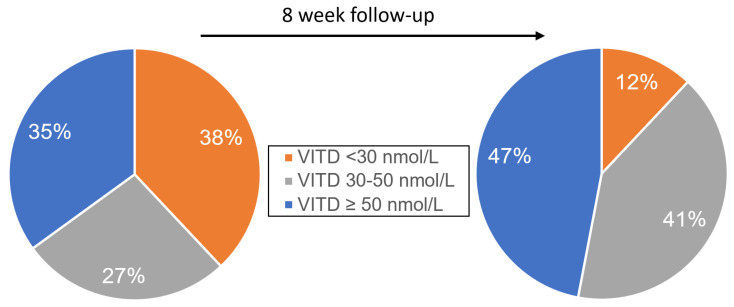
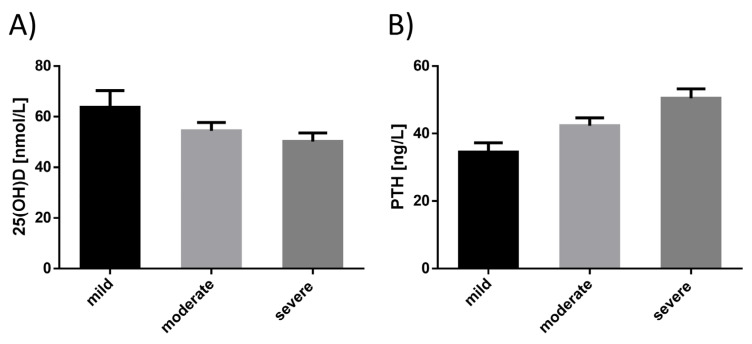
The novel Coronavirus disease 2019 (COVID-19) caused by severe acute respiratory syndrome coronavirus type 2 (SARS-CoV-2) is a global health concern. Vitamin D (VITD) deficiency has been suggested to alter SARS-CoV-2 susceptibility and the course of disease. Thus, we aimed to investigate associations of VITD status to disease presentation within the CovILD registry. This prospective, multicenter, observational study on long-term sequelae includes patients with COVID-19 after hospitalization or outpatients with persistent symptoms. Eight weeks after PCR confirmed diagnosis, a detailed questionnaire, a clinical examination, and laboratory testing, including VITD status, were evaluated. Furthermore, available laboratory specimens close to hospital admission were used to retrospectively analyze 25-hydroxyvitamin D levels at disease onset. A total of 109 patients were included in the analysis (60% males, 40% females), aged 58 ± 14 years. Eight weeks after the onset of COVID-19, a high proportion of patients presented with impaired VITD metabolism and elevated parathyroid hormone (PTH) levels. PTH concentrations were increased in patients who needed intensive care unit (ICU) treatment, while VITD levels were not significantly different between disease severity groups. Low VITD levels at disease onset or at eight-week follow-up were not related to persistent symptom burden, lung function impairment, ongoing inflammation, or more severe CT abnormalities. VITD deficiency is frequent among COVID-19 patients but not associated with disease outcomes. However, individuals with severe disease display a disturbed parathyroid-vitamin-D axis within their recovery phase. The proposed significance of VITD supplementation in the clinical management of COVID-19 remains elusive.
Keywords: COVID-19; PTH; SARS-CoV-2; VITD; parathyroid hormone; vitamin D.
Conflict of interest statement
The authors declare no conflict of interest.
Figures
References
-
- WHO Coronavirus Disease 2019. [(accessed on 23 June 2020)];2020 Available online: https://www.who.int/emergencies/diseases/novel-coronavirus-2019/events-a....
-
- CfDCaP Coronavirus (COVID-19) [(accessed on 23 June 2020)];2020 Available online: https://www.cdc.gov/coronavirus/2019-ncov/index.html.
-
- ECfDPaC COVID-19 Pandemic. [(accessed on 23 June 2020)];2020 Available online: https://www.ecdc.europa.eu/en/covid-19-pandemic.
-
- Cummings M.J., Baldwin M.R., Abrams D., Jacobson S.D., Meyer B.J., Balough E.M., Aaron J.G., Claassen J., Rabbani L.E., Hastie J., et al. Epidemiology, clinical course, and outcomes of critically ill adults with COVID-19 in New York City: A prospective cohort study. Lancet. 2020;395:1763–1770. doi: 10.1016/S0140-6736(20)31189-2. - DOI - PMC - PubMed
Publication types
MeSH terms
Substances
LinkOut - more resources
Full Text Sources
Medical
Miscellaneous
