


Recent Progress in the Systemic Treatment of Advanced/Metastatic Cholangiocarcinoma
- PMID: 32932925
- PMCID: PMC7565778
- DOI: 10.3390/cancers12092599
Recent Progress in the Systemic Treatment of Advanced/Metastatic Cholangiocarcinoma
Abstract
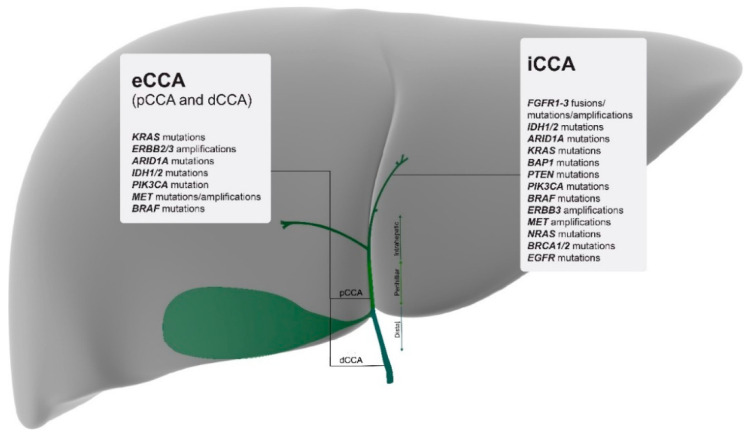
Cholangiocarcinomas (CCAs) comprise of a heterogeneous group of cancers arising in the biliary tract (intrahepatic or iCCA, perihilar or pCCA and distal or dCCA; the latter are known under the collective term of eCCA), each subtype having its own particularities in carcinogenesis, management and prognosis. The increasing incidence in recent decades, limited treatment options and high mortality rates, even in the early stages, have led to an imperious need for more in-depth understanding and development of tailored treatments for this type of aggressive tumour. The wide use of molecular profiling has increased the understanding of biology and identified key molecular drivers, for example, IDH1 mutations or FGFR2 fusions for iCCA, or BRAF mutations in eCCA. Most recently, the FDA approved pemigatinib, an FGFR inhibitor and ivosidenib, an IDH1 inhibitor, but even though progress has been made to better understand the mechanisms of tumorigenesis, genetic make-up, and tumour resistance to standard chemotherapy and targeted therapies, cholangiocarcinomas still represent an important challenge in the daily clinical practice of oncology. The purpose of this review is to highlight the recent progress in the systemic treatment of advanced/metastatic CCAs with a focus on targeted drugs and their biomarkers currently evaluated in early-phase clinical trials.
Keywords: biliary tract cancers; cholangiocarcinoma; driver mutations; immunotherapy; molecular profiling; targeted therapy.
Conflict of interest statement
The authors declare no conflict of interest.
Figures
References
-
- Benson A.B., III, D’Angelica M.I., Abbott D.E., Abrams T.A., Anaya D.A., Anders R., Are C., Borad M., Brown D., Chahal P., et al. NCCN Guidelines v. 4.2020 Hepatobiliary Cancers. [(accessed on 17 July 2020)]; Available online: https://www.nccn.org/professionals/physician_gls/pdf/hepatobiliary.pdf.
-
- Demols A., Borbath I., Eynde M.V.D., Houbiers G., Peeters M., Marechal R., Delaunoit T., Goemine J.-C., Laurent S., Holbrechts S., et al. Regorafenib after failure of gemcitabine and platinum-based chemotherapy for locally advanced/metastatic biliary tumors: A randomized, double-blind, phase 2 trial—REACHIN. Ann. Oncol. 2020 doi: 10.1016/j.annonc.2020.05.018. - DOI - PubMed
Publication types
LinkOut - more resources
Full Text Sources
Research Materials
Miscellaneous
