Review
. 2020 Sep 11;12(9):2785.
doi: 10.3390/nu12092785.

Nutrition, Bioenergetics, and Metabolic Syndrome

Affiliations
Review

Nutrition, Bioenergetics, and Metabolic Syndrome

Francesc Josep García-García et al. Nutrients. .

Abstract

According to the World Health Organization (WHO), the global nutrition report shows that whilst part of the world's population starves, the other part suffers from obesity and associated complications. A balanced diet counterparts these extreme conditions with the proper proportion, composition, quantity, and presence of macronutrients, micronutrients, and bioactive compounds. However, little is known on the way these components exert any influence on our health. These nutrients aiming to feed our bodies, our tissues, and our cells, first need to reach mitochondria, where they are decomposed into CO2 and H2O to obtain energy. Mitochondria are the powerhouse of the cell and mainly responsible for nutrients metabolism, but they are also the main source of oxidative stress and cell death by apoptosis. Unappropriated nutrients may support mitochondrial to become the Trojan horse in the cell. This review aims to provide an approach to the role that some nutrients exert on mitochondria as a major contributor to high prevalent Western conditions including metabolic syndrome (MetS), a constellation of pathologic conditions which promotes type II diabetes and cardiovascular risk. Clinical and experimental data extracted from in vitro animal and cell models further demonstrated in patients, support the idea that a balanced diet, in a healthy lifestyle context, promotes proper bioenergetic and mitochondrial function, becoming the best medicine to prevent the onset and progression of MetS. Any advance in the prevention and management of these prevalent complications help to face these challenging global health problems, by ameliorating the quality of life of patients and reducing the associated sociosanitary burden.

Keywords: balanced diet; lifestyle; metabolic syndrome; mitochondria; mitochondrial dysfunction; nutrients.


Conflict of interest statement

The authors declare no conflict of interest.

Figures
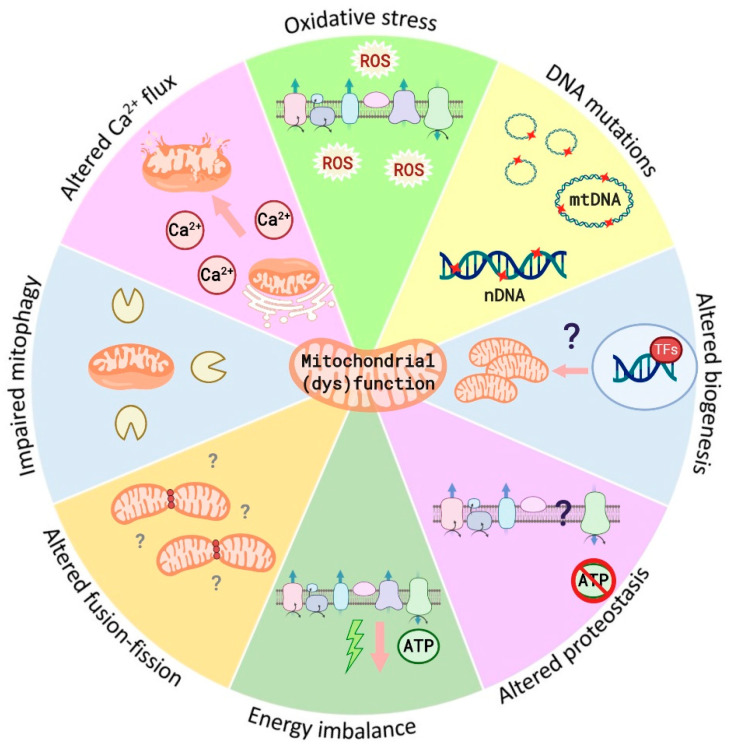
Figure 1
Figure 1
Mitochondrial (dys)function factors. Mitochondrial dysfunction is characterized by the combination of some of the processes described above and plays a central role in several diseases, such as metabolic syndrome. All these processes are closely related, usually affecting one each other and rarely having isolated effects. Oxidative stress leads to the accumulation of reactive oxygen species (ROS). In turn, high amount of ROS might trigger DNA mutations. Mitochondrial (dys)function can also be associated to reduced mitochondrial biogenesis through the decreased expression of mitochondrial genes. Moreover, altered proteostasis (biogenesis, folding, trafficking, and degradation of mitochondrial proteins) is common. Another frequent consequence is an energy imbalance limiting the ATP supply. Furthermore, mitochondrial (dys)function may condition mitochondrial fusion-fission processes compromising mitochondrial renewal and material exchange. Similarly, impaired mitophagy triggers the accumulation of non-functional mitochondria. Finally, mitochondrial altered Ca2+ flux and buffering, disrupt communication with other organelles such as endoplasmic reticulum and, in case of calcium release into the cytoplasm, the potential trigger of cell death.
Figure 2
Figure 2
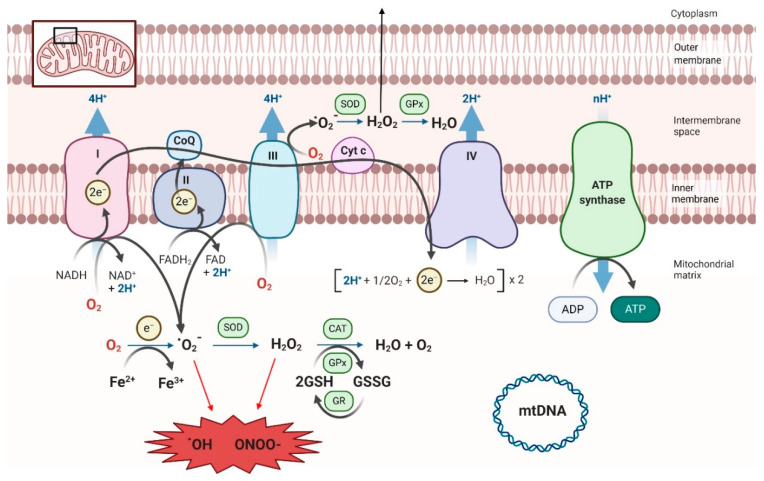
Main sources of mitochondrial reactive oxygen species (ROS). Mitochondrial respiratory chain (MRC) is composed of four enzyme complexes (I–IV). Electrons donated from NADH and FADH2 in the Krebs cycle are transferred at complex I and II respectively, and consecutively to complex III and IV. This electrons transfer is coupled with protons transport across the inner membrane, generating a proton-gradient, allowing ADP phosphorylation through ATP synthase (complex V). Oxygen metabolism generates superoxide anion (·02), which in turn is conversed into hydrogen peroxide (H2O2) by SOD (superoxide dismutase) and then converted into water thanks to the action of some of the antioxidant enzymatic defenses such as catalase (CAT) or the glutathione peroxidase (GPx) reductase (GPr) system. Excessive ROS production can oxidize proteins, lipids, or mitochondrial DNA (mtDNA), eventually leading to mitochondrial dysfunction and cell death.
Figure 3
Figure 3
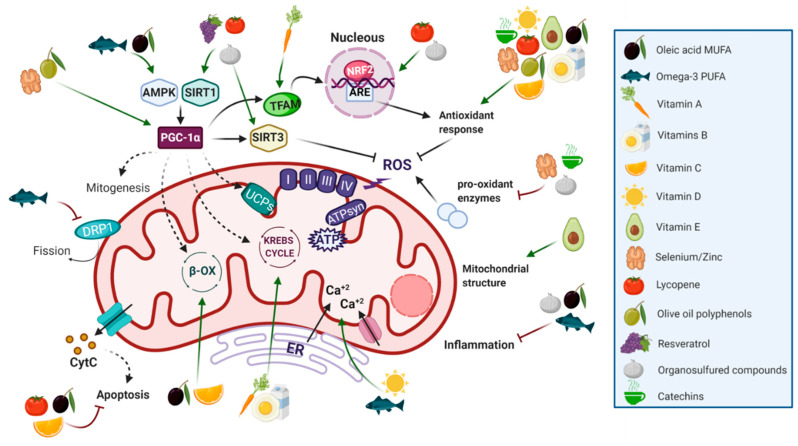
Principal nutrients with beneficial effects on mitochondrial function. Oleic acid, omega-3, selenium and zinc, resveratrol, lycopene, and the organosulfur compounds (OSCs) activate numerous pathways, among them, direct or indirectly, PGC-1α signaling, one of the main coactivators and master gene regulator of energy metabolism and mitochondrial biogenesis. The activation of the PGC-1α promotes mitogenesis, β-oxidation, glucose utilization, uncoupling, and antioxidant detoxification. Moreover, vitamin A and vitamins from the B group are essential for a correct functioning of the glycolytic energy system, and vitamin C and oleic acid for the functioning of β-oxidation, among others. One of the main effects of oleic acid, lycopene, organosulfur compounds (OSCs), vitamins B, C, D, selenium, and zinc, catechins and olive oil polyphenols (OOPs) in our cells is the decrease of oxidative stress by both promoting an antioxidant response and inhibiting pro-oxidant enzymes. Vitamin E also acts as an antioxidant and maintains a correct mitochondrial structure, while omega-3 inhibits mitochondrial fission. Omega-3 and vitamin D are involved in calcium homeostasis, among others. Vitamin C, lycopene, and oleic acid have been reported to inhibit apoptosis, while oleic acid, omega-3, and OSCs reduce inflammation.
Figure 4
Figure 4
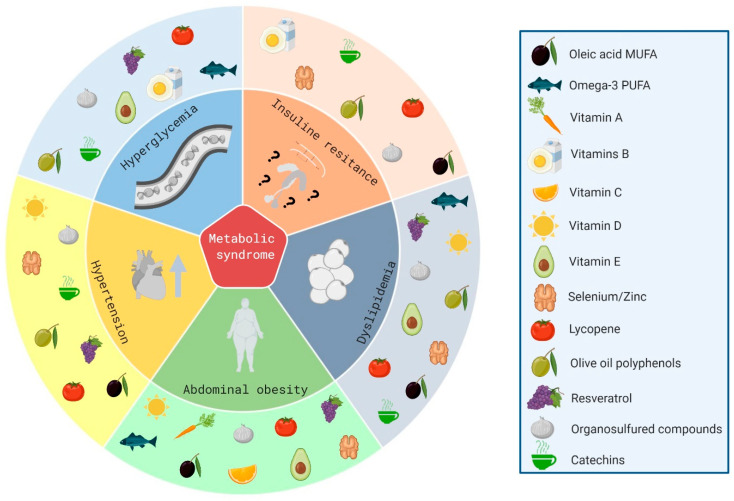
Main nutrient impact on metabolic syndrome (MetS) components. The MetS is a constellation of pathologic conditions which includes hyperglycemia, insulin resistance, dyslipidemia (hypertriglyceridemia and low high density lipoprotein (HDL)-cholesterol levels), central obesity, and hypertension. Several studies have demonstrated that nutrients such as oleic acid monounsaturated fatty acid (MUFA), omega-3 polyunsaturated fatty acids (PUFAs), vitamins A, B, C, D, and E, selenium and zinc elements, lycopene, olive oil polyphenols, resveratrol, organosulfured compounds, and catechins have a positive impact on MEtS components, improving the onset and development of the disease.

References

    1. Cena H., Calder P.C. Defining a healthy diet: Evidence for the role of contemporary dietary patterns in health and disease. Nutrients. 2020;12:334. doi: 10.3390/nu12020334. - DOI - PMC - PubMed
    1. World Health Organization Healthy Diet. [(accessed on 4 May 2020)]; Available online: https://www.who.int/news-room/fact-sheets/detail/healthy-diet.

    1. Kassi E., Pervanidou P., Kaltsas G., Chrousos G. Metabolic syndrome: Definitions and controversies. BMC Med. 2011;9:48. doi: 10.1186/1741-7015-9-48. - DOI - PMC - PubMed
    1. Bhatti J.S., Bhatti G.K., Reddy P.H. Mitochondrial dysfunction and oxidative stress in metabolic disorders—A step towards mitochondria based therapeutic strategies. Biochim. Biophys. Acta Mol. Basis Dis. 2016;1863:1066–1077. doi: 10.1016/j.bbadis.2016.11.010. - DOI - PMC - PubMed
    1. Bentley-Lewis R., Koruda K., Seely E.W. The metabolic syndrome in women. Nat. Clin. Pract. Endocrinol. Metab. 2007;3:696–704. doi: 10.1038/ncpendmet0616. - DOI - PMC - PubMed