


Are Respiratory Responses to Cold Air Exercise Different in Females Compared to Males? Implications for Exercise in Cold Air Environments
- PMID: 32933124
- PMCID: PMC7559764
- DOI: 10.3390/ijerph17186662
Are Respiratory Responses to Cold Air Exercise Different in Females Compared to Males? Implications for Exercise in Cold Air Environments
Abstract
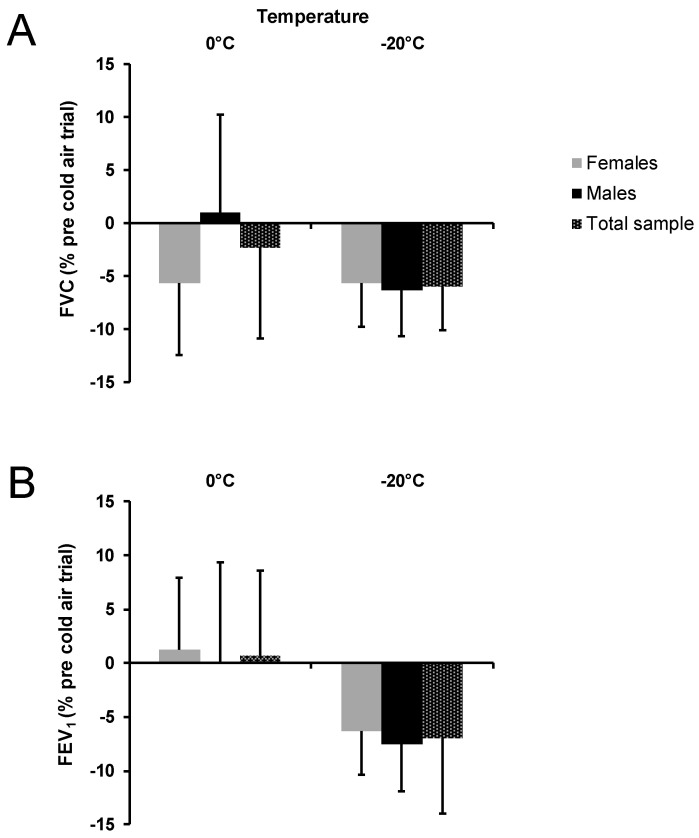
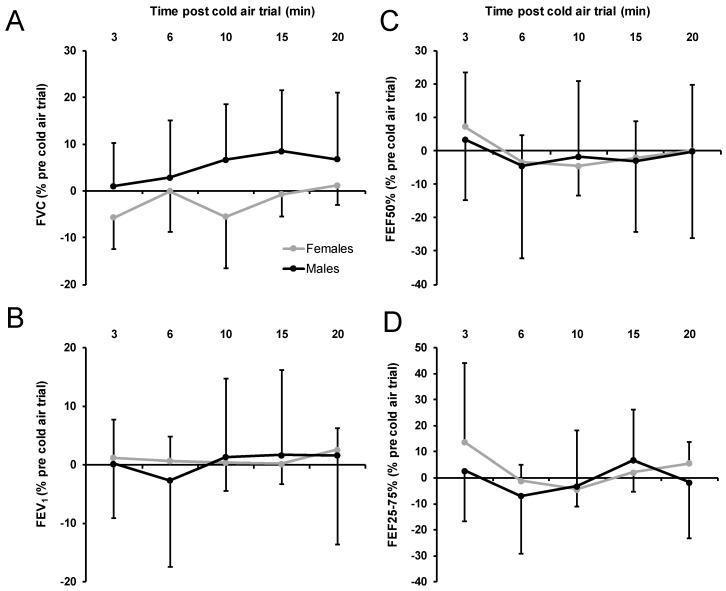
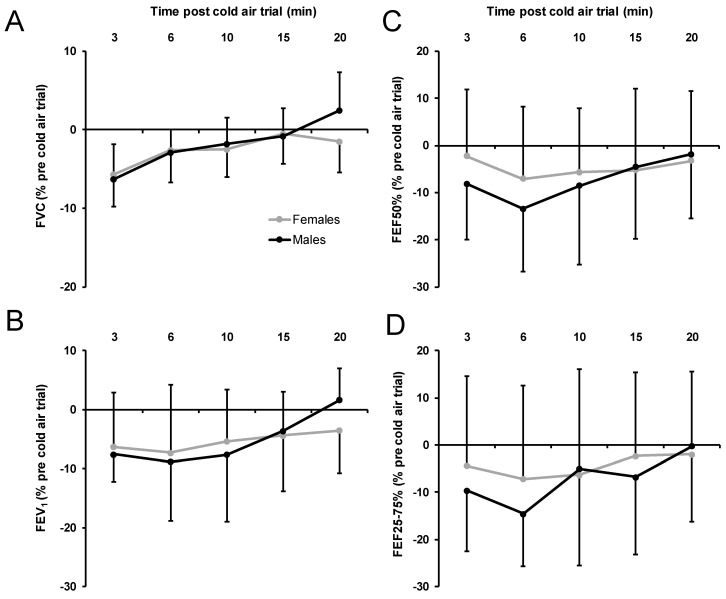
Research has shown that cold air exercise causes significant respiratory dysfunction, especially in female athletes. However, how female and male athletes respond to cold air exercise is not known. Thus, we aimed to compare acute respiratory responses (function, recovery and symptoms) in males and females after high-intensity cold air exercise. Eighteen (nine female) athletes completed two environmental chamber running trials at 0 °C and -20 °C (humidity 34 ± 5%) on different days in a randomized starting order. Spirometry was performed pre, 3, 6, 10, 15 and 20 min post. Respiratory symptoms were measured posttrial and heart rate and rating of perceived exertion were assessed during each trial. No significant differences in delta change (pre to post) were found at either temperature between sexes for FEV1, FVC, FEF50% and FEF25-75%. At -20 °C, FEV1 decreased similarly in both sexes (males: 7.5%, females: 6.3%) but not at 0 °C, p = 0.003. Postexertion respiratory function recovery and reported symptoms were not different between sexes at either temperature. These results indicate no sex-based differences in acute respiratory responses (function, recovery and symptoms) to cold air exercise. However, intense exercise at -20 °C is challenging to the respiratory system in both sexes and may lead to altered respiratory responses compared to mild winter conditions like 0 °C.
Keywords: airway hyperresponsiveness; airway provocation; athlete health; exercise induced bronchoconstriction; post exertion cough; spirometry; wheeze; winter sport athletes.
Conflict of interest statement
The authors declare no conflict of interest.
Figures
References
-
- Weiler J.M., Anderson S.D., Randolph C., Bonini S., Craig T.J., Pearlman D.S., Rundell K.W., Silvers W.S., Storms W.W., Bernstein D.I. Pathogenesis, prevalence, diagnosis, and management of exercise-induced bronchoconstriction: A practice parameter. Ann. Allergy Asthma Immunol. 2010;105:S1–S47. doi: 10.1016/j.anai.2010.09.021. - DOI - PubMed
-
- Fitch K.D., Sue-Chu M., Anderson S.D., Boulet L.-P., Hancox R.J., McKenzie D.C., Backer V., Rundell K.W., Alonso J.M., Kippelen P. Asthma and the elite athlete: Summary of the International Olympic Committee’s consensus conference, Lausanne, Switzerland, January 22–24, 2008. J. Allergy Clin. Immunol. 2008;122:254–260. doi: 10.1016/j.jaci.2008.07.003. - DOI - PubMed
MeSH terms
LinkOut - more resources
Full Text Sources
Medical
