


Postoperative delirium is associated with decreased recovery of ambulation one-month after surgery
- PMID: 32933746
- PMCID: PMC7910322
- DOI: 10.1016/j.amjsurg.2020.08.031
Postoperative delirium is associated with decreased recovery of ambulation one-month after surgery
Abstract
Background: We hypothesized that postoperative delirium is associated with diminished recovery toward baseline preoperative ambulation levels one-month postoperatively.
Methods: Patients included were ≥60 years old undergoing inpatient operations. Ambulation was measured as steps/day using an accelerometer worn for ≥3-days preoperatively and ≥28-days postoperatively. Primary outcome was the percent recovery of preoperative steps.
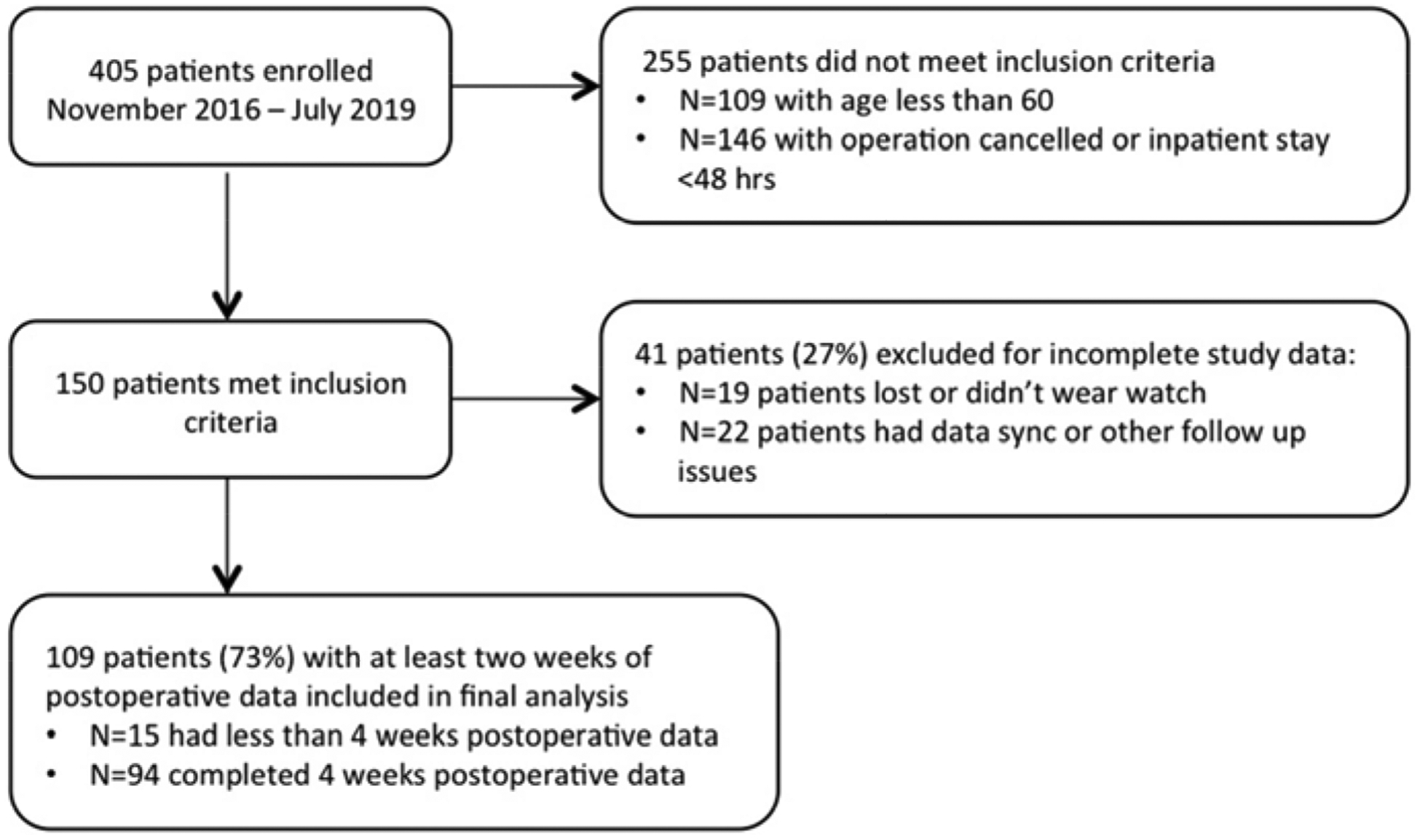
Results: 109 patients were included; 17 (16%) developed postoperative delirium. Recovery of ambulation toward preoperative baseline at postoperative day-28 was decreased in delirium group (34% vs. 69%; p < 0.01). Immediate postoperative ambulation was similar in the delirium vs. no-delirium groups (p = 0.79). Delirium occurred on average on postoperative 3 ± 4 days. Subsequently, ambulation was decreased in the delirium group compared to non-delirium group at postoperative week-1 (p = 0.01), week-2 (p = 0.02), week-3 (p < 0.01) and week-4 (p < 0.01).
Conclusion: Patients undergoing inpatient operations who develop delirium recover only one-third of their baseline steps one-month postoperatively. Postoperative delirium results in a decreased recovery towards baseline ambulation for at least 4-weeks following major operations in comparison to non-delirious patients. The decrease in ambulation in the delirium versus no-delirium groups occurred after the occurrence of postoperative delirium.
Keywords: Accelerometer activity tracker; Ambulation; Older adults; Postoperative delirium.
Published by Elsevier Inc.
Conflict of interest statement
Declaration of competing interest The authors have no conflict of interest to report.
Figures


References
-
- Marcantonio ER, Juarez G, Goldman L, et al. The relationship of postoperative delirium with psychoactive medications. JAMA. 1994;272(19):1518–1522. - PubMed
-
- Robinson TN, Raeburn CD, Tran ZV, Angles EM, Brenner LA, Moss M. Postoperative delirium in the elderly: risk factors and outcomes. Ann Surg. 2009;249(1):173–178. - PubMed
-
- Inouye SK, Bogardus ST Jr., Charpentier PA, et al. A multicomponent intervention to prevent delirium in hospitalized older patients. N Engl J Med. 1999;340(9):669–676. - PubMed
-
- Bureau USC. 2017 National Population Projections Tables: Main Series. https://www.census.gov/data/tables/2017/demo/popproj/2017-summary-tables.... Published 2017. Updated 2/20/2020. Accessed 5/18/2020.
Publication types
MeSH terms
Grants and funding
LinkOut - more resources
Full Text Sources
Medical
