. 2020 Sep 15;11(1):4620.
doi: 10.1038/s41467-020-18474-w.

Entamoeba and Giardia parasites implicated as hosts of CRESS viruses

Affiliations

Entamoeba and Giardia parasites implicated as hosts of CRESS viruses

Cormac M Kinsella et al. Nat Commun. .

Abstract

Metagenomic techniques have enabled genome sequencing of unknown viruses without isolation in cell culture, but information on the virus host is often lacking, preventing viral characterisation. High-throughput methods capable of identifying virus hosts based on genomic data alone would aid evaluation of their medical or biological relevance. Here, we address this by linking metagenomic discovery of three virus families in human stool samples with determination of probable hosts. Recombination between viruses provides evidence of a shared host, in which genetic exchange occurs. We utilise networks of viral recombination to delimit virus-host clusters, which are then anchored to specific hosts using (1) statistical association to a host organism in clinical samples, (2) endogenous viral elements in host genomes, and (3) evidence of host small RNA responses to these elements. This analysis suggests two CRESS virus families (Naryaviridae and Nenyaviridae) infect Entamoeba parasites, while a third (Vilyaviridae) infects Giardia duodenalis. The trio supplements five CRESS virus families already known to infect eukaryotes, extending the CRESS virus host range to protozoa. Phylogenetic analysis implies CRESS viruses infecting multicellular life have evolved independently on at least three occasions.


Conflict of interest statement

The authors declare no competing interests.

Figures
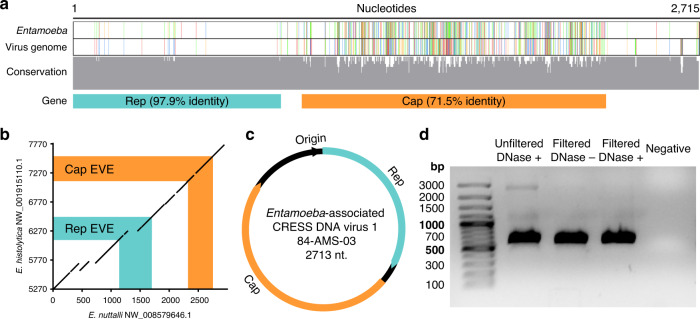
Fig. 1
Fig. 1. Whole CRESS virus genomes are integrated in Entamoeba genomes.
a Cropped nucleotide alignment between Entamoeba dispar contig (AANV02000527.1) containing a complete virus integration and the genome of Entamoeba-associated CRESS DNA virus 1, isolate 84-AMS-03 (accession MT293413.1); also see Supplementary Fig. 2. Coloured vertical bars denote single nucleotide variations between the sequences (adenine = green, guanine = red, thymine = blue, cytosine = orange), with conservation across the alignment displayed below. b Dotplot of BLAT generated nucleotide alignment between endogenous viral elements and flanking sequence from two closely related Entamoeba species (x-axis sequence reverse complemented). c Example of the circular genome organisation of identified CRESS viruses. d Exogenous virus DNA is protected by a viral capsid, as it can be PCR-amplified after filtration and treatment with DNase (one independent experiment).
Fig. 2
Fig. 2. Parasite-infecting CRESS virus genomes are distinct from known CRESS diversity.
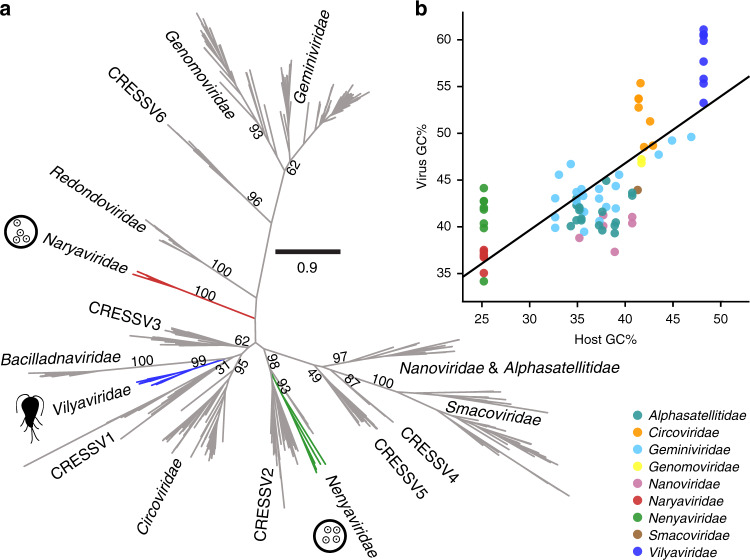
a Phylogenetic maximum-likelihood tree of the Rep protein, scale bar refers to amino acid substitutions per site, numerical values represent bootstrap support of major nodes. The Naryaviridae, Nenyaviridae, and Vilyaviridae contain endogenous viral element sequences extracted from host genomes, respective pictograms of Entamoeba (tetranucleate cyst stage) and Giardia (flagellated trophozoite stage) are shown to indicate this. Five public viral genomes were also found to cluster within these families (MG571899.1, KU043415.1, MH617639.1, KY487991.1 and LC406405.1). b Virus GC-content positively correlates with host GC-content (linear regression, n = 79 biologically independent viral genome sequences, r2 = 0.58, p = 0.01).
Fig. 3
Fig. 3. Cap genes of different ancestry in Naryaviridae and Nenyaviridae.
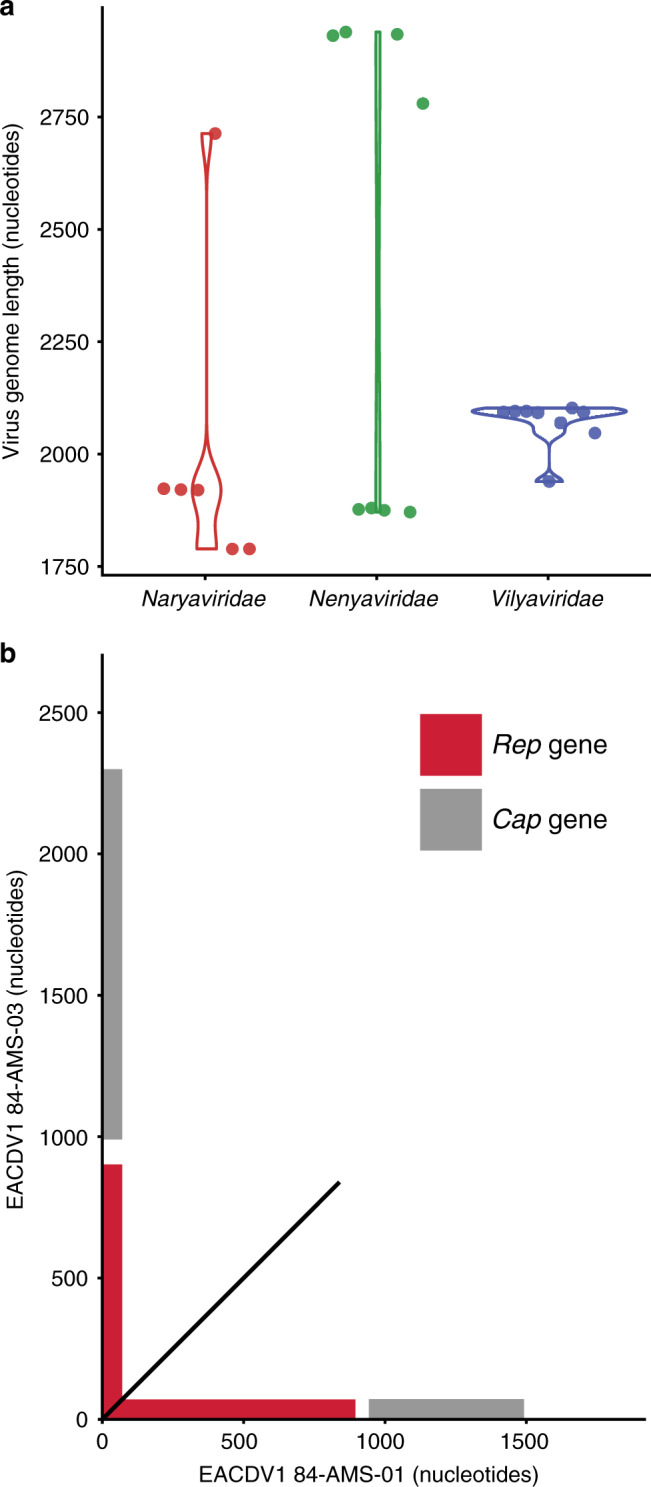
a Genome length variation in Naryaviridae, Nenyaviridae, and Vilyaviridae. Eighteen complete CRESS virus genomes identified in this study were plotted alongside five complete publicly available genomes. b Dotplot of BLAT generated nucleotide alignment between a short and a long genome from the Naryaviridae, showing no detectable alignment between the Cap genes.
Fig. 4
Fig. 4. Recombination of genetic modules between virus families infecting the same host.
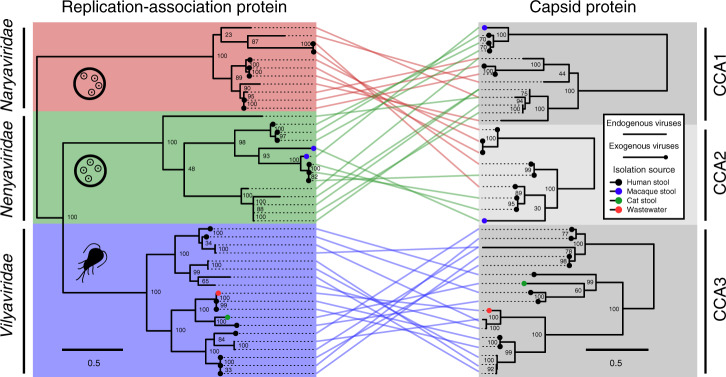
Phylogenetic maximum-likelihood trees of viral Rep and Cap proteins, scale bars refer to amino acid substitutions per site, numerical values represent bootstrap support. Lines connect genes from the same virus or physically close endogenous viral genes. Pictograms of Entamoeba (tetranucleate cyst stage) and Giardia (flagellated trophozoite stage) are shown to indicate virus host. CCA = CRESS virus Cap assemblage.

References

    1. Finkbeiner SR, et al. Metagenomic analysis of human diarrhea: viral detection and discovery. PLoS Pathog. 2008;4:e1000011. - PMC - PubMed
    1. Gregory AC, et al. Marine DNA viral macro- and microdiversity from pole to pole. Cell. 2019;177:1109–1123.e14. - PMC - PubMed
    1. Rosario K, et al. Virus discovery in all three major lineages of terrestrial arthropods highlights the diversity of single-stranded DNA viruses associated with invertebrates. PeerJ. 2018;6:e5761. - PMC - PubMed
    1. Zhao L, Rosario K, Breitbart M, Duffy S. Eukaryotic Circular Rep-Encoding Single-Stranded DNA (CRESS DNA) viruses: ubiquitous viruses with small genomes and a diverse host range. Adv. Virus Res. 2019;103:71–133. - PubMed
    1. Simmonds P, et al. Virus taxonomy in the age of metagenomics. Nat. Rev. Microbiol. 2017;15:161–168. - PubMed

Publication types