. 2020 Aug 31:2020:6372059.
doi: 10.1155/2020/6372059. eCollection 2020.

Scopolamine-Induced Memory Impairment in Mice: Neuroprotective Effects of Carissa edulis (Forssk.) Valh (Apocynaceae) Aqueous Extract

Affiliations

Scopolamine-Induced Memory Impairment in Mice: Neuroprotective Effects of Carissa edulis (Forssk.) Valh (Apocynaceae) Aqueous Extract

Fanta Sabine Adeline Yadang et al. Int J Alzheimers Dis. .

Abstract

Alzheimer's disease is first characterised by memory loss related to the central cholinergic system alteration. Available drugs provide symptomatic treatment with known side effects. The present study is aimed to evaluate the properties of Carissa edulis aqueous extract on a Scopolamine mouse model as an attempt to search for new compounds against Alzheimer's disease-related memory impairment. Memory impairment was induced by administration of 1 mg/kg (i.p.) of Scopolamine for 7 days, and mice were treated with Carissa edulis aqueous extract. Behavioural studies were performed using T-maze and novel object recognition task for assessing learning and memory and open field test for locomotion. Brain acetylcholinesterase enzyme (AChE) activity was measured to evaluate the central cholinergic system. The level of MDA, glutathione, and catalase activity were measured to evaluate the oxidative stress level. Administration of Scopolamine shows a decrease in learning and memory enhancement during behavioural studies. A significant decrease in the time spent in the preferred arm of T-maze, in the time spent in the exploration of the novel object, and in the discrimination index of the familiar object was also observed. The significant impairment of the central cholinergic system was characterised in mice by an increase of AChE activity to 2.55 ± 0.10 mol/min/g with an increase in oxidative stress. Treatment with the different doses of Carissa edulis (62.8, 157, 314, and 628 mg/kg orally administrated) significantly increased the memory of mice in T-maze and novel object recognition tests and also ameliorated locomotion of mice in the open field. Carissa edulis aqueous extract treatment also decreases the AChE activity and brain oxidative stress. It is concluded that administration of Carissa edulis aqueous extract enhances memory of mice by reducing AChE activity and demonstrating antioxidant properties. This could be developed into a novel therapy against memory impairment related to Alzheimer's disease.


Conflict of interest statement

The authors declare that there is no conflict of interest.

Figures
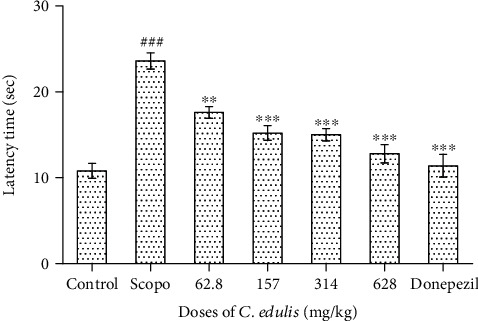
Figure 1
Figure 1
Latency time to enter into the preferred arm of the T-maze. Each bar represents the mean ± SEM (n = 5). The latency time increases for the Scopolamine group (###p < 0.001 vs. control), and the administration of C. edulis aqueous extract and Donepezil decreases this latency time (∗∗∗p < 0.001 vs. Scopo). One-way ANOVA followed by the Tukey multiple comparison test. Scopo: Scopolamine.
Figure 2
Figure 2
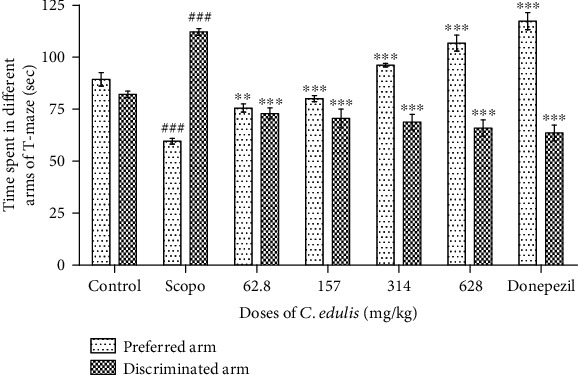
Time spent in the preferred and discriminated arms of the T-maze. Each bar represents the mean ± SEM (n = 5). The time spent in the preferred arm decreases, and the time spent in the discriminated arm increases in the Scopolamine group (###p < 0.001 vs. control), and the administration of C. edulis aqueous extract increases the time spent in the arm preferred and decreases the time spent in the discriminated arm (∗∗p < 0.01 and ∗∗∗p < 0.001 vs. Scopo). One-way ANOVA followed by the Tukey multiple comparison test. Scopo: Scopolamine.
Figure 3
Figure 3
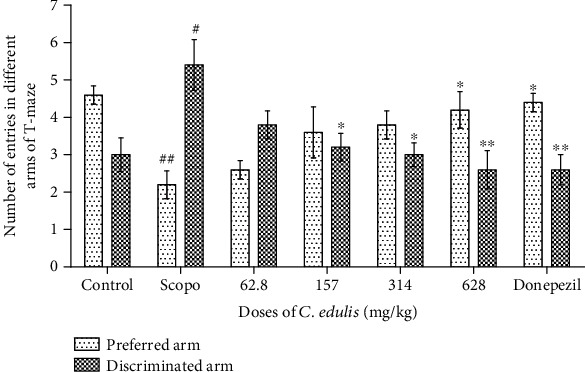
Number of entries in preferred and discriminated arms of the T-maze. Each bar represents the mean ± SEM (n = 5). The number of entries into the preferred arm decreases and in the discriminated arm increases in the Scopolamine group (#p < 0.05, ##p < 0.01 vs. control), and the administration of C. edulis increases the number of entries into the preferred arm and decreases the number of entries into the discriminated arm (p < 0.05 and ∗∗p < 0.01 vs. Scopo). One-way ANOVA followed by the Tukey multiple comparison test. Scopo: Scopolamine.
Figure 4
Figure 4
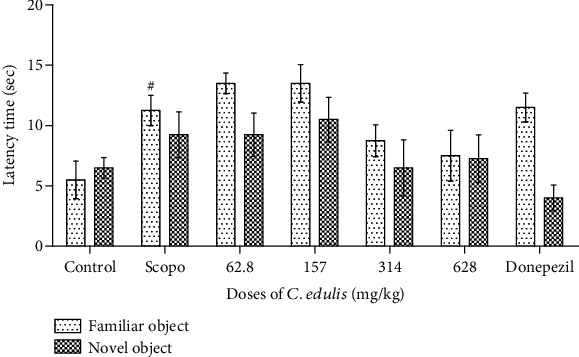
Effects of Carissa edulis aqueous extract on the latency time to discover the different objects. Each bar represents the mean ± SEM (n = 5). Latency time increases in the Scopolamine group (#p < 0.05 vs. control). No significant difference compared to the Scopolamine group. One-way ANOVA followed by the Tukey multiple comparison test. Scopo: Scopolamine.
Figure 5
Figure 5
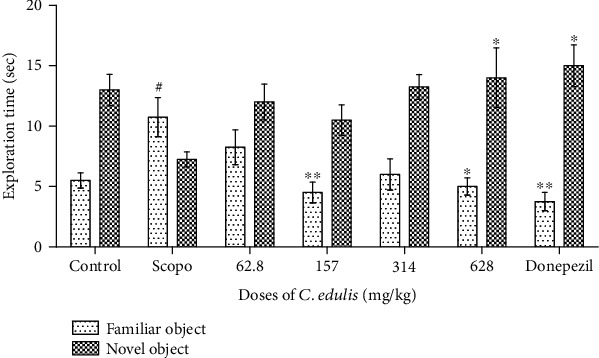
Effects of Carissa edulis aqueous extract on the exploration time of different objects. Each bar represents the mean ± ESM (n = 5). Exploration time increases in the Scopolamine group (#p < 0.001 vs. control), and administration of C. edulis increases this exploration time (p < 0.05 and ∗∗p < 0.01 vs. Scopo) for the new object. One-way ANOVA followed by the Tukey multiple comparison test. Scopo: Scopolamine.
Figure 6
Figure 6
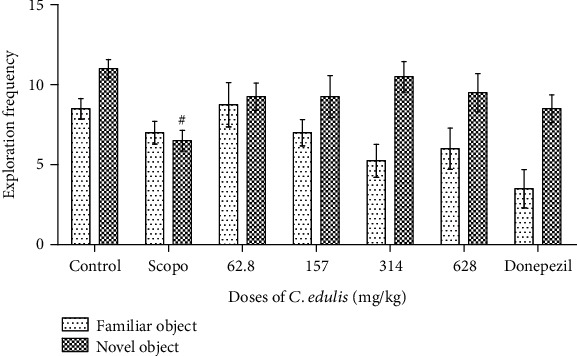
Effects of Carissa edulis aqueous extract on the number of explorations of different objects. Each bar represents the mean ± SEM (n = 5). The number of explorations decreases for the Scopolamine group (#p < 0.05 vs. control). No significant difference when compared to the Scopolamine group. One-way ANOVA followed by the Tukey multiple comparison test. Scopo: Scopolamine.
Figure 7
Figure 7
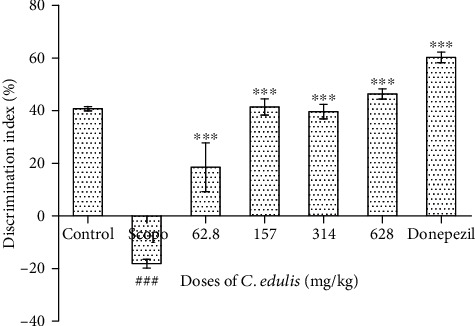
Effect of Carissa edulis aqueous extract on the discrimination index. Each bar represents the mean ± ESM (n = 5). The discrimination index decreases in the Scopolamine group (###p < 0.001 vs. control), and the administration of C. edulis aqueous extract increases this discrimination index (∗∗∗p < 0.001 vs. Scopo). One-way ANOVA followed by the Tukey multiple comparison test. Scopo: Scopolamine.

References

    1. Deschamps R., Moulignier A. Memory and related disorders. EMC-Neurologie. 2005;2(4):505–525. doi: 10.1016/j.emcn.2005.07.003. - DOI
    1. Kosteniuk J. G., Morgan D. G., O'Connell M. E., et al. Simultaneous temporal trends in dementia incidence and prevalence, 2005–2013: a population-based retrospective cohort study in Saskatchewan, Canada. International Psychogeriatrics. 2016;28(10):1643–1658. doi: 10.1017/S1041610216000818. - DOI - PubMed
    1. Hafez H. S., Ghareeb D. A., Saleh S. R., et al. Neuroprotective effect of Ipriflavone against Scopolamine-induced memory impairment in rats. Psychopharmacology. 2017;234(20):3037–3053. doi: 10.1007/s00213-017-4690-x. - DOI - PubMed
    1. Bachurin S. O., Bovina E. V., Ustyugov A. A. Drugs in clinical trials for Alzheimer's disease: the major trends. Medicinal Research Reviews. 2017;37(5):1186–1225. doi: 10.1002/med.21434. - DOI - PubMed
    1. Castellani R. J., Raj K. R., Mark A. S. Alzheimer disease. Disease-a-Month. 2010;56(9):484–546. doi: 10.1016/j.disamonth.2010.06.001. - DOI - PMC - PubMed

LinkOut - more resources