


Trial watch : the gut microbiota as a tool to boost the clinical efficacy of anticancer immunotherapy
- PMID: 32934879
- PMCID: PMC7466862
- DOI: 10.1080/2162402X.2020.1774298
Trial watch : the gut microbiota as a tool to boost the clinical efficacy of anticancer immunotherapy
Abstract
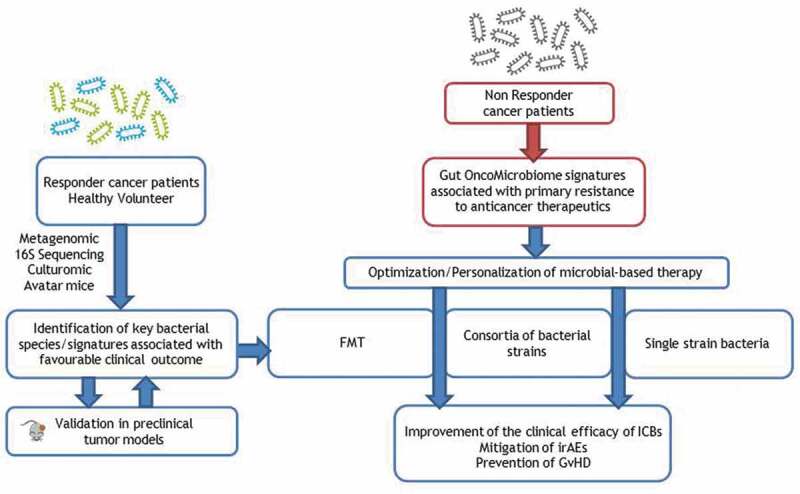
Accumulating evidence demonstrates the decisive role of the gut microbiota in determining the effectiveness of anticancer therapeutics such as immunogenic chemotherapy or immune checkpoint blockade in preclinical tumor models, as well as in cancer patients. In synthesis, it appears that a normal intestinal microbiota supports therapeutic anticancer responses, while a dysbiotic microbiota that lacks immunostimulatory bacteria or contains overabundant immunosuppressive species causes treatment failure. These findings have led to the design of clinical trials that evaluate the capacity of modulation of the gut microbiota to synergize with treatment and hence limit tumor progression. Along the lines of this Trial Watch, we discuss the rationale for harnessing the gut microbiome in support of cancer therapy and the progress of recent clinical trials testing this new therapeutic paradigm in cancer patients.
Keywords: Gut microbiota; anticancer therapeutics; clinical trials.
© 2020 The Author(s). Published with license by Taylor & Francis Group, LLC.
Figures
References
-
- Ansell SM, Lesokhin AM, Borrello I, Halwani A, Scott EC, Gutierrez M, Schuster SJ, Millenson MM, Cattry D, Freeman GJ, et al. PD-1 blockade with nivolumab in relapsed or refractory hodgkin’s lymphoma. New England Journal of Medicine. 2015;372(4):311–319. doi: 10.1056/NEJMoa1411087. - DOI - PMC - PubMed
-
- Topalian SL, Hodi FS, Brahmer JR, Gettinger SN, Smith DC, McDermott DF, Powderly JD, Carvajal RD, Sosman JA, Atkins MB, et al. Safety, activity, and immune correlates of anti–PD-1 antibody in cancer. New England Journal of Medicine. 2012;366(26):2443–2454. doi: 10.1056/NEJMoa1200690. - DOI - PMC - PubMed
Publication types
MeSH terms
Grants and funding
LinkOut - more resources
Full Text Sources
Medical
