


A rapid review of gender, sex, and sexual orientation documentation in electronic health records
- PMID: 32935124
- PMCID: PMC7671624
- DOI: 10.1093/jamia/ocaa158
A rapid review of gender, sex, and sexual orientation documentation in electronic health records
Abstract
Objective: The lack of precise and inclusive gender, sex, and sexual orientation (GSSO) data in electronic health records (EHRs) is perpetuating inequities of sexual and gender minorities (SGM). We conducted a rapid review on how GSSO documentation in EHRs should be modernized to improve the health of SGM.
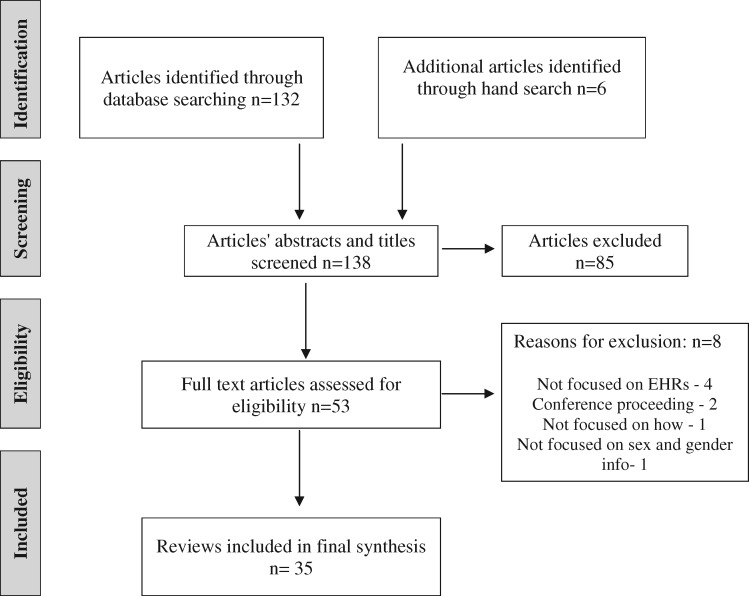
Materials and methods: We searched MEDLINE from 2015 to 2020 with terms for gender, sex, sexual orientation, and electronic health/medical records. Only literature reviews, primary studies, and commentaries from peer-reviewed journals in English were included. Two researchers screened citations and reviewed articles with help from a third to reach consensus. Covidence, Excel, and Atlas-TI were used to track articles, extract data, and synthesize findings, respectively.
Results: Thirty-five articles were included. The 5 themes to modernize GSSO documentation in EHRs were (1) creating an inclusive, culturally competent environment with precise terminology and standardized data collection; (2) refining guidelines for identifying and matching SGM patients with their care needs; (3) improving patient-provider relationships by addressing patient rights and provider competencies; (4) recognizing techno-socio-organizational aspects when implementing GSSO in EHRs; and (5) addressing invisibility of SGM by expanding GSSO research.
Conclusions: The literature on GSSO documentation in EHRs is expanding. While this trend is encouraging, there are still knowledge gaps and practical challenges to enabling meaningful changes, such as organizational commitments to ensure affirming environments, and coordinated efforts to address technical, organizational, and social aspects of modernizing GSSO documentation. The adoption of an inclusive EHR to meet SGM needs is a journey that will evolve over time.
Keywords: and sexual orientation; documentation practices; electronic health record; electronic medical record; gender; health information standards; rapid review; sex; sex and gender minorities.
© The Author(s) 2020. Published by Oxford University Press on behalf of the American Medical Informatics Association.
Figures
References
-
- Roberts TK, Fantz CR. Barriers to quality health care for the transgender population. Clin Biochem 2014; 47 (10–11): 983–7. - PubMed
-
- Bosse JD, Leblanc RG, Jackman K, Bjarnadottir RI. Benefits of implementing and improving collection of sexual orientation and gender identity data in electronic health records. Comput Inform Nurs 2018; 36 (6): 267–74. - PubMed
-
- Institute of Medicine. The Health of Lesbian, Gay, Bisexual, and Transgender People: Building a Foundation for Better Understanding. Washington, DC: National Academies Press (US; ); 2011. - PubMed
-
- Cahill SR, Baker K, Madeline MA, Deutsch MB, Keatley J, Makadon HJ. Inclusion of sexual orientation and gender identity in stage 3 meaningful use guidelines: a huge step forward for LGBT health. LGBT Health 2016; 3 (2): 100–2. - PubMed
