


Impact on using cryopreservation of testicular or epididymal sperm upon intracytoplasmic sperm injection outcome in men with obstructive azoospermia: a systematic review and meta-analysis
- PMID: 32935172
- PMCID: PMC7642125
- DOI: 10.1007/s10815-020-01940-1
Impact on using cryopreservation of testicular or epididymal sperm upon intracytoplasmic sperm injection outcome in men with obstructive azoospermia: a systematic review and meta-analysis
Abstract
Purpose: To determine whether there was a significant impact on using cryopreservation of testicular or epididymal sperm upon the outcomes of intracytoplasmic sperm injection (ICSI) in patients with obstructive azoospermia (OA).
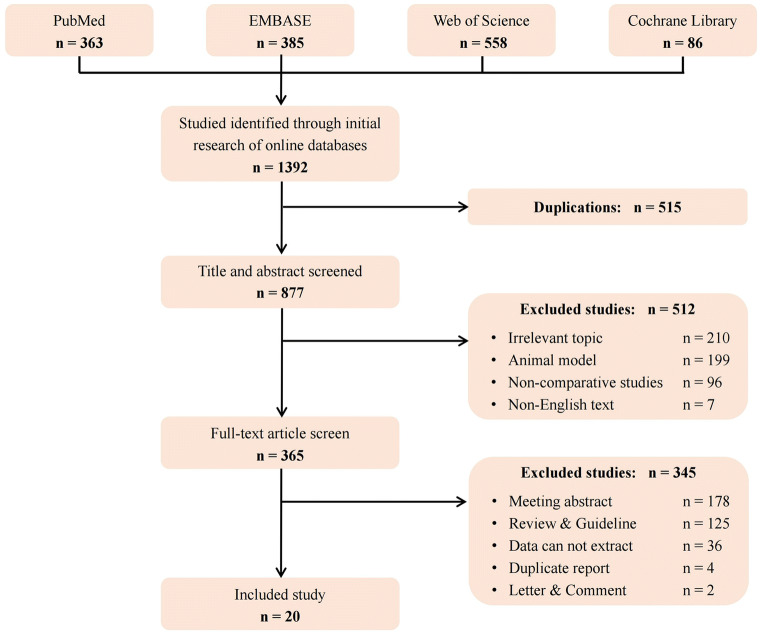
Method: Systematic review and meta-analysis of 20 retrospective studies in databases from January 1, 1995, to June 1, 2020.
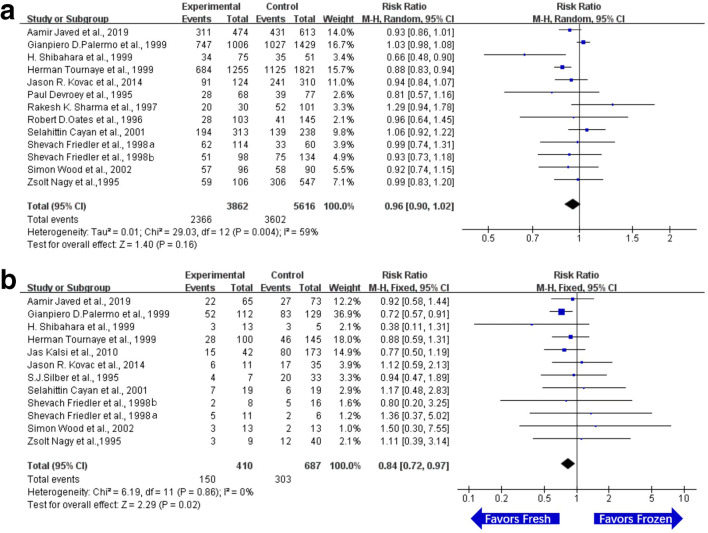
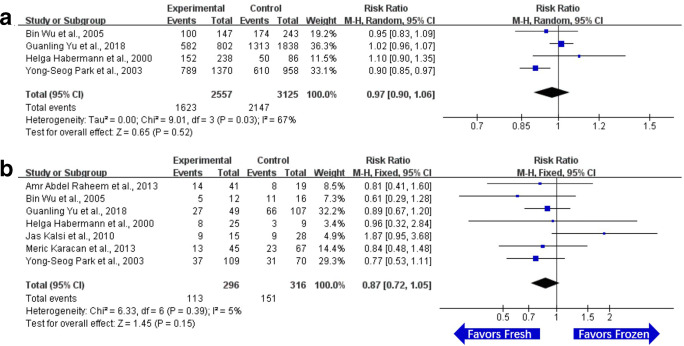
Result: Twenty articles were included in this study. A total of 3602 (64.1%) of 5616 oocytes injected with fresh epididymal sperm were fertilized, compared with 2366 (61.2%) of 3862 oocytes injected with cryopreserved sperm (relative risk ratio (RR) 0.96, 95% confidence interval (CI) (0.90, 1.02), P > 0.05). A total of 303 (44.1%) of 687 ICSI cycles using fresh epididymal sperm resulted in a clinical pregnancy, compared with 150 (36.6%) of 410 ICSI cycles using cryopreserved epididymal sperm (RR 0.84, 95% CI (0.72, 0.97), P < 0.05). In the testis, a total of 2147 (68.7%) of 3125 oocytes injected with fresh sperm were fertilized, compared with 1623 (63.5%) of 2557 oocytes injected with cryopreserved sperm (RR 0.97, 95% CI (0.90, 1.06), P > 0.05). A total of 151 (47.8%) of 316 ICSI cycles using fresh testicular sperm resulted in a clinical pregnancy, compared with 113 (38.2%) of 296 ICSI cycles using cryopreserved sperm (RR 0.87, 95% CI (0.72, 1.05), P > 0.05).
Conclusions: In men with OA, there was a statistical lower clinical pregnancy rate (CPR) by using frozen epididymal sperm compared with fresh epididymal sperm, but showing no difference on fertilization rate (FR). Additionally, FR and CPR were not affected by whether the retrieved testicular sperm was frozen or fresh.
Keywords: Cryopreservation; Epididymal spermatozoa; Intracytoplasmic sperm injection; Obstructive azoospermia; Testicular spermatozoa.
Conflict of interest statement
Authors declare no conflict of interest.
Figures
References
-
- Sperm retrieval for obstructive azoospermia. Fertil Steril. 2008;90(5 Suppl):S213-8. 10.1016/j.fertnstert.2008.08.047. - PubMed
-
- The management of obstructive azoospermia: a committee opinion. Fertil Steril. 2019;111(5):873-80. 10.1016/j.fertnstert.2019.02.013. - PubMed
-
- Ohlander S, Hotaling J, Kirshenbaum E, Niederberger C, Eisenberg ML. Impact of fresh versus cryopreserved testicular sperm upon intracytoplasmic sperm injection pregnancy outcomes in men with azoospermia due to spermatogenic dysfunction: a meta-analysis. Fertil Steril. 2014;101(2):344–349. doi: 10.1016/j.fertnstert.2013.10.012. - DOI - PubMed
Publication types
MeSH terms
Supplementary concepts
LinkOut - more resources
Full Text Sources
