


Prescription Opioid Dispensing Patterns Prior to Heroin Overdose in a State Medicaid Program: a Case-Control Study
- PMID: 32935311
- PMCID: PMC7661590
- DOI: 10.1007/s11606-020-06192-4
Prescription Opioid Dispensing Patterns Prior to Heroin Overdose in a State Medicaid Program: a Case-Control Study
Abstract
Background: A large proportion of individuals who use heroin report initiating opioid use with prescription opioids. However, patterns of prescription opioid use preceding heroin-related overdose have not been described.
Objective: To describe prescription opioid use in the year preceding heroin overdose.
Design: Case-control study comparing prescription opioid use with a heroin-involved overdose, non-heroin-involved opioid overdose, and non-overdose controls from 2015 to 2017.
Participants: Oregon Medicaid beneficiaries with linked administrative claims, vital statistics, and prescription drug monitoring program data.
Main measures: Opioid, benzodiazepine, and other central nervous system depressant prescriptions preceding overdose; among individuals with one or more opioid prescription, we assessed morphine milligram equivalents per day, overlapping prescriptions, prescriptions from multiple prescribers, long-term use, and discontinuation of long-term use.
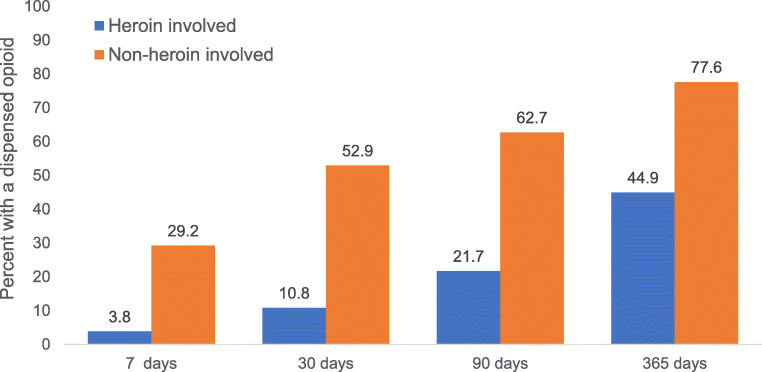
Key results: We identified 1458 heroin-involved overdoses (191 fatal) and 2050 non-heroin-involved opioid overdoses (266 fatal). In the 365 days prior to their overdose, 45% of individuals with a heroin-involved overdose received at least one prescribed opioid compared with 78% of individuals who experienced a non-heroin-involved opioid overdose (p < 0.001). For both heroin- and non-heroin-involved overdose cases, the likelihood of receiving an opioid increased with age. Among heroin overdose cases with an opioid dispensed, the rate of multiple pharmacy use was the only high-risk opioid pattern that was greater than non-overdose controls (adjusted odds ratio 3.2; 95% confidence interval 1.48 to 6.95). Discontinuation of long-term opioid use was not common prior to heroin overdose and not higher than discontinuation rates among non-overdose controls.
Conclusions: Although individuals with a heroin-involved overdose were less likely to receive prescribed opioids in the year preceding their overdose relative to non-heroin opioid overdose cases, prescription opioid use was relatively common and increased with age. Discontinuation of long-term prescription opioid use was not associated with heroin-involved overdose.
Keywords: heroin; overdose; prescription opioids.
Conflict of interest statement
Dr. Hartung reports grants from the Centers for Disease Control and Prevention, during the conduct of the study and grants from National Multiple Sclerosis Society, outside the submitted work. Ms. Johnston reports grants from the Centers for Disease Control and Prevention, during the conduct of the study. Ms. Hallvik reports grants from the Centers for Disease Control and Prevention, during the conduct of the study. Ms. Leichtling reports grants from the Centers for Disease Control and Prevention, during the conduct of the study. Mr. Geddes has nothing to disclose. Dr. Hildebran reports grants from the Centers for Disease Control and Prevention, during the conduct of the study. Dr. Keast reports grants from the Centers for Disease Control and Prevention, during the conduct of the study, grants from Otsuka Pharmaceuticals, and grants from Amgen, outside the submitted work. Dr. Chan has nothing to disclose. Dr. Korthuis reports grants from the Centers for Disease Control and Prevention, during the conduct of the study.
Figures
References
-
- Hedegaard H, Minino AM, Warner M. Drug Overdose Deaths in the United States, 1999-2017. NCHS data brief 2018:1–8. - PubMed
Publication types
MeSH terms
Substances
Grants and funding
LinkOut - more resources
Full Text Sources
