Remote Optimization of Guideline-Directed Medical Therapy in Patients With Heart Failure With Reduced Ejection Fraction
- PMID: 32936209
- PMCID: PMC7495335
- DOI: 10.1001/jamacardio.2020.3757
Remote Optimization of Guideline-Directed Medical Therapy in Patients With Heart Failure With Reduced Ejection Fraction
Erratum in
-
Error in Supplement.JAMA Cardiol. 2021 Apr 1;6(4):485. doi: 10.1001/jamacardio.2021.0091. JAMA Cardiol. 2021. PMID: 33625470 Free PMC article. No abstract available.
Abstract
Importance: Optimal treatment of heart failure with reduced ejection fraction (HFrEF) is scripted by treatment guidelines, but many eligible patients do not receive guideline-directed medical therapy (GDMT) in clinical practice.
Objective: To determine whether a remote, algorithm-driven, navigator-administered medication optimization program could enhance implementation of GDMT in HFrEF.
Design, setting, and participants: In this case-control study, a population-based sample of patients with HFrEF was offered participation in a quality improvement program directed at GDMT optimization. Treating clinicians in a tertiary academic medical center who were caring for patients with heart failure and an ejection fraction of 40% or less (identified through an electronic health record-based search) were approached for permission to adjust medical therapy according to a sequential titration algorithm modeled on the current American College of Cardiology/American Heart Association heart failure guidelines. Navigators contacted participants by telephone to direct medication adjustment and conduct longitudinal surveillance of laboratory tests, blood pressure, and symptoms under supervision of a pharmacist, nurse practitioner, and heart failure cardiologist. Patients and clinicians declining to participate served as a control group.
Exposures: Navigator-led remote optimization of GDMT compared with usual care.
Main outcomes and measures: Proportion of patients receiving GDMT in the intervention and control groups at 3 months.
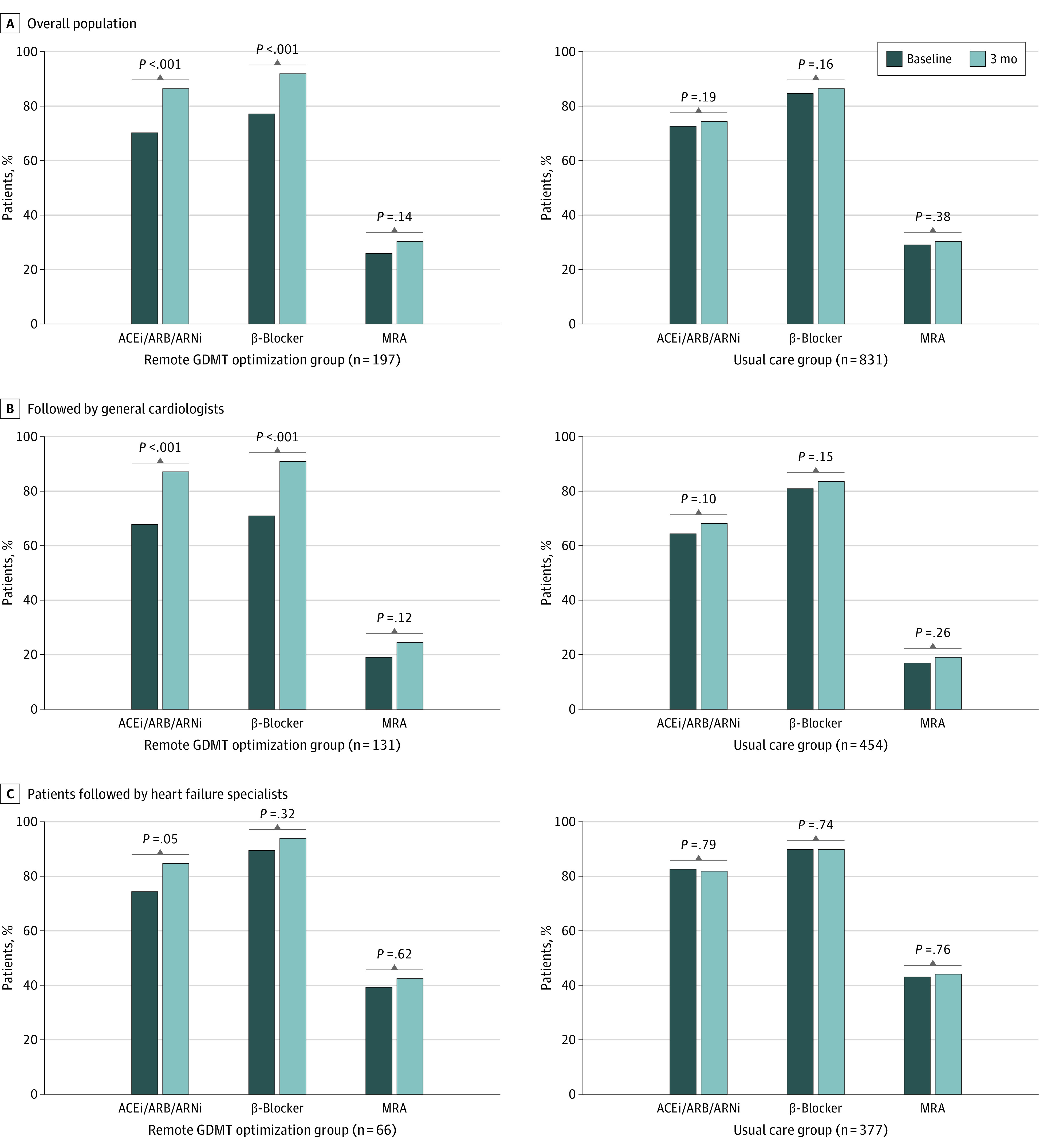
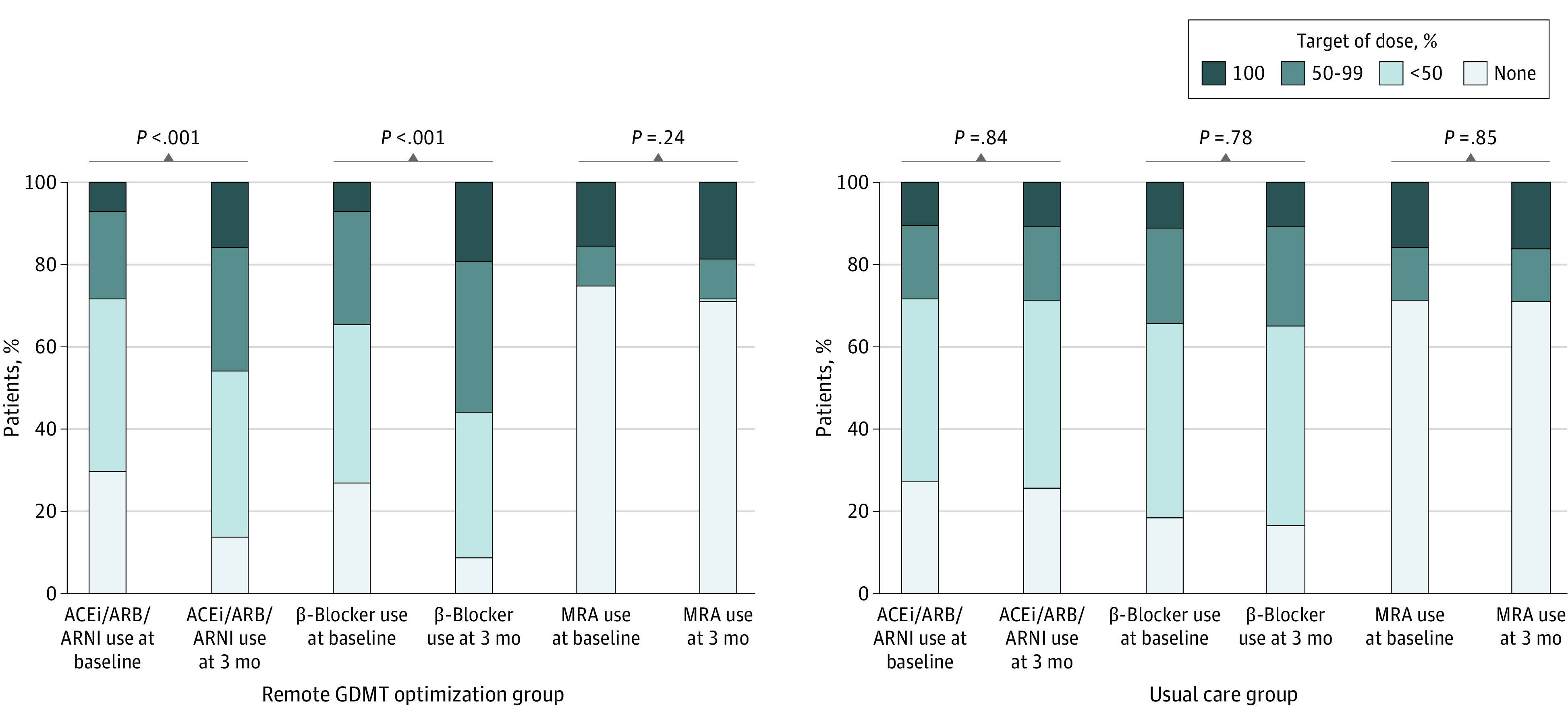
Results: Of 1028 eligible patients (mean [SD] values: age, 68 [14] years; ejection fraction, 32% [8%]; and systolic blood pressure, 122 [18] mm Hg; 305 women (30.0%); 892 individuals [86.8%] in New York Heart Association class I and II), 197 (19.2%) participated in the medication optimization program, and 831 (80.8%) continued with usual care as directed by their treating clinicians (585 [56.9%] general cardiologists; 443 [43.1%] heart failure specialists). At 3 months, patients participating in the remote intervention experienced significant increases from baseline in use of renin-angiotensin system antagonists (138 [70.1%] to 170 [86.3%]; P < .001) and β-blockers (152 [77.2%] to 181 [91.9%]; P < .001) but not mineralocorticoid receptor antagonists (51 [25.9%] to 60 [30.5%]; P = .14). Doses for each category of GDMT also increased from baseline in the intervention group. Among the usual-care group, there were no changes from baseline in the proportion of patients receiving GDMT or the dose of GDMT in any category.
Conclusions and relevance: Remote titration of GDMT by navigators using encoded algorithms may represent an efficient, population-level strategy for rapidly closing the gap between guidelines and clinical practice in patients with HFrEF.
Conflict of interest statement
Figures
Comment in
-
An Excellent Model to Increase Adherence to Guideline-Directed Medical Therapy-With Far-reaching Implications.JAMA Cardiol. 2021 Jun 1;6(6):726. doi: 10.1001/jamacardio.2021.0321. JAMA Cardiol. 2021. PMID: 33787819 No abstract available.
-
An Excellent Model to Increase Adherence to Guideline-Directed Medical Therapy-With Far-reaching Implications-Reply.JAMA Cardiol. 2021 Jun 1;6(6):726-727. doi: 10.1001/jamacardio.2021.0327. JAMA Cardiol. 2021. PMID: 33787827 No abstract available.
References
Publication types
MeSH terms
LinkOut - more resources
Full Text Sources
Other Literature Sources
Medical
Miscellaneous