Observational Study
. 2020 Nov 1;156(11):1216-1222.
doi: 10.1001/jamadermatol.2020.3275.

Association of Clinical and Demographic Factors With the Severity of Palmoplantar Pustulosis

Affiliations
Observational Study

Association of Clinical and Demographic Factors With the Severity of Palmoplantar Pustulosis

Natashia Benzian-Olsson et al. JAMA Dermatol. .

Abstract

Importance: Although palmoplantar pustulosis (PPP) can significantly impact quality of life, the factors underlying disease severity have not been studied.

Objective: To examine the factors associated with PPP severity.

Design, setting, and participants: An observational, cross-sectional study of 2 cohorts was conducted. A UK data set including 203 patients was obtained through the Anakinra in Pustular Psoriasis, Response in a Controlled Trial (2016-2019) and its sister research study Pustular Psoriasis, Elucidating Underlying Mechanisms (2016-2020). A Northern European cohort including 193 patients was independently ascertained by the European Rare and Severe Psoriasis Expert Network (2014-2017). Patients had been recruited in secondary or tertiary dermatology referral centers. All patients were of European descent. The PPP diagnosis was established by dermatologists, based on clinical examination and/or published consensus criteria. The present study was conducted from October 1, 2014, to March 15, 2020.

Main outcomes and measures: Demographic characteristics, comorbidities, smoking status, Palmoplantar Pustulosis Psoriasis Area Severity Index (PPPASI), measuring severity from 0 (no sign of disease) to 72 (very severe disease), or Physician Global Assessment (PGA), measuring severity as 0 (clear), 1 (almost clear), 2 (mild), 3 (moderate), and 4 (severe).

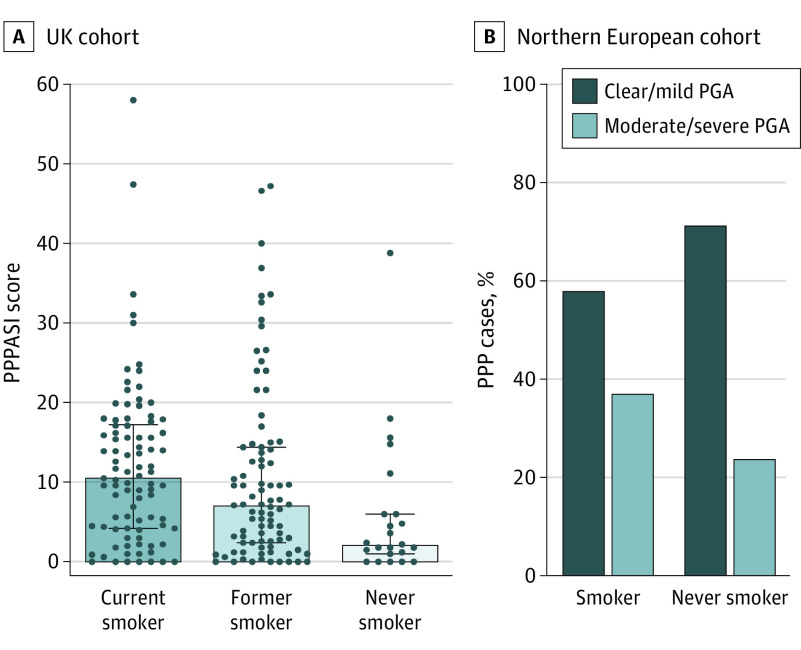
Results: Among the 203 UK patients (43 men [21%], 160 women [79%]; median age at onset, 48 [interquartile range (IQR), 38-59] years), the PPPASI was inversely correlated with age of onset (r = -0.18, P = .01). Similarly, in the 159 Northern European patients who were eligible for inclusion in this analysis (25 men [16%], 134 women [84%]; median age at onset, 45 [IQR, 34-53.3] years), the median age at onset was lower in individuals with a moderate to severe PGA score (41 years [IQR, 30.5-52 years]) compared with those with a clear to mild PGA score (46.5 years [IQR, 35-55 years]) (P = .04). In the UK sample, the median PPPASI score was higher in women (9.6 [IQR, 3.0-16.2]) vs men (4.0 [IQR, 1.0-11.7]) (P = .01). Likewise, moderate to severe PPP was more prevalent among Northern European women (57 of 134 [43%]) compared with men (5 of 25 [20%]) (P = .03). In the UK cohort, the median PPPASI score was increased in current smokers (10.7 [IQR, 4.2-17.5]) compared with former smokers (7 [IQR, 2.0-14.4]) and nonsmokers (2.2 [IQR, 1-6]) (P = .003). Comparable differences were observed in the Northern European data set, as the prevalence of moderate to severe PPP was higher in former and current smokers (51 of 130 [39%]) compared with nonsmokers (6 of 24 [25%]) (P = .14).

Conclusions and relevance: The findings of this study suggest that PPP severity is associated with early-onset disease, female sex, and smoking status. Thus, smoking cessation intervention might be beneficial.


Conflict of interest statement

Conflict of Interest Disclosures: Dr Borroni reported receiving grants from Celgene Research Award and personal fees from AbbVie outside the submitted work. Dr Burden reported receiving personal fees from Boehringer Ingelheim, Novartis, Celgene, Janssen, AbbVie, and Almirall outside the submitted work. Dr Cro reported receiving grants from the National Institute for Health Research (NIHR) Efficacy and Mechanism Evaluation during the conduct of the study. Dr Griffiths reported receiving grants from the Medical Research Council (MRC) NIHR during the conduct of the study. Dr Koks reported receiving grants from Estonian Research Council and grants from H2020 ERAchair during the conduct of the study and Prion Ltd, a member of the board and shareholder of the company. Dr McAteer reported receiving grants from AbbVie, Almirral, Amgen, Celgene, Eli Lilly, Janssen, LEO Pharma, UCB, and Thornton and Ross Derma outside the submitted work. Dr Patel reported receiving grants from Efficacy and Mechanism Evaluation (EME) Programme during the conduct of the study. Dr Pink reported receiving personal fees from AbbVie, Lilly, Sanofi, Leo Pharma, Novartis, Almirall, UCB, Janssen, and La Roche-Posay outside the submitted work. Dr Reynolds reported receiving lecture fees from AbbVie (to Newcastle University), payment for medical advisory board meeting and lectures fees from Almirall (to Newcastle University), contributing to a clinical trial from AnaptysBio (to Newcastle upon Tyne Hospital), lecture fees from Celgene to Newcastle University), lecture fees from Janssen (to Newcastle University), grants and serving as a paid member of a medical advisory board from Novartis, and lecture fees from UCB Pharma Ltd (to Newcastle University) outside the submitted work. Dr Wahie reported receiving nonfinancial support from Janssen, AbbVie, Novartis, and Almirall outside the submitted work. Dr Navarini reported receiving grants from EADV during the conduct of the study; grants and personal fees from AbbVie; personal fees from Almirall, Amgen, Eli Lilly, Galderma, Leo Pharma, Novartis, Sanofi, UCB, and Biomed; grants and personal fees from Boehringer Ingelheim; and nonfinancial support from Janssen-Cilag outside the submitted work. Dr Smith reported receiving grants from National Institute for Health Research and nonfinancial support from SOBI during the conduct of the study; grants from Medical Research Council, grants from Boehringer Ingelheim GmbH, grants from Innovative Medicines Initiative Horizon 2020, and grants from Medical Research Council outside the submitted work; and serving as an unpaid guideline committee member for UK and European guidelines for psoriasis, including pustular psoriasis. Dr Capon reported receiving grants from the European Academy of Dermatology and Venereology and MRC/NIHR during the conduct of the study; and grants from Boehringer-Ingelheim and personal fees from AnaptysBio outside the submitted work. No other disclosures were reported.

Figures

Figure 1.
Figure 1.. Association Between Disease Severity and Age of Onset
A, In the UK cohort, the Palmoplantar Pustulosis Psoriasis Area Severity Index (PPPASI) score was inversely correlated with age of onset (r = −0.18, P = .01). Regression lines are plotted with their 95% CIs (gray areas). B, In the Northern European sample, age of onset was significantly lower among patients with moderate-to-severe disease. Data are presented as median (interquartile range). P < .05 per Mann-Whitney test. PPPASI measures severity with scores from 0 (no sign of disease) to 72 (very severe disease).
Figure 2.
Figure 2.. Disease Severity Scores in Women and Men
A, In the UK cohort, Palmoplantar Pustulosis Psoriasis Area Severity Index (PPPASI) scores were significantly higher in women than men. Data are presented as median (interquartile range). P < .01 per Mann-Whitney test. B, In the Northern European sample, the proportion of individuals with moderate to severe disease was significantly elevated in women compared with men. P < .05 per Fisher exact test. Physician Global Assessment (PGA) measures severity as 0 (clear), 1 (almost clear), 2 (mild), 3 (moderate), and 4 (severe). PPPASI measures severity with scores from 0 (no sign of disease) to 72 (very severe disease). PPP indicates palmoplantar pustulosis.
Figure 3.
Figure 3.. Disease Severity Scores in Current, Former, and Never Smokers
A, In the UK cohort, Palmoplantar Pustulosis Psoriasis Area Severity Index (PPPASI) scores are highest in current smokers, intermediate in former smokers and lowest in never smokers. Data are presented as median (interquartile range). P < .01 per Kruskal-Wallis test. B, In the Northern European sample, the proportion of individuals with moderate to severe disease was elevated in current and former smokers compared with never smokers. Physician Global Assessment (PGA) measures severity as 0 (clear), 1 (almost clear), 2 (mild), 3 (moderate), and 4 (severe). PPPASI measures severity with scores from 0 (no sign of disease) to 72 (very severe disease). PPP indicates palmoplantar pustulosis.

References

    1. Mahil SK, Barker JN, Capon F. Pustular forms of psoriasis related to autoinflammation. In: Hashkes P, Laxer R, Simon A, eds. Textbook of Autoinflammation. Switzerland: Springer Nature; 2019:471-484. doi: 10.1007/978-3-319-98605-0_26 - DOI
    1. Twelves S, Mostafa A, Dand N, et al. Clinical and genetic differences between pustular psoriasis subtypes. J Allergy Clin Immunol. 2019;143(3):1021-1026. doi: 10.1016/j.jaci.2018.06.038 - DOI - PMC - PubMed
    1. Wilsmann-Theis D, Jacobi A, Frambach Y, et al. Palmoplantar pustulosis—a cross-sectional analysis in Germany. Dermatol Online J. 2017;23(4):13030/qt0h15613d. - PubMed
    1. Kharawala S, Golembesky AK, Bohn RL, Esser D. The clinical, humanistic, and economic burden of generalized pustular psoriasis: a structured review. Expert Rev Clin Immunol. 2020;16(3):239-252. doi: 10.1080/1744666X.2019.1708193 - DOI - PubMed
    1. Naldi L, Chatenoud L, Linder D, et al. Cigarette smoking, body mass index, and stressful life events as risk factors for psoriasis: results from an Italian case-control study. J Invest Dermatol. 2005;125(1):61-67. doi: 10.1111/j.0022-202X.2005.23681.x - DOI - PubMed

Publication types

MeSH terms