


[Provisioning of personal protective equipment in hospitals in preparation for a pandemic]
- PMID: 32936348
- PMCID: PMC7493059
- DOI: 10.1007/s00101-020-00843-1
[Provisioning of personal protective equipment in hospitals in preparation for a pandemic]
Abstract
Background: At the beginning of the SARS-CoV‑2 outbreak, personal protective equipment (PPE) was scarce worldwide, leading to the treatment of patients partially without sufficient protection for the medical personnel. In order to be prepared for a new epidemic or pandemic or a "second wave" of COVID-19 outbreak and to meet a renewed deficiency of PPE, considerations were made on how personnel and patients can be better protected by appropriate provisioning.
Objective: The aim of this study was to develop a tool to predict the necessary amount of PPE to be in stock at a transregional university hospital for a certain period of time during a pandemic.
Material and methods: The consumption of PPE needed for every patient was calculated based on the following data of the Ulm University Hospital: the total consumption of healthcare workers' PPE for April 2020 recorded by the materials management department and the number of patients suffering from COVID-19 and their treatment days. From the amount of PPE necessary for every patient in the intensive care unit (ICU) or in an infection ward, a PPE calculator was created in which the estimated amount of PPE can be calculated with the input variables "patients in intensive care unit", "patients in infection ward" and "treatment days". To validate the PPE calculator, the actual consumption of PPE for May 2020 at the Ulm University hospital was compared to the theoretically calculated demand by the PPE calculator.
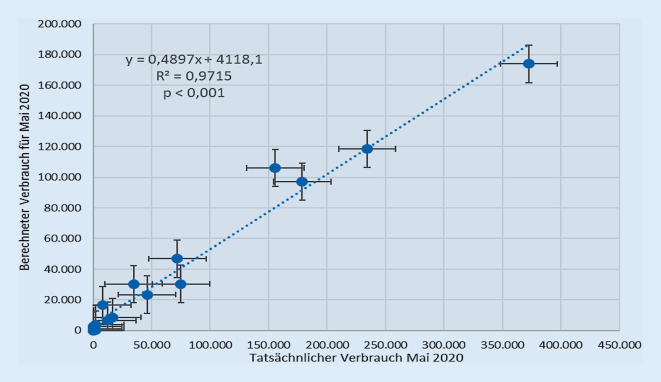
Results: In April 2020 PPE consisting of 18 different items were kept in stock at Ulm University Hospital and in total 1,995,500 individual items were used. 22 intensive care patients with 257 nursing days and in the infection ward 39 patients with 357 nursing days were treated for COVID-19 disease, leading to a total of 603.2 man-days. A total of 34,550 KN95 masks, 1,558,780 gloves and 1100 goggles or protective visors were used, with a daily average of 49 NK95 masks and 2216 gloves required per ICU patient. In May 2020, 6 ICU patients and 19 patients in infection wards were treated for COVID-19 with 34 nursing days in intensive care and 201 nursing days in infection wards. The use of PPE material was 39% lower than in the previous month but in absolute terms 82% and on average 39% higher than calculated.
Conclusion: The developed tool allows our hospital to estimate the necessary amount of PPE to be kept in stock for future pandemics. By taking local conditions into account this tool can also be helpful for other hospitals.
Zusammenfassung: HINTERGRUND: Durch ungenügende Bevorratung war weltweit von Anfang des SARS-CoV-2(Severe Acute Respiratory Corona Virus 2)-Ausbruchs die persönliche Schutzausrüstung (PSA) knapp. Um beim Ausbruch einer erneuten Epidemie oder Pandemie oder einer „zweiten Welle“ der dadurch bedingten Coronavirus-Krankheit (COVID-19) einem nochmaligen Mangel an PSA begegnen zu können, wird überlegt, wie man durch entsprechende Bevorratung Personal und Patienten besser schützen kann.
Fragestellung: Ziel der vorliegenden Studie war, in einer überregionalen Universitätsklinik einen PSA-Bedarfsrechner zu erstellen, der eine Vorhersage erlaubt, welcher PAS-Bedarf bevorratet werden soll.
Material und methoden: Am Universitätsklinikum Ulm wurde vom 01.04.2020 bis zum 30.04.2020 der Verbrauch an PSA erhoben, sowie die Anzahl der an COVID-19 erkrankten Patienten bzw. deren Behandlungstage. Daraus wurde der Verbrauch an PSA pro Patient errechnet. Aus den so gewonnenen Verbrauchszahlen pro Patient wurde ein Bedarfsrechner erstellt, in dem sich mit den Variablen „Patienten auf Intensivstation“, „Patienten Infektionsstation“ und „Behandlungstage“ der jeweilige Bedarf an PSA errechnen lässt. Zur Validierung des PSA-Rechners wurde der tatsächliche Verbrauch an PSA für Mai 2020 erhoben und dem mit dem PSA-Rechner ermittelten Bedarf gegenübergestellt.
Ergebnisse: Im April 2020 wurden 18 PSA-Einzelartikel vorrätig gehalten und in insgesamt 1.995.500 Einzelteilen verbraucht. 22 Intensivpatienten mit 257 Pflegetagen und 39 Patienten mit 357 Pflegtagen auf der Infektionsstation wurden mit COVID-19 behandelt. Insgesamt waren hierfür 603,2 Personaltage (sog. Manntage) notwendig. Es wurden 34.550 Atemschutzmasken, 1.558.780 Handschuhe und 1100 Schutzbrillen oder Schutzvisiere verbraucht, wobei pro Intensivpatient im Schnitt täglich 49 Atemschutzmasken und 2216 Handschuhe benötigt wurden. Im Mai 2020 wurden 6 Intensivpatienten mit COVID-19 behandelt und 19 Patienten auf der Infektionsstation. Der Verbrauch an PSA-Material lag um 39 % niedriger gegenüber dem Vormonat, aber absolut um 82 % und relativ im Mittel um 39 % höher als berechnet.
Schlussfolgerung: Mit dem entwickelten Tool kann für zukünftige Pandemien die notwendige zu bevorratende Menge an PSA abgeschätzt und vorrätig gehalten werden. Dieses Tool kann auch unter Beachtung der örtlichen Gegebenheiten hilfreich für andere Kliniken sein.
Keywords: COVID-19; Epidemic; Protective masks; SARS-CoV‑2; Stocks in hospitals.

References
-
- Robert Koch-Institut (2020) COVID-19: Fallzahlen in Deutschland und weltweit. https://www.rki.de/DE/Content/InfAZ/N/Neuartiges_Coronavirus/Fallzahlen..... Zugegriffen: 17. Aug. 2020
-
- European Centre for Disease Prevention and Control (2020) COVID-19 situation update for the EU/EEA and the UK, as of 29 June 2020. https://www.ecdc.europa.eu/en/cases-2019-ncov-eueea. Zugegriffen: 17. Aug. 2020
-
- World Health Organization (2020) WHO coronavirus disease (COVID-19) Dashboard. Data last updated: 2020//11. https://covid19.who.int/. Zugegriffen: 17. Aug. 2020
Publication types
MeSH terms
LinkOut - more resources
Full Text Sources
Medical
Miscellaneous
