


Burn Injury Does Not Exacerbate Heat Strain during Exercise while Wearing Body Armor
- PMID: 32936596
- PMCID: PMC7503202
- DOI: 10.1249/MSS.0000000000002375
Burn Injury Does Not Exacerbate Heat Strain during Exercise while Wearing Body Armor
Abstract
Introduction: Although evaporative heat loss capacity is reduced in burn-injured individuals with extensive skin grafts, the thermoregulatory strain due to a prior burn injury during exercise-heat stress may be negligible if the burn is located underneath protective clothing with low vapor permeability.
Purpose: This study aimed to test the hypothesis that heat strain during exercise in a hot-dry environment while wearing protective clothing would be similar with and without a simulated torso burn injury.
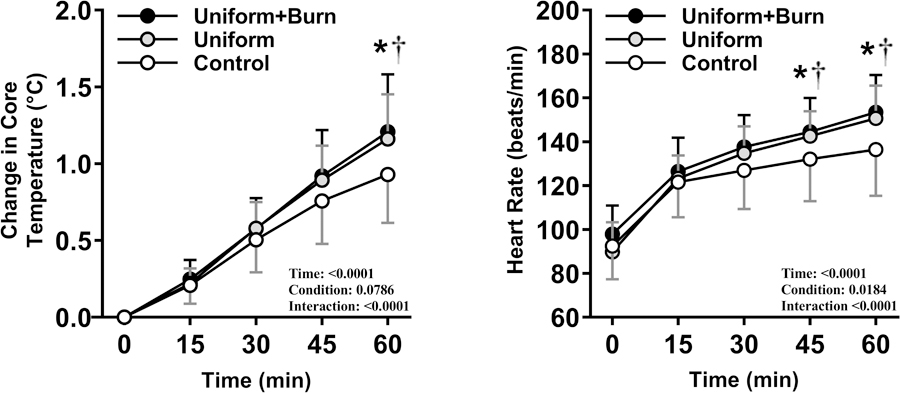
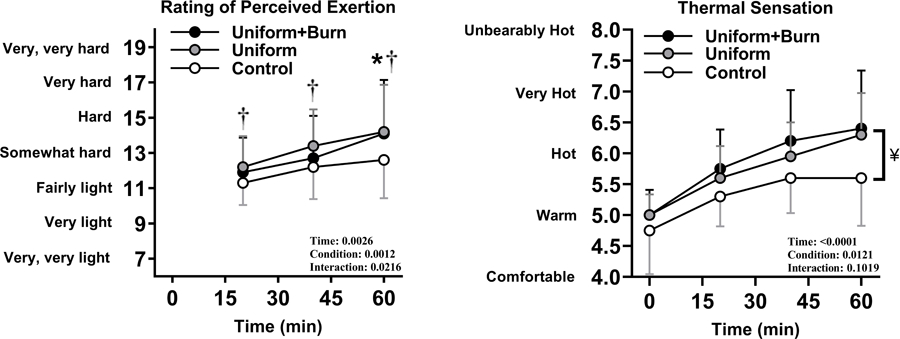
Methods: Ten healthy individuals (8 men/2 women) underwent three trials wearing: uniform (combat uniform, tactical vest, and replica torso armor plates), uniform with a 20% total body surface area simulated torso burn (uniform + burn), or shorts (and sports bra) only (control). Exercise consisted of treadmill walking (5.3 km·h; 3.7% ± 0.9% grade) for 60 min at a target heat production of 6.0 W·kg in 40.0°C ± 0.1°C and 20.0% ± 0.6% relative humidity conditions. Measurements included rectal temperature, heart rate, ratings of perceived exertion (RPE), and thermal sensation.
Results: No differences in rectal temperature (P ≥ 0.85), heart rate (P ≥ 0.99), thermal sensation (P ≥ 0.73), or RPE (P ≥ 0.13) occurred between uniform + burn and uniform trials. In the control trial, however, core temperature, heart rate, thermal sensation, and RPE were lower compared with the uniform and uniform + burn trials (P ≤ 0.04 for all).
Conclusions: A 20% total body surface area simulated torso burn injury does not further exacerbate heat strain when wearing a combat uniform. These findings suggest that the physiological strain associated with torso burn injuries is not different from noninjured individuals when wearing protective clothing during an acute exercise-heat stress.
Conflict of interest statement
CONFLICTS OF INTEREST
The authors have no conflicts of interest to disclose. The results of the study are presented clearly, honestly, and without fabrication, falsification, or inappropriate data manipulation, and the results of the present study do not constitute endorsement by ACSM.
Figures
References
-
- McGibbon B, Beaumont WV, Strand J, Paletta FX. Thermal regulation in patients after the healing of large deep burns. Plast Reconstr Surg 1973; 52 (2): 164–70. - PubMed
