


Rapid hematoma growth triggers spreading depolarizations in experimental intracortical hemorrhage
- PMID: 32936730
- PMCID: PMC8142136
- DOI: 10.1177/0271678X20951993
Rapid hematoma growth triggers spreading depolarizations in experimental intracortical hemorrhage
Abstract
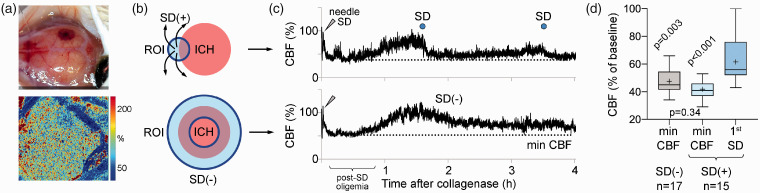
Recurrent waves of spreading depolarization (SD) occur in brain injury and are thought to affect outcomes. What triggers SD in intracerebral hemorrhage is poorly understood. We employed intrinsic optical signaling, laser speckle flowmetry, and electrocorticography to elucidate the mechanisms triggering SD in a collagenase model of intracortical hemorrhage in mice. Hematoma growth, SD occurrence, and cortical blood flow changes were tracked. During early hemorrhage (0-4 h), 17 out of 38 mice developed SDs, which always originated from the hematoma. No SD was detected at late time points (8-52 h). Neither hematoma size, nor peri-hematoma perfusion were associated with SD occurrence. Further, arguing against ischemia as a trigger factor, normobaric hyperoxia did not inhibit SD occurrence. Instead, SDs always occurred during periods of rapid hematoma growth, which was two-fold faster immediately preceding an SD compared with the peak growth rates in animals that did not develop any SDs. Induced hypertension accelerated hematoma growth and resulted in a four-fold increase in SD occurrence compared with normotensive animals. Altogether, our data suggest that spontaneous SDs in this intracortical hemorrhage model are triggered by the mechanical distortion of tissue by rapidly growing hematomas.
Keywords: Cerebral amyloid angiopathy; electrocorticography; intracerebral hemorrhage; laser speckle imaging; spreading depolarization.
Conflict of interest statement
Figures




References
-
- O'Donnell MJ, Xavier D, Liu L, et al.. Risk factors for ischaemic and intracerebral haemorrhagic stroke in 22 countries (the INTERSTROKE study): a case-control study. Lancet 2010; 376: 112–123. - PubMed
-
- van Asch CJ, Luitse MJ, Rinkel GJ, et al.. Incidence, case fatality, and functional outcome of intracerebral haemorrhage over time, according to age, sex, and ethnic origin: a systematic review and meta-analysis. Lancet Neurol 2010; 9: 167–176. - PubMed
-
- Poon MT, Fonville AF, Al-Shahi Salman R.Long-term prognosis after intracerebral haemorrhage: systematic review and meta-analysis. J Neurol Neurosurg Psychiatry 2014; 85: 660–667. - PubMed
Publication types
MeSH terms
Grants and funding
LinkOut - more resources
Full Text Sources
