


Persistent El Niño driven shifts in marine cyanobacteria populations
- PMID: 32936809
- PMCID: PMC7494125
- DOI: 10.1371/journal.pone.0238405
Persistent El Niño driven shifts in marine cyanobacteria populations
Abstract
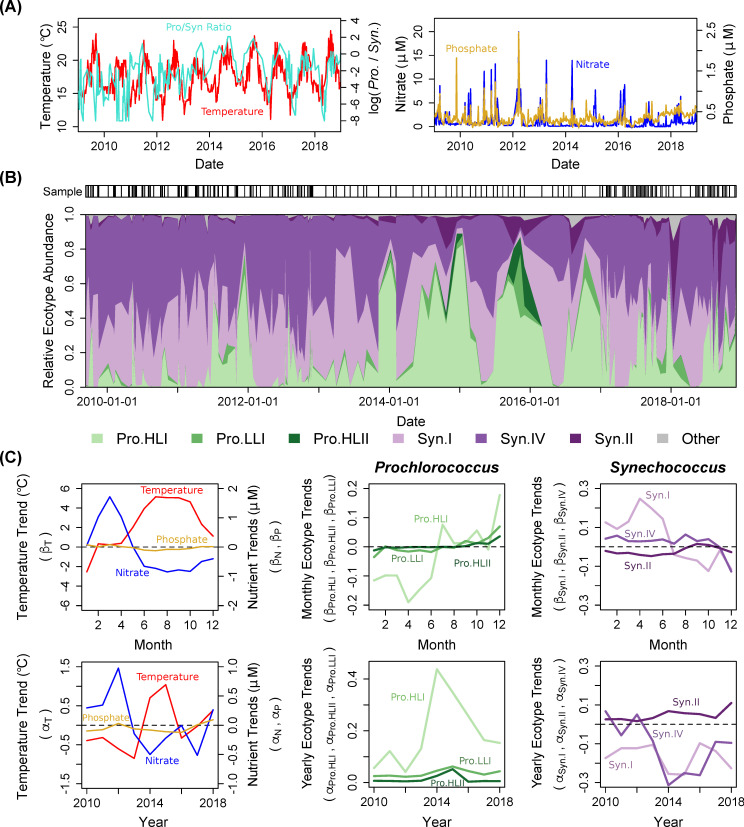
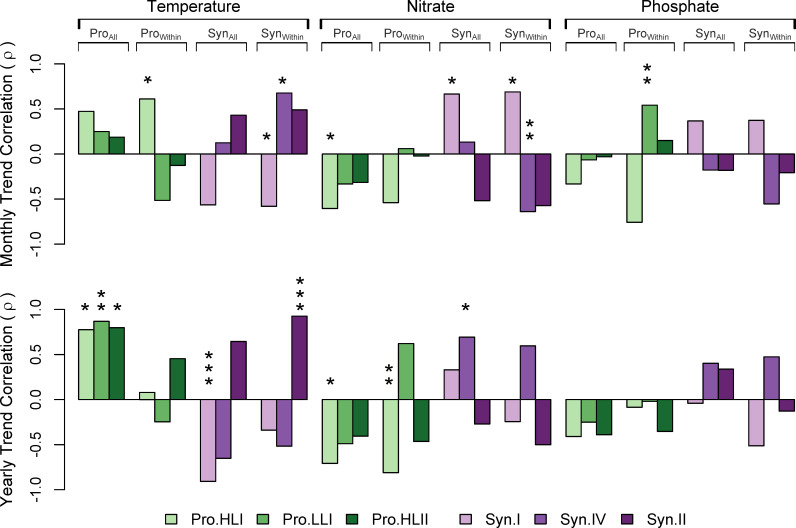
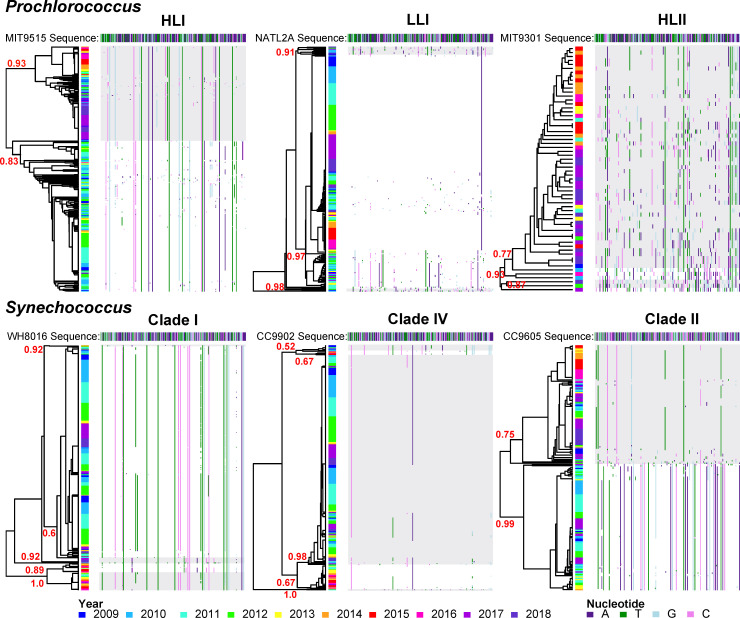
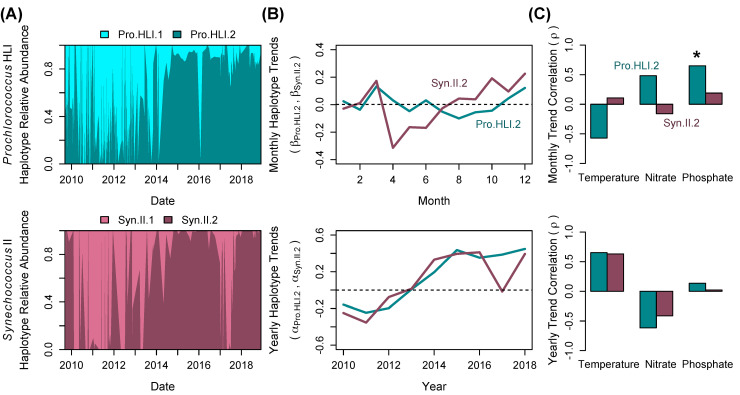
In the California Current Ecosystem, El Niño acts as a natural phenomenon that is partially representative of climate change impacts on marine bacteria at timescales relevant to microbial communities. Between 2014-2016, the North Pacific warm anomaly (a.k.a., the "blob") and an El Niño event resulted in prolonged ocean warming in the Southern California Bight (SCB). To determine whether this "marine heatwave" resulted in shifts in microbial populations, we sequenced the rpoC1 gene from the biogeochemically important picocyanobacteria Prochlorococcus and Synechococcus at 434 time points from 2009-2018 in the MICRO time series at Newport Beach, CA. Across the time series, we observed an increase in the abundance of Prochlorococcus relative to Synechococcus as well as elevated frequencies of ecotypes commonly associated with low-nutrient and high-temperature conditions. The relationships between environmental and ecotype trends appeared to operate on differing temporal scales. In contrast to ecotype trends, most microdiverse populations were static and possibly reflect local habitat conditions. The only exceptions were microdiversity from Prochlorococcous HLI and Synechococcus Clade II that shifted in response to the 2015 El Niño event. Overall, Prochlorococcus and Synechococcus populations did not return to their pre-heatwave composition by the end of this study. This research demonstrates that extended warming in the SCB can result in persistent changes in key microbial populations.
Conflict of interest statement
The authors have declared that no competing interests exist.
Figures
References
-
- Polovina JJ, Dunne JP, Woodworth PA, Howell EA. Projected expansion of the subtropical biome and contraction of the temperate and equatorial upwelling biomes in the North Pacific under global warming. ICES Journal of Marine Science. 2011;68(6):986–95.
-
- Moore JK, Lindsay K, Doney SC, Long MC, Misumi K. Marine Ecosystem Dynamics and Biogeochemical Cycling in the Community Earth System Model CESM1(BGC): Comparison of the 1990s with the 2090s under the RCP4.5 and RCP8.5 Scenarios. Journal of Climate. 2013;26(23):9291–312.
-
- Martiny AC, Talarmin A, Mouginot C, Lee JA, Huang JS, Gellene AG, et al. Biogeochemical interactions control a temporal succession in the elemental composition of marine communities. Limnology and Oceanography. 2016;61(2):531–42.
