Review
. 2020 Sep 15;53(3):496-509.
doi: 10.1016/j.immuni.2020.08.012.

Systemic Immunometabolism: Challenges and Opportunities

Affiliations
Review

Systemic Immunometabolism: Challenges and Opportunities

Alexander Lercher et al. Immunity. .

Abstract

Over the past 10 years, the field of immunometabolism made great strides to unveil the crucial role of intracellular metabolism in regulating immune cell function. Emerging insights into how systemic inflammation and metabolism influence each other provide a critical additional dimension on the organismal level. Here, we discuss the concept of systemic immunometabolism and review the current understanding of the communication circuits that underlie the reciprocal impact of systemic inflammation and metabolism across organs in inflammatory and infectious diseases, as well as how these mechanisms apply to homeostasis. We present current challenges of systemic immunometabolic research, and in this context, highlight opportunities and put forward ideas to effectively explore organismal physiological complexity in both health and disease.


Figures

Figure 1
Figure 1
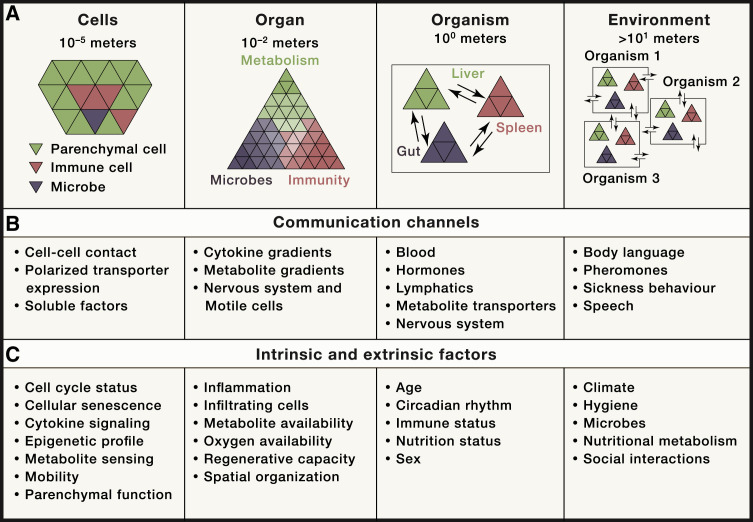
Communication Levels of Systemic Immunometabolism (A) Organizational units of higher organisms ranging from the cellular level, to organs, to the whole organism, up to the environment and inter-individual relationships. (B) Communication channels that are critically involved for communication within and/or between the individual organizational units. (C) Intrinsic and extrinsic factors shaping the identity of the described organizational units.
Figure 2
Figure 2
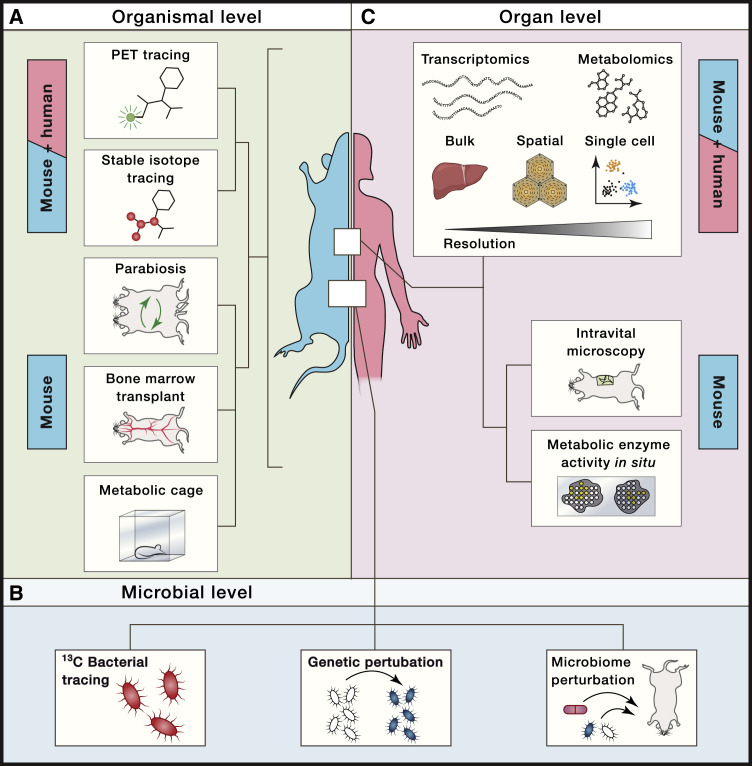
Technical Approaches to Study Systemic Immunometabolism (A–C) Schematic depiction of selected complementary technical approaches to dissect immune-metabolic crosstalk and relationships in experimental model systems and patients at the (A) organismal (e.g., PET tracing, stable isotope tracing, parabiosis, bone marrow transplant experiments, or metabolic cages), (B) microbial (e.g., 13C bacterial tracing experiments, genetic or microbime perturbations), and (C) organ (e.g., bulk, spatial or single-cell transcriptomics and metabolomics, intravital microscopy, or measuring metabolic enzyme activity in situ) levels.
Figure 3
Figure 3
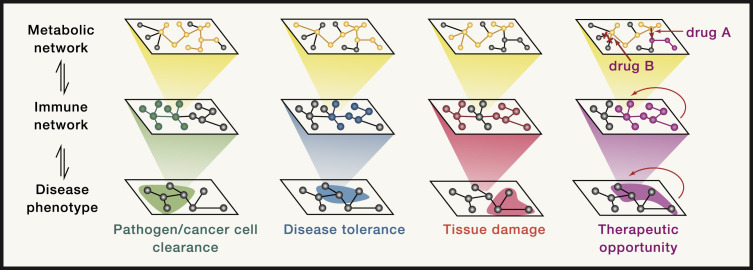
Reprogramming of Systemic Immunometabolism as Therapeutic Intervention Strategy Schematic depiction of the hierarchical order of metabolic, immune, and disease pathology networks. The metabolic network of a cell or organism is the basal regulator of immune responses in different tissues or organs. The quality of the immune response, immune cell activation state, and cytokine signaling in turn shapes beneficial or detrimental disease pathophysiology. These outcomes include removal of the perturbation (e.g., pathogen or cancer cell) and disease tolerance (e.g., pathogen-host co-adaptations), but also extensive tissue damage (e.g., viral hepatitis) that can be life threatening to the host. Specific therapeutic interventions at the level of the metabolic network bears the potential to effectively modulate immune-related disease pathologies.

References

    1. Abou-Alfa G.K., Qin S., Ryoo B.-Y., Lu S.-N., Yen C.-J., Feng Y.-H., Lim H.Y., Izzo F., Colombo M., Sarker D., et al. Phase III randomized study of second line ADI-PEG 20 plus best supportive care versus placebo plus best supportive care in patients with advanced hepatocellular carcinoma. Ann. Oncol. 2018;29:1402–1408. - PubMed
    1. Abt M.C., Osborne L.C., Monticelli L.A., Doering T.A., Alenghat T., Sonnenberg G.F., Paley M.A., Antenus M., Williams K.L., Erikson J., et al. Commensal bacteria calibrate the activation threshold of innate antiviral immunity. Immunity. 2012;37:158–170. - PMC - PubMed
    1. Aizarani N., Saviano A., Sagar, Mailly L., Durand S., Herman J.S., Pessaux P., Baumert T.F., Grün D. A human liver cell atlas reveals heterogeneity and epithelial progenitors. Nature. 2019;572:199–204. - PMC - PubMed
    1. Alexandrov T. Spatial Metabolomics and Imaging Mass Spectrometry in the Age of Artificial Intelligence. Annual Review of Biomedical Data Science. 2020;3 doi: 10.1146/annurev-biodatasci-011420-031537. - DOI - PMC - PubMed
    1. Almeida A., Mitchell A.L., Boland M., Forster S.C., Gloor G.B., Tarkowska A., Lawley T.D., Finn R.D. A new genomic blueprint of the human gut microbiota. Nature. 2019;568:499–504. - PMC - PubMed

Publication types