. 2020 Jul 1;6(27):eaba3756.
doi: 10.1126/sciadv.aba3756. Print 2020 Jul.

The fungal collaboration gradient dominates the root economics space in plants

Affiliations

The fungal collaboration gradient dominates the root economics space in plants

Joana Bergmann et al. Sci Adv. .

Abstract

Plant economics run on carbon and nutrients instead of money. Leaf strategies aboveground span an economic spectrum from "live fast and die young" to "slow and steady," but the economy defined by root strategies belowground remains unclear. Here, we take a holistic view of the belowground economy and show that root-mycorrhizal collaboration can short circuit a one-dimensional economic spectrum, providing an entire space of economic possibilities. Root trait data from 1810 species across the globe confirm a classical fast-slow "conservation" gradient but show that most variation is explained by an orthogonal "collaboration" gradient, ranging from "do-it-yourself" resource uptake to "outsourcing" of resource uptake to mycorrhizal fungi. This broadened "root economics space" provides a solid foundation for predictive understanding of belowground responses to changing environmental conditions.


Figures

Fig. 1
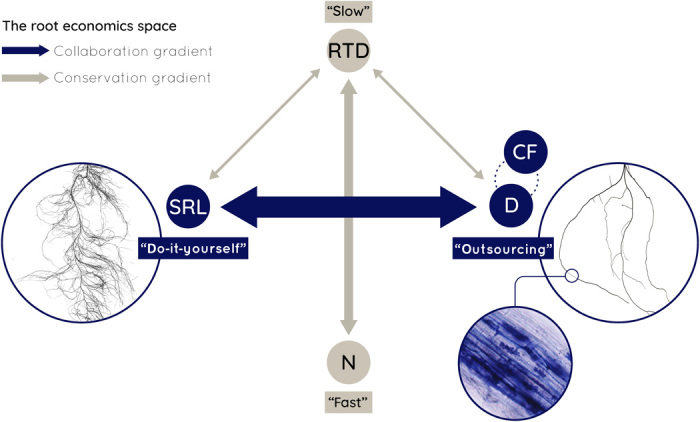
Fig. 1. Conceptual framework of the root economics space.
On the basis of this concept, we hypothesize (i) a collaboration gradient ranging from do-it-yourself soil exploration by high specific root length (SRL) to outsourcing by investing carbon into the mycorrhizal partner and hence extraradical hypheae, which requires a large cortex fraction (CF) and root diameter (D) and (ii) a conservation gradient ranging from roots with high root tissue density (RTD) that show a slow resource return on investment but are long-lived and well-protected, to fast roots with a high nitrogen content (N) and metabolic rate for fast resource return on investment but a short life span. Arrows indicate negative correlations between the single traits (see Table 1).
Fig. 2
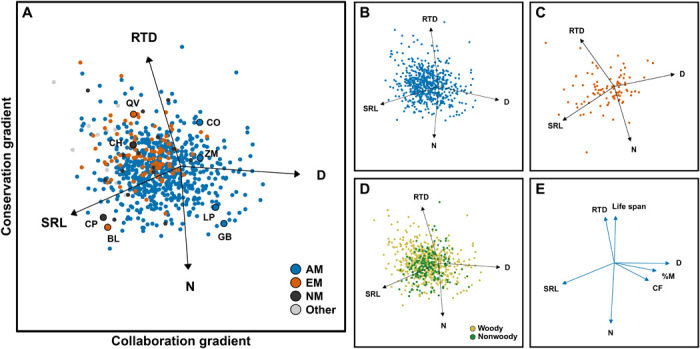
Fig. 2. The root economics space.
Phylogenetically informed principal component analyses (PCAs) of core traits of (A) 748 global species, (B) 621 arbuscular mycorrhizal (AM) species (blue), and (C) 94 ectomycorrhizal (EM) species (red). NM, nonmycorrhizal. The collaboration gradient (44%) ranges from do-it-yourself roots with high SRL to outsourcing roots with “thick diameters” (D). The conservation gradient (33%) ranges from fast (N) to slow (RTD). For each corner of the root economics space, in (A) we highlight two representative plant species: QV, Quercus virginiana Mill.; CH, Carex humilis Leyss.; CO, Cornus officinalis Siebold & Zucc.; ZM, Zea mays L.; LP, Lathyrus pratensis L.; GB, Ginkgo biloba L.; BL, Betula lenta L.; CP, Cardamine pratensis L. (D) Woody (ocher) and nonwoody (green) species show no distinct pattern within the root economics space (see fig. S4 and table S4). (E) PCA based on bivariate trait relationships. The percentage mycorrhizal colonization (%M) and the CF are positively correlated with D along the collaboration gradient, while root life span is negatively correlated with N along the conservation gradient. See table S1 for PCA scores.
Fig. 3
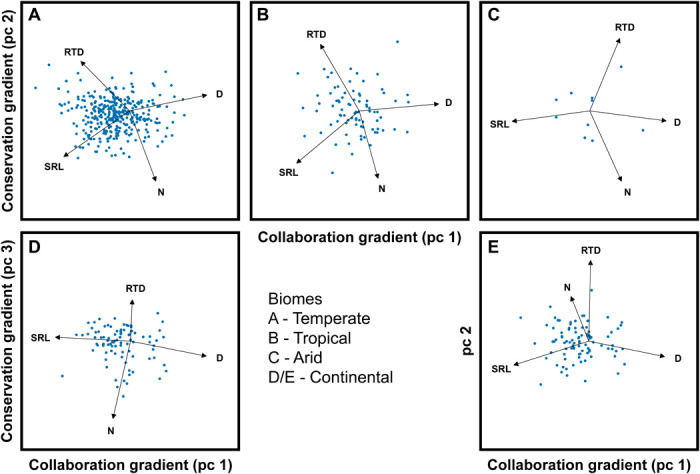
Fig. 3. The root economics space is present in different biomes.
Root traits and trait relations are known to vary across biomes (14). We found no respective between group variation within the root economics space (table S4). Still, to test whether the concept is broadly generalizable, we present separate PCAs for biomes spanning arid to tropical. We found that the root economics space was apparent in all of the biomes represented by our species (panels A, B, C, and D). In continental systems, the conservation gradient was represented by principal component 3 (D) instead of principal component 2 (E). See table S1 for principal component analyses. pc, principal component.
Fig. 4
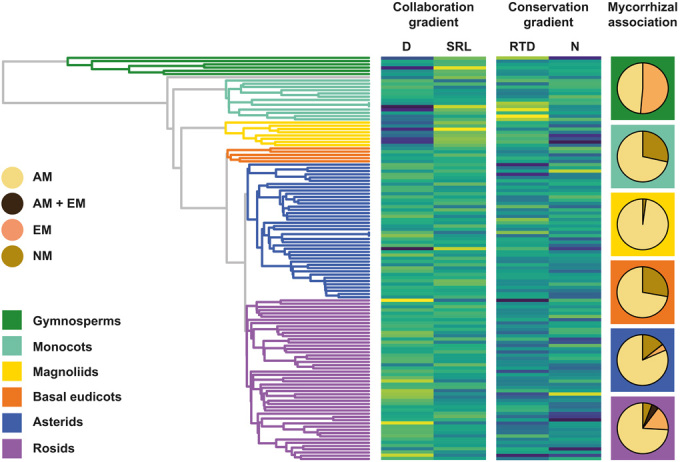
Fig. 4. The collaboration gradient is phylogenetically conserved.
On the left, we display the phylogenetic tree of 1810 species aggregated at a family level with the standardized family mean trait values of the four core traits (center) ranging from low (yellow) to medium (green) to high (blue). The collaboration gradient shows a strong phylogenetic pattern (λ = 0.8, P < 0.001) with a transition from families with thick D to those with high SRL. The phylogenetic signal in the conservation gradient is less pronounced (λ = 0.5, P < 0.001), although still significant (see also table S3). For detailed information about specific clades, see table S5, and for family distribution across clades, see table S6. Pie charts (right) depict the fraction of different mycorrhizal association types within the broader plant phylogenetic clades (indicated by corresponding background colors).

References

    1. Reich P. B., The world-wide `fast-slow’ plant economics spectrum: A traits manifesto. J. Ecol. 102, 275–301 (2014).
    1. Wright I. J., Reich P. B., Westoby M., Ackerly D. D., Baruch Z., Bongers F., Cavender-Bares J., Chapin T., Cornelissen J. H. C., Diemer M., Flexas J., Garnier E., Groom P. K., Gulias J., Hikosaka K., Lamont B. B., Lee T., Lee W., Lusk C., Midgley J. J., Navas M.-L., Niinemets U., Oleksyn J., Osada N., Poorter H., Poot P., Prior L., Pyankov V. I., Roumet C., Thomas S. C., Tjoelker M. G., Veneklaas E. J., Villar R., The worldwide leaf economics spectrum. Nature 428, 821–827 (2004). - PubMed
    1. Díaz S., Kattge J., Cornelissen J. H. C., Wright I. J., Lavorel S., Dray S., Reu B., Kleyer M., Wirth C., Prentice I. C., Garnier E., Bönisch G., Westoby M., Poorter H., Reich P. B., Moles A. T., Dickie J., Gillison A. N., Zanne A. E., Chave J., Wright S. J., Sheremet’ev S. N., Jactel H., Baraloto C., Cerabolini B., Pierce S., Shipley B., Kirkup D., Casanoves F., Joswig J. S., Günther A., Falczuk V., Rüger N., Mahecha M. D., Gorné L. D., The global spectrum of plant form and function. Nature 529, 167–171 (2016). - PubMed
    1. Eissenstat D. M., Costs and benefits of constructing roots of small diameter. J. Plant Nutr. 15, 763–782 (1992).
    1. Freschet G. T., Cornelissen J. H. C., van Logtestijn R. S. P., Aerts R., Evidence of the ‘plant economics spectrum’ in a subarctic flora. J. Ecol. 98, 362–373 (2010).

Publication types

LinkOut - more resources