


Intensity-modulated radiation therapy versus three-dimensional conformal radiotherapy in head and neck squamous cell carcinoma: long-term and mature outcomes of a prospective randomized trial
- PMID: 32938468
- PMCID: PMC7493335
- DOI: 10.1186/s13014-020-01666-5
Intensity-modulated radiation therapy versus three-dimensional conformal radiotherapy in head and neck squamous cell carcinoma: long-term and mature outcomes of a prospective randomized trial
Abstract
Purpose: To compare long-term disease-related outcomes and late radiation morbidity between intensity-modulated radiation therapy (IMRT) and three-dimensional conformal radiotherapy (3D-CRT) in head and neck squamous cell carcinoma (HNSCC) in the setting of a prospective randomized controlled trial.
Methods: Previously untreated patients with early to moderately advanced non-metastatic squamous carcinoma of the oropharynx, larynx, or hypopharynx (T1-T3, N0-N2b, M0) planned for comprehensive irradiation of primary site and bilateral neck nodes were randomly assigned to either IMRT or 3D-CRT after written informed consent. Patients were treated with 6MV photons to a total dose of 70Gy/35 fractions over 7 weeks (3D-CRT) or 66Gy/30 fractions over 6 weeks (IMRT). A sample size of 60 patients was estimated to demonstrate 35% absolute difference in the incidence of ≥grade 2 acute xerostomia between the two arms. All time-to-event outcomes were calculated from date of randomization until the defined event using the Kaplan-Meier method.
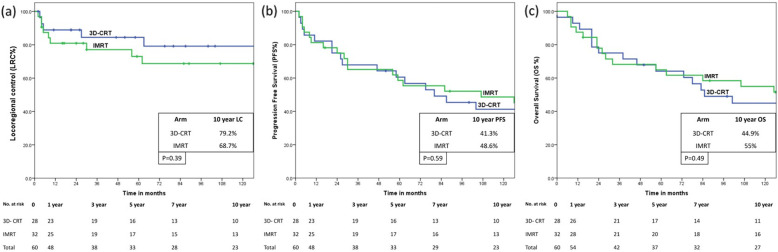
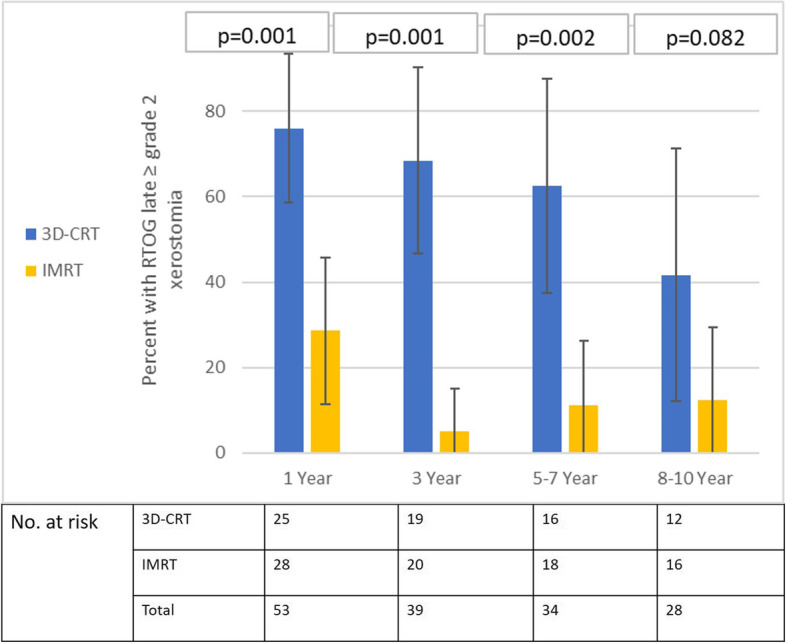
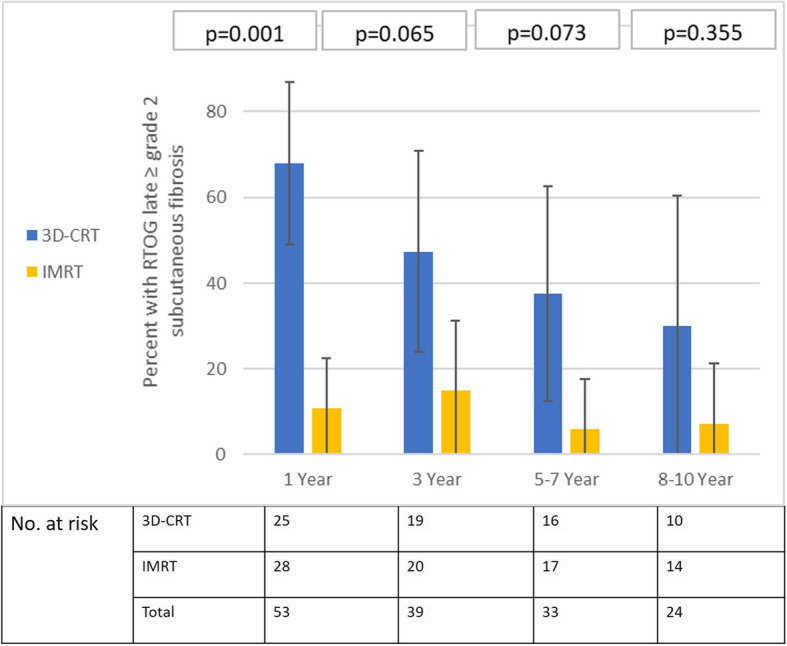
Results: At a median follow-up of 140 months for surviving patients, 10-year Kaplan-Meier estimates of loco-regional control (LRC); progression-free survival (PFS); and overall survival (OS) with 95% confidence interval (95%CI) were 73.6% (95%CI: 61.2-86%); 45.2% (95%CI: 32-58.4%); and 50.3% (95%CI: 37.1-63.5%) respectively. There were no significant differences in 10-year disease-related outcomes between 3D-CRT and IMRT for LRC [79.2% (95%CI: 62.2-96.2%) vs 68.7% (95%CI: 51.1-86.3%), p = 0.39]; PFS [41.3% (95%CI: 22.3-60.3%) vs 48.6% (95%CI: 30.6-66.6%), p = 0.59]; or OS [44.9% (95%CI: 25.7-64.1%) vs 55.0% (95%CI: 37-73%), p = 0.49]. Significantly lesser proportion of patients in the IMRT arm experienced ≥grade 2 late xerostomia and subcutaneous fibrosis at all time-points. However, at longer follow-up, fewer patients remained evaluable for late radiation toxicity reducing statistical power and precision.
Conclusions: IMRT provides a clinically meaningful and sustained reduction in the incidence of moderate to severe xerostomia and subcutaneous fibrosis compared to 3D-CRT without compromising disease-related outcomes in long-term survivors of non-nasopharyngeal HNSCC.
Keywords: Head-neck cancer; Outcomes; Radiotherapy; Subcutaneous fibrosis; Xerostomia.
Conflict of interest statement
None.
Figures
References
-
- Pignon JP, le Maitre A, Maillard E, Bourhis J. Meta-analysis of chemotherapy in head and neck cancer (MACH-NC): an update on 93 randomised trials and 17,346 patients. Radiother Oncol. 2009;92:4–14. - PubMed
-
- Colevas AD, Yom SS, Pfister DG, Spencer S, Adelstein D, Adkins D, et al. NCCN guidelines insights: head and neck cancers, version 1.2018. J Natl Compr Cancer Netw. 2018;16(5):479–490. - PubMed
-
- Chambers MS, Garden AS, Kies MS, Martin JW. Radiation-induced Xerostomia in patients with head and neck cancer: pathogenesis, impact on quality of life and management. Head Neck. 2004;26(9):797–807. - PubMed
-
- Scott-Brown M, Miah A, Harrington K, Nutting C. Evidence-based review: quality of life following head and neck intensity-modulated radiotherapy. Radiother Oncol. 2010;97:249–257. - PubMed
-
- Ge X, Liao Z, Yuan J, Mao D, Li Y, Yu E, et al. Radiotherapy-related quality of life in patients with head and neck cancers: a meta-analysis. Support Care Cancer. 2020;28(6):2701–2712. - PubMed
Publication types
MeSH terms
LinkOut - more resources
Full Text Sources
Medical
Research Materials
